

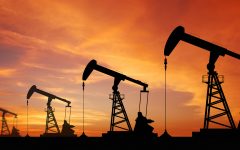
Oil pumpjack, Hwy 101, San Ardo, CA, Monterey County. (Photo: Katy Grimes for California Globe)
Ringside: The Best Way to Eliminate Methane Leaks is to Drill
The shifting geology in California opens up pathways for the state’s massive reserves of underground oil and gas to find natural vents to the surface
By Edward Ring, June 25, 2026 6:30 am
California’s oil industry has been active for well over a century, and Los Angeles was always at the heart of it. By 1894, about 80 wells were already producing oil in the city, setting off a boom that peaked in the 1970s at nearly 100 million barrels per year. Today oil production in Los Angeles County is barely one-tenth of that, and conventional wisdom holds the cause to be reservoir depletion.
That may be part of the reason for the decline, but according to a 2013 assessment by the U.S. Geological Survey, “between 1.4 and 5.6 billion barrels of additional oil could be recovered” from just the ten major oil fields of the Los Angeles Basin. Even on the low end of that range, that’s a lot of oil, and there could be much more. The Los Angeles Basin has one of the highest concentrations of crude oil in the world.
The other reason for the production decline is regulatory. State and local laws and ordinances have systematically reduced oil production throughout California. Nowhere is this more evident than in Los Angeles County, where emissions of methane and volatile organic compounds are allegedly linked to production of oil and gas. Stop the production, stop the pollution.
But not so fast. As a study released on 6/17 concludes, the exact opposite may be more accurate.
The study by lead author James Rector, joined by a distinguished team of civil, environmental, chemical, and biomolecular engineers at UC Berkeley, concludes that more drilling is the only practical solution to eliminating most oil related sources of methane and VOC emissions.
It is not possible to overstate the significance of this conclusion. When it comes to policies affecting oil production in California, this could be the most important scientific paper to be released in decades, if ever. It estimates methane leaks from oil and gas production and gathering facilities are between 0.65% and 2.21% of natural and orphaned well seeps, and that “The only demonstrated way to reduce these emissions over time is by producing and depleting the reservoirs in the underlying oil and gas field.”
Consider the implications of this study, given the rather explicit title “Emissions from natural seeps and orphaned wells are orders of magnitude greater than fugitive emissions from oil production equipment in Southern California.” This finding represents a victory of sorts for regulators, insofar as despite substantial remaining oil production in Los Angeles, the amount of air pollution now generated by active production, distribution, and refining operations is negligible.
On the other hand, it completely upends the underlying goal of these regulations, which is that if we put a complete stop to oil production in the Los Angeles Basin, and cap all the wells, we will completely eliminate oil related methane and VOC emissions. Rector’s study demonstrates that such an assumption is wishful thinking.
Even if natural seepage was not the prevailing source of emissions, it is impossible to locate and cap every abandoned well in Los Angeles County. From Beverly Hills to Elysian Park and beyond, throughout the sprawling metropolis there are long lost wells that haven’t been active for over a century. Official estimates identify over 25,000 wells countywide, but there are probably many more. And capping wells is expensive.
According to the California Legislative Analyst’s Office, the average cost to plug a well is $111,000. That equates to $2.8 billion, if there are only 25,000 wells, and if that is enough money per well. In Los Angeles, according to the city clerk, full site remediation “averages out to $361,232 per well. That’s $9.0 billion. But more to the point, plugging wells in a region as seismically active as California is an exercise in futility. All this underground oil, both in Los Angeles County and throughout Southern California, does not stay inert, thanks to the state’s multiple active faults.
As Rector explains, the shifting geology in California opens up pathways for the state’s massive reserves of underground oil and gas to find natural vents to the surface. This explains the tar that seeps into the ocean offshore, onto California beaches, and as well the tar and gasses that escape on land; the La Brea tar pits in the heart of downtown Los Angeles being a prime example.
There are two things we now know with almost absolute certainty: (1) Californians will consume at least another 5 billion barrels of oil, even if consumption reaches zero by 2045, and (2) depleting our oil reserves, especially in Los Angeles, Ventura, and Santa Barbara counties, is the most effective way to control oil-related emissions of methane and volatile organic compounds. Drilling for oil in California is no longer just a compelling economic choice. It is also guaranteed to help the environment.


- Ringside: Save Our Lawns, Reform AB 1572 - October 21, 2026
- Ringside: Induced Demand is a Prerequisite for Abundance - October 14, 2026
- Ringside: Observations as a New Water Year Begins - October 8, 2026
RELATED ARTICLES
-
 June 5, 2025
 -
 October 23, 2025
 -
February 5, 2026
I have personally seen oil seeping to the surface in Los Angeles, and not just at the La Brea Tar Pits. I think you are better off putting in a well, rather than letting it randomly seep to the surface all over the place.