
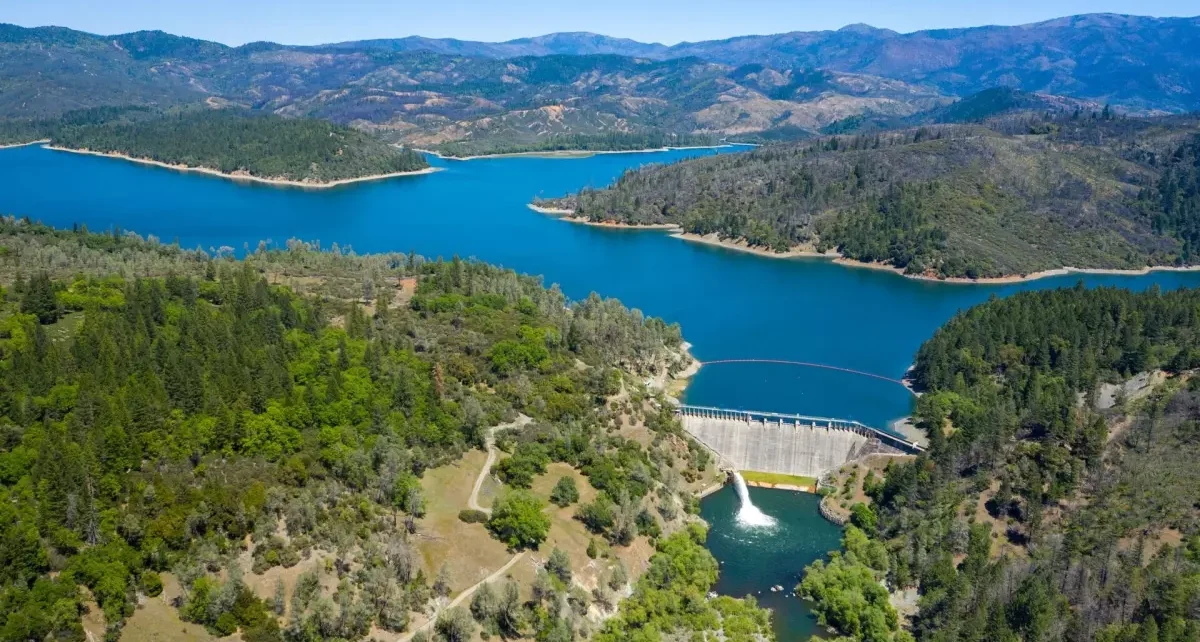
Scott Dam. (Photo: Scott Dam on the Eel River in Northern California, Kyle Schwartz/California Trout, Copyrighted, All Rights Reserved - Used by Permission, https://www.fws.gov/media/scott-dam-eel-river-northern-california)
Ringside: An Alternative Vision – Keep Scott Dam, Save Lake Pillsbury
The original storage capacity of the lake was 94,863 acre feet; today sediment has reduced its capacity to under 70,000 acre feet
By Edward Ring, June 11, 2026 6:00 am
A recent article in Grist characterized recent efforts by the Trump administration to preserve Scott Dam as a “culture war crusade.” That is accurate, so long as we recognize that efforts to demolish the dam – and diminish the value of the entire Potter Valley Project that the dam is a part of – are also the result of a culture war crusade.
Behind Scott Dam is Lake Pillsbury, completed in 1922. The original storage capacity of the lake was 94,863 acre feet; today sediment has reduced its capacity to under 70,000 acre feet. Twelve miles downstream from Scott Dam is the much smaller Lake Van Arsdale. It is a forebay for an 8 foot diameter, one mile long diversion tunnel that sends water to the north end of the Potter Valley. The 450 foot drop in elevation provides enough hydropower to generate 9 megawatts, and this water diversion nourishes farms, ranches and cities all the way down to Marin County. The average amount of water diverted rarely reaches even 60,000 acre feet per year, representing barely one percent of the average annual flow reaching the ocean via the Eel River.
The article in Grist offers an in-depth exploration of the events and actors dedicated to removing Scott Dam. An interview with a farmer in the Potter Valley, posted eight months ago on YouTube, offers many counterpoints, including claiming there are not structural problems with the dam, that the hydroelectric facility could be restarted, that the pike minnow is the biggest threat to salmon, that demolishing the dam would be mostly harmful to fish in the river because the dam is relied upon to deliver summertime flow to the Eel River, that thousands of endangered Tule Elk depend on the ecosystem created by Lake Pillsbury, and much more.
If you read the article, and watch the video, you’ll be steeped in the details. Rather than attempt to recap them, why not imagine a completely different scenario for the Potter Valley Project. Imagine a complete restoration and upgrade of these facilities.
To inform this alternative vision, two premises are required. First, we live in a managed ecosystem. For most places in California, certainly including Potter Valley and Lake Pillsbury, there is no such thing as a total return to nature. There are only tradeoffs. If we demolish the dam, the benefit to fish populations is debatable, whereas the devastating impact on Tule Elk is beyond debate. If we lose Lake Pillsbury, we lose a critical resource for fighting wildfires. And, relating to that, if we increased responsible logging, grazing, mechanical thinning and controlled burns to balance necessary fire suppression, the forests and the watersheds they protect would be healthier and less fire-prone ecosystems.
Second, the options for how we can manage ecosystems with investments in new and upgraded infrastructure are growing, not shrinking. We not only have the sophistication to construct water projects with far more sensitivity to environmental impact, but we are on the cusp of an explosion in new construction technology that will dramatically lower costs. From the cost to refine materials and manufacture equipment, to the cost to deploy and operate construction equipment, better materials science and robotics are delivering a revolution in productivity. Whether it’s a modular desalination plant or a small modular reactor, a tunnel boring machine, or a robot dredger, costs to do big things are poised to drop significantly. Our challenge is to embrace the change.
So why not drop “Nessie” into Lake Pillsbury and restore its full storage capacity? Affectionately marketed as “NESSIE,” the full name for this robot dredger is “New Environmental System for Sediment Innovative Excavation.” It is “an autonomous, remotely operated underwater robot designed for eco-friendly sediment dredging, built to maintain hydroelectric dams, reservoirs, and waterways without requiring floating pontoons or manned surface vessels.”
Pricing for these systems varies, and they’re certainly not cheap, but there are many options. In addition to WaterTracks, the manufacturer of Nessie, there is EDDY Pump, Dragflow, Dredge Robotics, and DAE Pumps. A large robot dredger can remove up to 300 tons of sediment per hour – about five acre feet per day. Put a fleet of them into Lake Pillsbury and let them go to work. The silt has value for levee repair, construction fill, soil amendment for agriculture, and habitat restoration. Every yard removed is a valuable product, while its removal creates more capacity for flood control and water storage. We should make Lake Pillsbury a test bed for reservoir dredging to restore capacity in every major reservoir in the state.
As for the hydropower facility in Potter Valley, the estimated cost to replace the transformer is $10 million. That is easily recovered. A $10 million bond at 5 percent over 20 years would require an annual payment of $802,000. At a reported output of 9.2 megawatts and at a price of $.10 per kilowatt-hour, the powerhouse would only have to run 10 percent of the time to pay the cost of its restoration. Every hour beyond that could deliver profit for the operator.
There is a perception of inevitability over dam removal that relies on an alleged consensus that it’s the only rational course of action. But this consensus is manufactured. It is the product of a coalition that has selectively chosen what environmental values matter. Tule Elk and summertime releases into the Eel River don’t matter. Pike Minnow predators that eat salmon, or downstream water guzzling marijuana farmers don’t matter. But giving salmon access to what amounts to only 7.3 percent of the Eel River’s total watershed does matter.
Similarly, the narrative of financial inevitability is also selective. It claims it would be financially infeasible to dredge Lake Pillsbury, or restore the Potter Valley Project’s hydroelectricity production. But no such withering skepticism is applied to the hundreds of millions that would be spent to demolish the dam, restore downstream habitat impacted by millions of tons of silt, or make generous annual payments to “stakeholders.” And this narrative of inevitability is profoundly indifferent to the financial hardship the loss of the Scott Dam will inflict on downstream farmers, ranchers, and municipal water customers.
There is indeed a cultural crusade at work in the Potter Valley. Or more accurately, there is a cultural war that until the federal government intervened, was remarkably one-sided. Our cultural crusade, if we must refer to it using such terms, is one that has faith in the potential for rapidly evolving construction technologies to lower costs for new infrastructure, combined with faith in our ability to deliver abundance while improving the health of the environment.


- Ringside: Observations as a New Water Year Begins - October 8, 2026
- Ringside – Geothermal Energy: A Huge Wildcard - October 1, 2026
- Ringside: El Nino Emergency Planning Must Include Dredging the Delta - September 24, 2026
RELATED ARTICLES
-

-
 October 24, 2024
 -
 September 7, 2021
Nice job at looking at an environmental restoration project with an eye toward cost-benefits and retaining/expanding the renewable energy supply.
I wonder if this has anything to do with the UN’s UNDRIP aka UN DECLARATION on RIGHTS of INDIGENOUS PEOPLE to actually get rid of our dams and FOOD SUPPLY. Yes, the UN and other GLOBALISTS want to destroy our food supply. That’s also why they want to shut down most farms and targeted COWS for Passing Gas, and also used Fake and Criminal PCR TESTS to KILL OFF MILLIONS of Chickens. The Higher the cycle of the PCR TESTS, the Higher the FALSE-POSITIVE used to justify killing off millions of Hens, especially. no hens, NO EGGS. This.was used to justify killing all those Ostriches in CANADA too. And was also used to Justify LOCKING US DOWN, DESTROYING our Economy and Supply chains as well as our RIGHTS. These GLOBALISTS are EVIL and our CA POLITICIANS and GAVIN NEWSOM were very happy to comply. And don’t forget our Evil-Vile Mainstream MEDIA was very happy to be the Mouthpieces and PROPAGANDISTS and LIARS for all this.