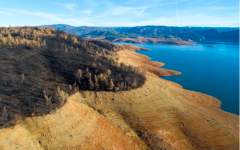
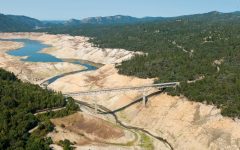
San Luis Reservoir water, 4/27/2026. (Photo: Katy Grimes for California Globe)
Ringside: Comments on the ‘Water Quality Control Plan’ for the Delta
Nowhere in this plan is any attempt to quantify how much water pouring into the San Francisco Bay every year is enough to ensure ecosystem health
By Edward Ring, September 9, 2026 4:39 pm
 The August 2026 final draft of the State Water Resources Control Board’s (SWRCB) “Water Quality Control Plan for the San Francisco Bay/Sacramento-San Joaquin Delta Watershed” has been released. Written comments will be accepted through September 18, and the board will also take oral comments at the October 28-29, 2026 meeting where the SWRCB may formally adopt the plan.
Anyone who hasn’t spent a lifetime in this business will quickly realize that this plan is huge and hard to follow. The “plan” is a 128 page PDF, with accompanying staff reports that in aggregate run to thousands of pages. Even for experts, it would take months to fully decipher.
From reading the plan and talking with people familiar with it, who have been anticipating its release, I would attempt to describe its purpose and intent as follows: It updates an existing water quality control plan for the San Francisco Bay, as well as the entire Sacramento and San Joaquin river watershed, with a focus on the delta. It expands the definition of beneficial use, updates water quality standards, and sets tributary inflow and delta outflow standards.
It appears that the updated tributary inflow standards will, in general, require more “unimpaired flow” as a percentage of total flow than was previously required. The new standard will be to leave unimpaired 55 percent of the year-round flow of the Sacramento River, with a provision to drop that to 45 or even 35 percent in dry years. For the San Joaquin River, the unimpaired flow requirement will be 40 percent, with the SWRCB able to increase that to 50 percent or lower it to 30 percent depending on conditions.
Another prominent feature of this plan are the “voluntary agreements,” wherein participating water agencies and irrigation districts can commit to engaging in habitat restoration projects which, at least theoretically, could allow them at times to withdraw more water than they would otherwise be allowed based on a fixed percentage.
Exactly how any of that would work, however, was unclear. For starters, while the State Water Resources Control Board is apparently the final arbiter on all actions pursuant to this plan, the number of actors formally involved in its implementation and management are numerous. Here’s a summary:
The State Water Resources Control Board, California Department of Water Resources, California Department of Fish and Wildlife, Central Valley Regional Water Board, and the San Francisco Bay Regional Water Board. Also the California Coastal Commission, State Lands Commission, Fish & Game Commission, State Parks/Boating & Waterways. And don’t forget the California Department of Food and Agriculture, Central Valley Flood Protection Board, California Natural Resources Agency, Federal Bureau of Reclamation, National Marine Fisheries Service, US Fish and Wildlife Service, EPA, US Army Corps of Engineers, FERC, USDA, and US Forest Service, not to mention the Central Valley Project, State Water Project, and the San Joaquin River Restoration Program.
And then there are water-right holders: agricultural, municipal, and industrial. There are water districts, irrigation districts, public water agencies, hydropower entities, FERC licensees, reservoir owners and operators, and local governments: counties, agencies including flood agencies, and local agricultural commissions.
Also involved, quoting from the SWRCB plan “in addition, the Bay-Delta watershed is also home to nearly 100 California Native American Tribes that rely upon these waterways, the surrounding lands, and the native fish and fauna for subsistence, cultural, ceremonial, and spiritual purposes.”
The list goes on. Don’t forget environmental NGOs, agricultural interests, dischargers of industrial and residential wastewater, fishing interests, scientific bodies, local landowners, and environmental justice communities.
Imagine you want to do anything that will in some way impact the delta watershed. Depending on the magnitude of your project, you may run into every one of these “stakeholders.”
When attempting to grasp what this document will mean for the future of California’s water supply and water quality, the sheer volume and the inclusivity built into the plan’s processes point to the biggest takeaway: whatever effect it has, and whatever big projects it facilitates, it will take decades instead of years, and cost tens of billions instead of billions.
That’s too bad. Nowhere in this plan, which micromanages every channel and tributary in the Sacramento-San Joaquin watershed, is any attempt to quantify how much water pouring into the San Francisco Bay every year is enough to ensure ecosystem health. How is this not relevant?
Why is it, for example, that in the water year ended 9/30/2020, 7.0 million acre feet (MAF) flowed into the SF Bay and 3.5 MAF was pumped into the California and Delta Mendota aqueducts, but so far through 8/31/2026, with 12.9 MAF already flowed into the SF Bay, only 3.0 MAF made it into the California and Delta Mendota aqueducts? How is it that after four years of extraordinary rain, with reservoirs full, and a super El Nino on the way, with just a month left in our water year, we have only managed to pump 3.0 MAF south for our farms and cities?
Moving on, why is there no mention whatsoever in this “Water Quality Control Plan” of the need to restore flow capacity, especially in the south channels of the delta? While the plan is not meant to specify actual projects, it nonetheless mentions flood bypasses and tidal wetland projects, and it acknowledges the need to reduce the velocity of flows. So here’s a specific comment for the SWRCB, based on a simple calculation:
At an ideal downstream flow velocity of 4 feet per second for juvenile salmonids, a channel 2 feet deep and 100 feet wide can sustain a flow of 800 CFS. If that same channel is restored to an 8 foot depth, the same flow velocity will deliver 3,200 CFS downstream. This is yet another reason salmon thrived in a channelized environment during an entire century when dredging was permitted. These deeper channels, by the way, would ensure cooler water in the depths.
The intricacy of the processes described in this draft, and the number of stakeholders granted a role in those processes, guarantees that nothing will happen unless there is strong leadership. The SWRCB appears to retain that authority. Will they set big priorities and demand big results? Here are some recommendations:
Clean up the treatment plants along the SF Bay and delta waterways that discharge more than a half-million acre feet of nitrogen rich sewage every year. Do it by moving the effluent into new wetlands where marsh grass can absorb the nitrogen while creating fish habitat, and use the sediment from dredging to construct them.
Or go on with process for the sake of process. That is clearly a proven skill for our state’s water bureaucrats, and the more the merrier.


- Ringside: Comments on the ‘Water Quality Control Plan’ for the Delta - September 9, 2026
- Ringside: Where Does California Get its Energy? - September 2, 2026
- Ringside: Without Sediment Removal in the Delta, Catastrophic Flooding is Coming to California - August 27, 2026