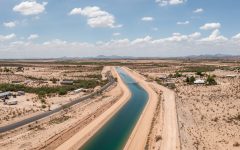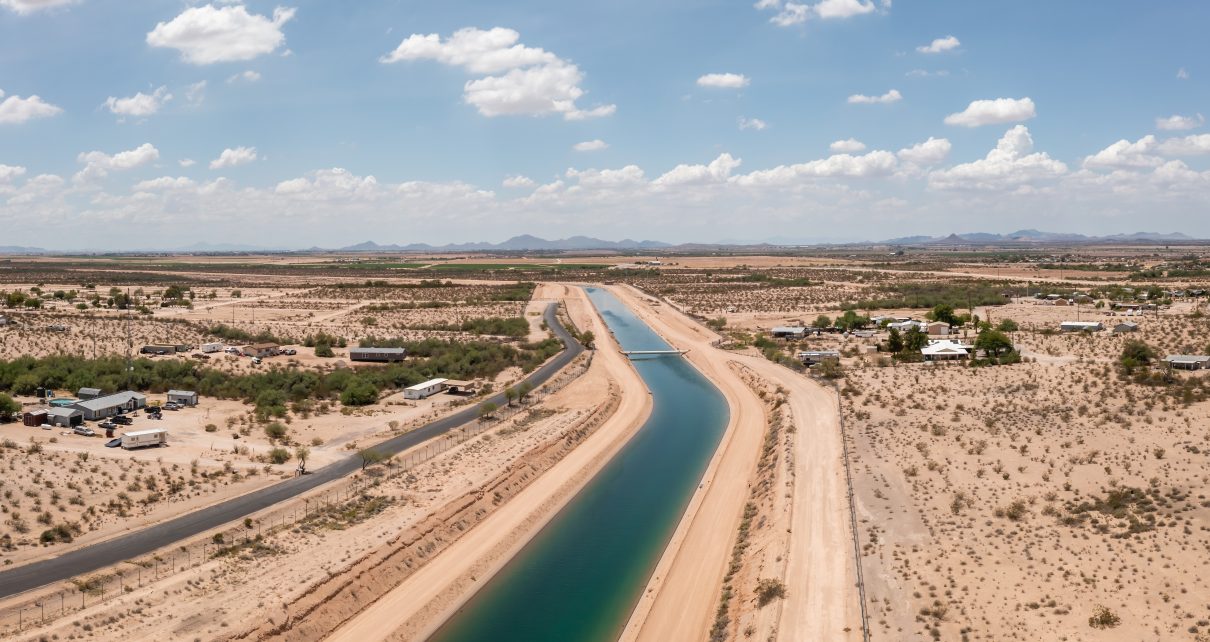
The Central Arizona Project (CAP), designed to bring 1.5 million acre-feet of Colorado River water per year to Pima, Pinal and Maricopa counties. (Photo: Manuela Durson/Shutterstock)
Arizona Seeks To Join Colorado River Lawsuit After Failed Negotiations, GOP Criticism Of Hobbs
California faces annual reductions of 440,000 acre-feet, according to Arizona’s filing, as the Lower Basin states continue negotiating a separate agreement
By Matthew Holloway, October 21, 2026 2:26 pm
Arizona has asked a federal court to let it join Nevada’s lawsuit challenging new Colorado River operating rules after seven-state negotiations failed to produce an agreement and Republican lawmakers criticized Gov. Katie Hobbs’ handling of the talks.
The Oct. 16 filing comes as Arizona, California and Nevada continue negotiating a separate agreement to distribute the effects of federal water reductions. Arizona Department of Water Resources Director Tom Buschatzke said completing that agreement remained the state’s priority.
As California Globe reported Aug. 24, Nevada, the Colorado River Commission of Nevada and the Southern Nevada Water Authority filed the original lawsuit challenging the federal government’s Colorado River operating framework. The plaintiffs argued that the plan imposed excessive reductions on Lower Basin states while requiring no comparable mandatory cuts upstream.
The case, State of Nevada et al. v. Burgum et al., is pending in the U.S. District Court for Nevada. Defendants include Interior Secretary Doug Burgum, the Interior Department, the Bureau of Reclamation and federal official Aubrey Bettencourt.
Arizona’s motion to intervene and proposed complaint allege violations of the Administrative Procedure Act, National Environmental Policy Act and laws governing Colorado River allocations.
The state asks the court to set aside the final environmental impact statement and record of decision, return the 2027–2028 guidelines to the agencies for reconsideration without vacating them, and block implementation of the challenged framework after 2028. The proposed complaint argues that immediately vacating the two-year guidelines would have catastrophic consequences for Arizona.
The negotiating impasse was already public in February. As California Globe reported Feb. 13, Hobbs, Nevada Gov. Joe Lombardo and California Gov. Gavin Newsom acknowledged that a second federal deadline was passing without a consensus agreement.
In their joint statement, the governors said Arizona had offered to reduce its Colorado River allocation by 27%, California by 10% and Nevada by nearly 17%. They maintained that all seven basin states should participate in conservation.
Republican U.S. Rep. Andy Biggs criticized Hobbs’ coordination with Arizona’s congressional delegation during March remarks reported by the Arizona Capitol Times. Biggs said lawmakers were working with the Bureau of Reclamation and “we really haven’t seen much help from the Governor’s Office.”
🚨🚨 Under Katie Hobbs, Arizona has been forced to take massive water cuts.
She wasn’t prepared and didn’t fight for our state, but she’s calling it a win?
Ridiculous.
Arizonans need a leader who will protect our resources.
I’ll step up and lead as Governor. pic.twitter.com/tdc9RYYCUJ
— Andy Biggs (@andybiggs4az) September 25, 2026
The same report noted that Biggs and Democratic Sen. Mark Kelly had jointly urged Reclamation to withdraw its draft environmental impact statement. Hobbs’ communications director, Christian Slater, rejected the Republican criticism, characterizing it as election-year politics and accusing the lawmakers of insufficient engagement.
State Rep. Alexander Kolodin directly challenged the administration’s negotiating record in a Sept. 23 legislative release.
“Her Colorado River talks stalled without a deal that enforces the Compact or that requires the Upper Basin to share in cuts,” Kolodin said.
ARIZONANS DESERVE MORE WATER — HOBBS FAILED TO PROTECT IT
PHOENIX, AZ — State Representative Alexander Kolodin (R-LD3) today called on the federal government to give Arizona a larger share of Colorado River water under the post-2026 operating rules released this morning and… pic.twitter.com/OFaDoqcioo
— Rep. Alexander Kolodin (@realAlexKolodin) July 31, 2026
Kolodin issued the statement while endorsing Biggs’ proposed Colorado River Basin Water Security and Infrastructure Act. He also criticized Hobbs’ record on developing additional water supplies.
House Speaker Steve Montenegro also endorsed the proposal. In September reporting by KAWC, Montenegro said Arizona should have begun preparing for additional supplies years earlier and praised Biggs’ legislation as a serious response.
Montenegro’s earlier July 31 statement urged state leaders to remain united in defending Arizona’s allocation while pursuing reclaimed water, brackish groundwater, efficiency improvements and additional supply projects.
According to Arizona’s Oct. 16 court filing, the 2027–2028 guidelines establish annual Lower Basin reductions totaling 1.25 million acre-feet: 760,000 for Arizona, 440,000 for California and 50,000 for Nevada. Arizona’s share represents approximately 61% of that total.
The distribution continues a long-running dispute over access to the river. California Globe’s September reporting examined Arizona’s disproportionate share of the anticipated reductions alongside the state’s historical conflicts with California, including the confrontation over construction of Parker Dam.
The Upper Basin states—Colorado, New Mexico, Utah and Wyoming—are not subject to comparable mandatory reductions under the federal plan. Their officials have argued that available supplies already constrain their water use, while Lower Basin officials have demanded shared mandatory cutbacks, Nevada Current reported.
The separate Lower Basin agreement would allow Arizona to shift some of its reduction burden to California and Nevada, KJZZ reported. Sources familiar with the negotiations told the outlet that discussions among major California water users over their respective reductions could be delaying completion.
Hobbs’ Oct. 16 announcement said the Lower Basin agreement would conserve more than 3.2 million acre-feet during 2027 and 2028. The announcement also identified finalizing the agreement as an outstanding priority.
Hobbs argued that federal officials were failing to enforce Upper Basin delivery obligations and exposing downstream states to excessive reductions.
Buschatzke separately warned that provisions governing years three through ten could trigger Lower Basin reductions of up to 3 million acre-feet annually. His statement said cuts of that magnitude could severely affect the Central Arizona Project and communities along the river.
The Interior Department disputed Arizona’s approach. In a statement reported by The Guardian, a spokesperson accused Arizona of playing politics and said, “Litigation won’t create a single additional drop of water or change the hydrologic realities facing the Colorado River Basin.”
Water attorney Cynthia Campbell questioned the timing of Arizona’s move while the Lower Basin negotiations remained unresolved, KJZZ reported. She also cautioned that the litigation was unlikely to produce a quick suspension of the federal rules.
Arizona’s filing seeks participation in the federal-agency case. It does not initiate the separate interstate lawsuit officials have discussed over upstream water-delivery obligations. Buschatzke said that option remained available.


- Arizona Seeks To Join Colorado River Lawsuit After Failed Negotiations, GOP Criticism Of Hobbs - October 21, 2026
- Former AZ State Prison Closed by Governor Hobbs Set To Reopen As ICE Detention Center - October 20, 2026
- Federal Audit Reveals Backlog, Unmanageable Workloads in Missing Indigenous Persons Unit - October 17, 2026