
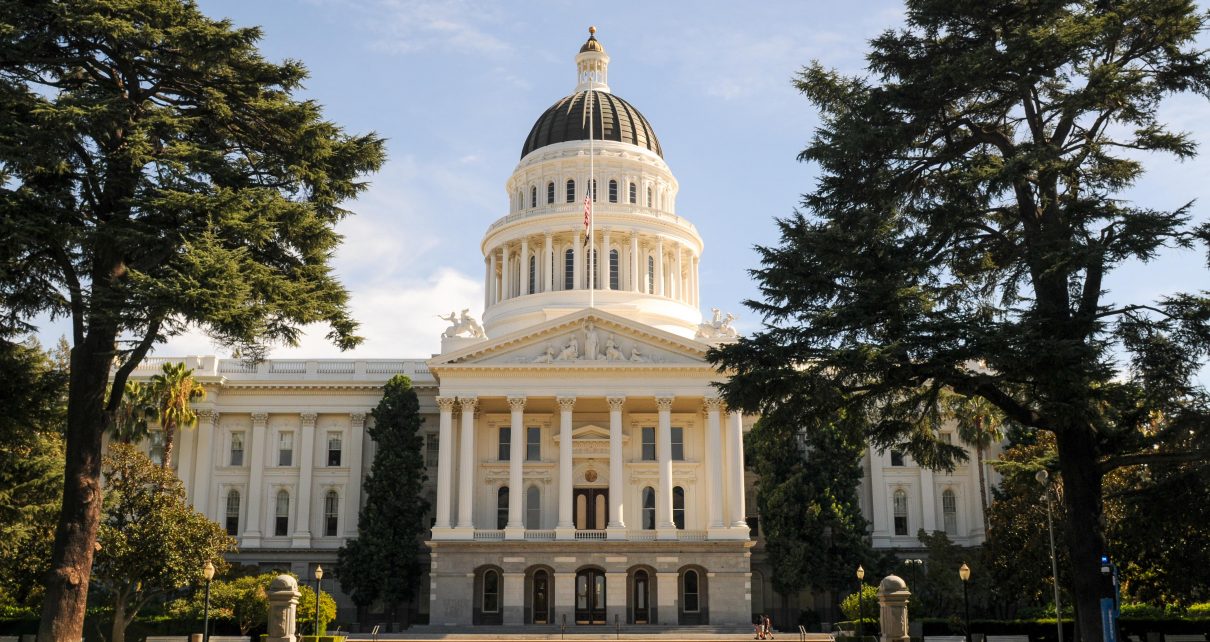
California State Capitol. (Photo: Kevin Sanders for California Globe)
Uniform Sales Taxes
Deals with the uniform local sales and use tax laws
By Chris Micheli, April 10, 2026 2:00 pm
Revenue and Taxation Code Division 2, Part 1.5 deals with the uniform local sales and use tax laws. Chapter 1 provides general provisions.
Section 7200 names this part as the “Bradley-Burns Uniform Local Sales and Use Tax Law.”
Section 7201 provides that any county may by action of its board of supervisors adopt a sales and use tax in accordance with the provisions of this part.
Section 7202 provides that the sales tax portion of any sales and use tax ordinance adopted under this part must be imposed for the privilege of selling tangible personal property at retail, and include provisions in substance as specified.
Section 7202.5 explains that a city, county, or city and county sales and use tax ordinance may provide that any person subject to a sales and use tax under the city’s, county’s, or city and county’s ordinance must be entitled to credit against the payment of taxes due under that ordinance the amount of sales and use taxes due to the redevelopment agency.
Section 7202.8 states that any pledge of taxes made with respect to taxes imposed to the payment of principal and interest on bonds of a redevelopment agency constitute the obligation of a contract between the redevelopment agency and the holder of the bonds and be protected from impairment by the United States and California Constitutions.
Section 7203 provides that the use tax portion of any sales and use tax ordinance adopted under this part must impose a complementary tax upon the storage, use or other consumption in the county of tangible personal property purchased from any retailer for storage, use or other consumption in the county. That tax is at the rate of 11/4 percent of the sales price of the property whose storage, use or other consumption is subject to the tax and must include five specified provisions.
Section 7203.1 specifies that, during the revenue exchange period only, the authority of a county or a city to impose a tax rate as specified in an ordinance is suspended, and the tax rate to be applied instead during that period under any ordinance as adopted is the applicable of the two specified amounts. The term “revenue exchange period” is defined.
Section 7203.2 states that the sales and use tax ordinance of a county, city, city and county, or redevelopment agency adopted pursuant to this part, must be deemed to adopt by reference the provisions of Sections 7202 to 7203, which are required to be included in the ordinance, regardless of whether or not the ordinance was adopted or amended, prior to or after the effective date of this section.
Section 7203.5 prohibits the State Board of Equalization from administering and terminating its contract to administer any sales or use tax ordinance of a city, county, or city and county, if that city, county, or city and county imposes a sales or use tax in addition to the sales and use taxes imposed under an ordinance.
Section 7204.03 explains that, in the case of retail sales of jet fuel that are consummated at the point of delivery of that jet fuel to an aircraft at a multijurisdictional airport, the sales tax revenues collected by the board pursuant to this part with respect to those sales must be transmitted by the board. The term “multijurisdictional airport” is defined.
Section 7204.1 defines the following terms: “local agency,” “quarterly taxes,” “refund,” “offset portion,” If the board has deducted a refund from a local agency’s quarterly taxes which includes an offset portion, then the three specified provisions apply. The board cannot transmit the offset portion of the refund to the local agency if that transmittal would reduce or delay either the board’s payment of the refund to the taxpayer or the board’s periodic transmittals of sales and use taxes to other local agencies.
Section 7204.4 requires the Director of Transportation and the Controller to charge for the cost of their services in administering the responsibilities assigned to them by the Public Utilities Code. Amounts to be charged must be specified in the Budget Act. Those amounts are deducted from the taxes collected by the board for the counties and the cities and counties.
Section 7205 explains that, for the purpose of a sales tax imposed by an ordinance adopted pursuant to this part, all retail sales are consummated at the place of business of the retailer unless the tangible personal property sold is delivered by the retailer or his or her agent to an out-of-state destination or to a common carrier for delivery to an out-of-state destination. The gross receipts from those sales include delivery charges, when those charges are subject to the state sales and use tax, regardless of the place to which delivery is made.
In the event a retailer has no permanent place of business in the state or has more than one place of business, the place or places at which the retail sales are consummated for the purpose of a sales tax imposed by an ordinance are to be determined under rules and regulations to be prescribed and adopted by the board. In the case of a sale of jet fuel, the place at which the retail sale of that jet fuel is consummated for the purpose of a sales tax imposed by an ordinance adopted is the point of the delivery of that jet fuel to the aircraft.
Section 7205.1 states that, in connection with any use tax imposed pursuant to this part with respect to the lease of a new or used motor vehicle by a dealer or leasing company, the place of use for the reporting and transmittal of the use tax is determined as specified. The terms “city,” “motor vehicle,” and “leasing company” are defined.
Section 7207 explains that nothing in this part requires or is to be construed to require any city, county, or city and county, to impose any sales or use taxes or to increase any sales or use taxes.
Section 7209 authorizes the board to redistribute tax, penalty and interest distributed to a county or city other than the county or city entitled, but the redistribution is not to be made as to amounts originally distributed earlier than two quarterly periods prior to the quarterly period in which the board obtains knowledge of the improper distribution.
Section 7210 requires the SBE to continue to administer the sales and use tax ordinance of any city, county, or city and county which adopts an ordinance imposing a tax on the sale, storage, use, or consumption of motor vehicle fuel.
Section 7211 requires the SBE to continue to administer the sales and use tax ordinance of any city, county, or city and county that adopts a transactions and use tax ordinance administered by the board.
Section 7212 provides that any redevelopment agency adopting a sales and use tax ordinance is required to pay to the board its costs of preparation to administer and operate the sales and use tax ordinance. The agency pays the costs monthly as incurred and billed by the board.
Any disputes as to the amount of preparatory costs incurred are to be resolved by the Director of Finance, and his decision is final. The maximum amount of all preparatory costs to be paid by the district cannot $570,000. If for any reason the ordinance adopted is declared to be invalid, the board is not required to refund any or all revenues collected pursuant to that ordinance, but rather those revenues are to be distributed to the city within which the redevelopment agency operates.
Section 7213 defines the terms “local agency” and “rebated sales and use tax revenues.” A local agency is required to publish on its internet website, on or before April 30 of each year, the information submitted to the department as specified in this section.


- General Provisions for Common Interest Developments - October 21, 2026
- What Are Some Unique Aspects of Statutory Interpretation in California? - October 21, 2026
- Corporate Net Income - October 21, 2026
RELATED ARTICLES
-

-
 August 18, 2021
 -
 February 21, 2019
One thought on “Uniform Sales Taxes”