
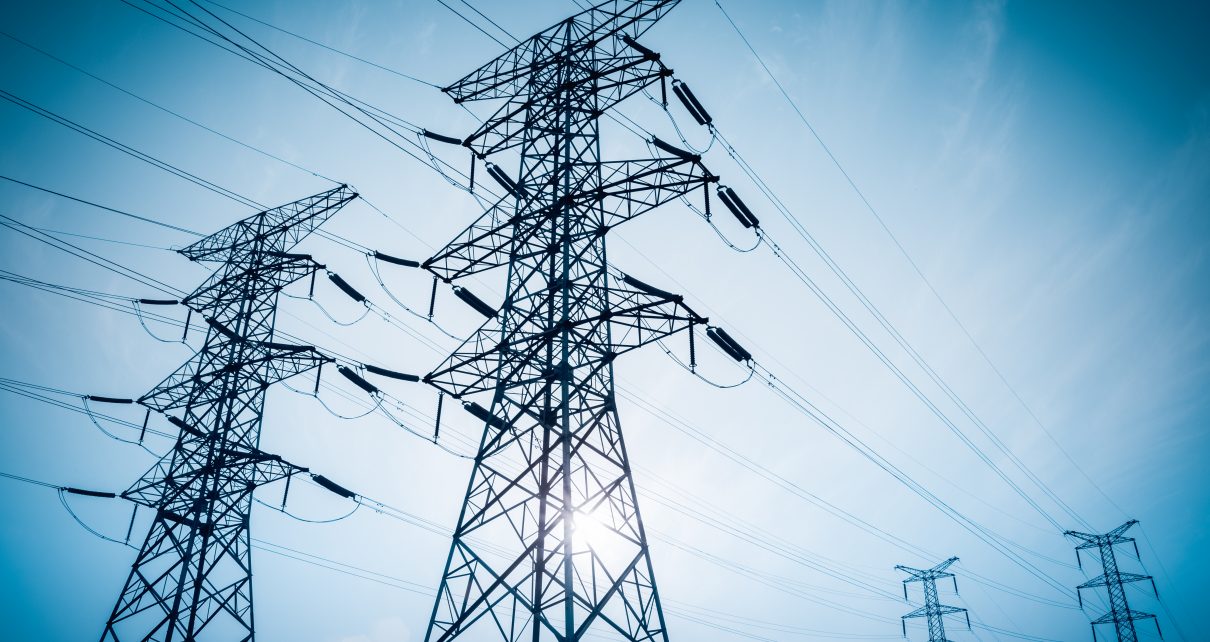
Electricity Transmission Pylon at Dusk. (Photo: chuyuss/Shutterstock)
Whoa! The SMUD CEO’s Salary is Over $900,000 Annually
The U.S. average retail price per kilowatthour is 12.68 cents; California’s price per kilowatt hour is 27.04 cents
By Katy Grimes, January 6, 2026 3:25 am
Sacramento Municipal Utility District CEO and General Manager Paul Lau is paid $936,617 in total wages, and $45,374 in retirement and health benefits, totaling $981,991 annually. Lau is paid nearly $1 million annually to manage 2,400 employees, and revenue of $2 billion.
El Dorado County Auditor-Controller Joe Harn brought this to the attention of the Globe because he’s “concerned that if situations like this continue, it will further erode the public support in our public employee retirement system and continue to erode the financial health of our public employees retirement system.”
According to his bio, Lau is a 41-year SMUD veteran, and has held several other executive leadership positions, including Assistant General Manager of Power Supply & Grid Operations and Assistant General Manager of Customer, Distribution & Technology, starting with a SMUD internship in 1982.

“As CEO, he leads the sixth largest community-owned electric utility in the nation, serving a population of 1.5 million residents and managing a $2.1 billion budget.”
Lau’s resume is impressive, as is his 41-year tenure with SMUD. “A registered professional electrical engineer in the state of California, Lau received his bachelor’s degree in electrical power engineering from California State University, Sacramento.”
But paying a public employee nearly $1 million annually is an abuse of taxpayer funding.
The Globe contacted SMUD Board President David Tamayo about the CEO/GM salary. I identified myself as a credentialed member of the Capitol media and asked for information:
Hello SMUD Director and Board President Tamayo,
I have been reviewing government salaries and see that the SMUD GM makes over $900,000 per year.
Can you direct me to the public meeting where this was discussed and approved? Particularly since SMUD voted in tiered pricing, punishing ratepayers for using electricity at peak times.
The Globe was referring to SMUD’s tiered rates:
In May 2019, we reported “Sacramento Utility Penalizing Working Families With Tiered Rates”:
“The Sacramento Municipal Utility District announced last year Sacramento electricity ratepayers would be under a new rate system that charges residential users higher rates between 5:00 p.m. and 8:00 p.m. — just in time for everyone to arrive home after work and begin evening family rituals: homework on computers, dinner, television, stereo, baths, laundry, and dishwasher after dinner.”
In June 2019, we reported “SMUD Utility ‘Summer Rates‘ Surge To Accommodate Increasing Renewable Cost Subsidies”:
On June 1st, the Sacramento Municipal Utility District began charging Sacramento electricity users and ratepayers a new rate system that charges residential users higher rates between 5:00 p.m. and 8:00 p.m… much higher rates, just in time to get home from work, feed the family, do a couple loads of laundry, bathe the kiddies, maybe vacuum a room or two, and watch a little Netflix.
These new summer “peak” rates appear to be about 40% – 200% higher, looking at the bill.
SMUD says the goal is to “reduce energy usage,” but they don’t say why. Instead they make suggestions like “start or program your dishwasher, washing machine or clothes dryer to run and finish before 5 p.m. or to start after 8 p.m., or schedule these chores for any time on the weekend when all hours are at the lowest off-peak price.”
“A SMUD analysis suggests that 57 percent of customers would experience a monthly bill increase if they do not change their usage patterns,” the Sacramento Bee reported. “A statewide customer advocacy group says switching to time-based rates does not necessarily prompt lower usage or energy conservation, and it could penalize some families who are not in a position to change their use hours.”
SMUD President Tamayo responded to my email request for information:
SMUD Board President, and Ward 6 representative
As for the CEO/GM’s salary being fair, “especially focusing on the benefit to our customers and the community,” SMUD Board President Tamayo could use a gentle reminder.
The tiered rate goal never actually appeared to be for customers to use less power; “The utility provider said the rate increases will be used for upgrades for a modern energy grid and to meet customer needs,” according to the Sacramento Bee. “The increases also will go to improve technology that SMUD customers use to monitor and manage their energy use.”
Public comments made during the 2017 proposal process, published on SMUD’s website, were all about the same. On time-of-day rates, a customer said: “I can hardly wait to see how I’ll be gouged by my utility provider so that I can be comfortable in my own home because I need to use the electricity when I need to use it. I suppose I’ll have to get used to being uncomfortable.”
We reported that the February 2019 data of electricity rates in the country show the average U.S. price of 12.70 cents per kilowatt hour. California is 19.82, one of the highest in the country, despite the natural gas and petroleum resources indigenous to the state, but heavily regulated and limited by the Legislature.
Today, U.S. Energy Information Administration reports that the U.S. average retail price per kilowatthour is 12.68 cents (Release Date: November 10, 2025). In California the retail price per kilowatt hour is 27.04 cents.
And the SMUD CEO is paid nearly $1 million annually… it’s not clear how he is “focusing on the benefit to our customers and the community” when California is paying some of the highest electricity rates in the country.


The SMUD Board President says the CEO/GM’s $1M salary “is based on his performance. SMUD has the second or third lowest rates among all utilities in the state, and over 50% lower than PGE.”
Given that California’s electricity providers have a history of hiking the rates, SMUD hovers 5% behind PG&E and claims it is “performance based.” Right.
Anecdotally, my SMUD bill is up 38% over this time last year, at a home I use 50% of the time. It’s not clear how I am up 379 kWh in a year. And the cost does not add up… except for these 2024-2025 rate changes:
The rate increase proposal includes the following rate increases for all customers:
- 2.75% effective Jan. 1, 2024
- 2.75% effective May 1, 2024
- 2.75% effective Jan. 1, 2025
- 2.75% effective May 1, 2025
For the average residential customer, the rate increases would add:
- $3.61 per month beginning Jan. 1, 2024
- $3.72 per month beginning May 1, 2024
- $3.81 per month beginning Jan. 1, 2025
- $3.92 per month beginning May 1, 2025
From my most recent SMUD electricity bill:



A California native and Navy mom, Katy lives in Sacramento, CA.
- Candidates for California Governor: What are Their Priorities? - May 1, 2026
- Straight Talk with Jon Fleischman & Katy Grimes: Gov’s Race, Billionaire Tax, HSR, Newsom – We Hit It All! - April 30, 2026
- Mayor Bill Wells Sues AG Bonta over State Law Prohibiting Local Police from Assisting Federal ICE Officers - April 30, 2026

What I find interesting with the retail energy markets (electricity, natural gas, gasoline/diesel) is that you incentivize reduction in use by increasing prices based on a set rate of return (specifically for CPUC-regulated entities). The analogy in the supermarket is typically buying the mega-package of laundry detergent typically results in a lower cost per wash. With energy costs, increasing the unit costs actually increases the bottom line for energy companies. Hard to imagine why they supported the state’s climate change regulations.
The CEO of the LA Dept of water and power receives more not to mention her $750K a year security detail.
The head of LA Dept of Water and Power — Janisse Quinones, who was appointed by Karen Bass, and who has been quoted as viewing her job “through an equity lens,” did NOT do her job in the devastating Palisades fire, which is putting it extremely lightly, has an annual salary of $750,000.00 and is still in the job as we speak despite her criminal negligence. Unknown if “Cadillac” health and other such generous benefits are included in that salary or not. Unknown what her “security detail” costs — if she has it, it’s A LOT, no doub t — but it is her annual salary that is $750K. Which is beyond obscene given the piss-poor job she did, if she did her job at all, which it looks like she did NOT. Certainly part of her bailiwick is to make sure the hydrants are operating properly and ready to go to fight fires, which they were not, leading to no ability AT ALL to fight the Palisades fire. Then there is the matter of the nearby EMPTY reservoir meant for firefighting. Perhaps her “equity lens” means that she enjoyed seeing Palisades burn. Because it’s more “equitable.”
The SMUD CEO’s annual salary is also obviously beyond obscene. Oh sure, such a CEO salary is “performance based.” Maybe they forgot to add the word “bad.” “Bad-performance-based.” The worse the performance the higher the salary. Sounds like a joke but it’s not. Disgusting.
https://www.dailynews.com/2025/03/11/ladwp-ceo-seeks-750000-private-security-contract-after-receiving-wildfire-related-threats/
PG&E’s Patti Poppe tells SMUD’s Paul Lau “Hold my beer” –
https://agenergyca.org/energy-rates/pge-ceo/
Her 2023 compensation was $16,994,840 –
https://energyandpolicy.org/as-customers-struggled-utility-ceos-pay-spiked-last-year/
BTW, if you’re a SMUD customer, count your blessings. My current PG&E Tier 1 rate is just under 40¢ per kWh. Tier 2 is just under 50¢ per kWh.
Re PG&E’s Patti Poppe, WHAT THE HECK? Wow.
We’ve reached peak shamelessness now; nowhere to go but UP, right?
Let’s hope
Interesting that the only state with higher electricity rates than California is an island in the middle of the Pacific Ocean. Chalk up another failure to Newsom and his Commucrat comrades.
By the way, you can get out of time of use electricity pricing and eliminate SmartMeter radio emissions by having an analog mechanical electric meter installed at your house. You just have to formally opt out of the SmartMeter program.
A year ago, we requested out of the SmartMeter program on a house we bought six years ago, that was requested by the previous owner.
SCE is slow-walking our request….
Now do the Calleguas Water System in Southern California…
That’ll be another target-rich environment…
Rate increases to cover pension costs….
4 rate increases in the last 2 years. You would think that would equate to more electricity generation but now I know where it went to. PG&E’s reputation is known in this state, but to compare SMUD’s rates to them is nothing to be proud of. The last 10 years rates have increased 32.75%. The thought that SMUD has increased rates and then “proudly” gives away 4 million dollars to other nonprofits frustrate me. When I use less energy, but pay more, I don’t see how SMUD’s CEO deserves 1 million a year for a “not for profit” company.
Keep at them Katy!
The most I know about SMUD is that it exists, so I can’t trash them like other utilities I have had direct experience with. I don’t know if this is the case with SMUD, but an investor owned utility former employer of mine had a board of perhaps 6 members who individually served on the boards of 57 corporations. This included major banks, major defense contractors, telecoms, land development, etc and even a winery. I don’t know how they had the time to oversee one company much less multiple outfits. I assume what they did is while serving on each other’s boards they rubber stamped whatever program the CEO at hand had going on while milking all those other companies they weren’t CEO of in addition to their high dollar salaries. I’m not sure if this is the right way to look at it, but if the group at the executive top of SMUD are only employed by SMUD, they are way behind their counterparts at other utilities in truly obscene compensation. Howard P Allen, CEO of SCE during the 80s had a salary of some $800,000.00. What would that be in today’s dollars, in addition to everything he siphoned off everywhere else?
Time of use (TOU) rates have been around for a long, long time, but in my exposure was applied to certain businesses and I don’t know the historical scope of it. It used to be the utilities desired a 24 hour steady rate of demand, presumably to avoid uncertainty of fluctuation of in house generation and outside bulk purchases. Being required to purchase “green energy” blew that all to hell with wind and solar farms in addition to rooftop solar. I think that residential time of use billing is government mandated to punish ratepayers for using electricity. One thing that has always bedeviled utilities is the traditional workday when everyone got home around the same time and turned on at the same time, sends residential demand through the roof.
The high price of electricity in california is entirely due to deregulation with requiring the utilities to divest themselves of generation and prioritizing the purchase of “green energy” over less expensive means. I don’t entirely know how the “green energy” scam works now, but it was originally at the highest avoided cost of building new power plants, that if power purchased at the time from northwest hydro was 2 cents per kwh and the wind farm was 13 cents, the utilities were required to buy from the wind farm. The end result of taking generation away from the utilities under the guise of competition took away protection from predatory pricing of bulk sales. Enron was an immediate early proof. A utility might havr kept fully manned yet idle generation facilities as a financial safeguard. While idle, bored management and labor would play stupid you screw me I screw you games on each other, but what justified keeping that clown show around was when the price of bulk purchase went up, the boilers would fire up, the turbines would spin, in house electricity was generated, buying outside power ceased, and the price of purchased power dropped. Then the utility would go back to purchasing low cost outside power and the gotcha games at the power plant resumed. This is best viewed by the fact that millions of dollars per minute flows through a single 500kv transmission circuit. The problem is that through ignorance deregulation exchanged a competition model that worked for one that doesn’t.
Although SMUD isn’t mismanaged as much as PG&E, it’s still guilty of not providing the level of service that it should. I spend 5 years in Colorado with MVEA as my electric provider. Despite howling winds, flooding, fires and blizzards, my power was out ONCE and only for about 30 minutes. I’m retired from a CA Public Utility; I understand the role of the CPUC and I understand the obligations and roadblocks face by public utilities. Bottom line is, if you are unhappy after reading this article, remember that his compensation is awarded by the the Board. When members come up for election, DON’T VOTE FOR THEM. Perhaps they will get the hint.
This is not a personal attack on @ Lisa Hutchin, just a discussion. I worked in the Dever area for a couple of contractors on several coop properties like the MVEA, which is in the colorado springs area.. I think that colorado east of the rockies and california in general are apples and oranges in political, geographical and litigious ways. The only real wind I experienced in colorado was around fort collins and it wasn’t that bad. I worked in below zero weather but I was never miserable in colorado like I have been in the mojave desert with the wind blowing a gazillion mph in mid to low 30 temps and colder. I worked fires every year in california but never heard of a fire in colorado, although all that grassland has great potential. There is a lot of arson in california in addition to utility failures and other causes such as car hit poles, lightning and acts of God contributing to outages. Due to the enormous fine PG&E shelled out after one ca fire (sacramento was at least half culpable in that fire for several reasons), SCE now shuts the power off at mid 20 mph plus at a certain humidity level, then will reenergize circuits after the wind dies down and circuits are patroled – which could be several days. I’m not sure what other utilities do, I’m out of the loop now. I don’t know how it is now after all the rebuilding in california over the last 33 years, but snow and Ice loading would tear up mountain circuits every year. It seems that MVEA residential rates are on a par with SMUD average residential rates, but SMUD has several rates including a brutal TOU evening rate that is about double MVEA flat rate.