
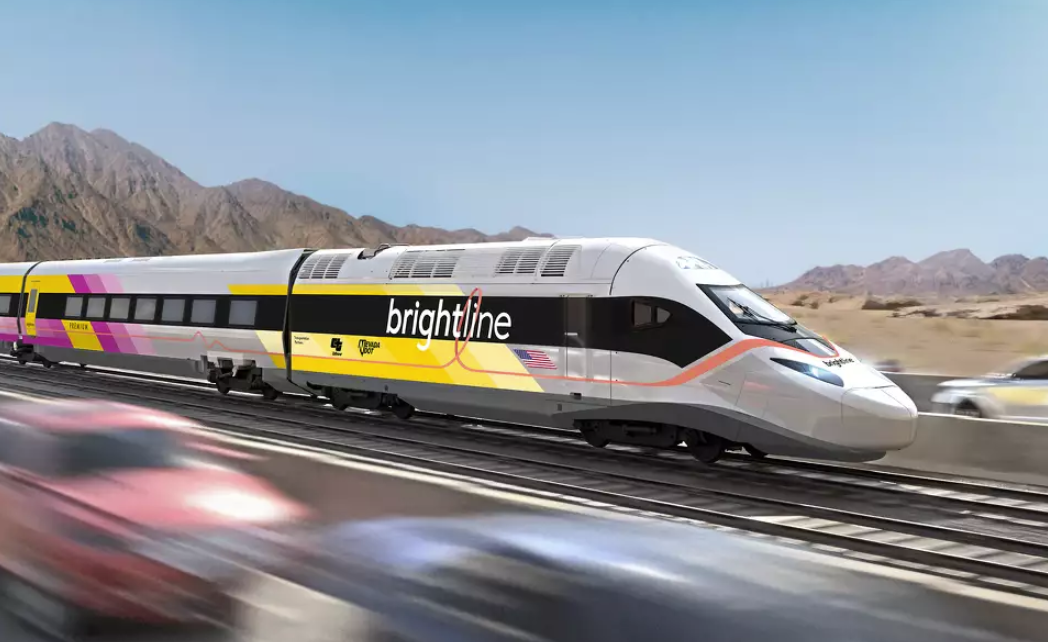
Brightline West Train (Photo: Brightline)
Another California High Speed Rail Disaster: Brightline West Makes Federal Loan Bailout Request
The private venture market has effectively declined to fully fund this project, and now taxpayers are being asked to fill the gap the market would not
By Katy Grimes, September 9, 2026 1:00 pm
California’s perpetually incomplete high-speed rail project has no operational trains and no high-speed track laid on the actual alignment, as of August 2026. Gov. Gavin Newsom has blown $18 billion on the High Speed Rail and the project is about to run out of money, the Globe reported in “Gavin’s High Speed Rail Disaster in August.” So the governor replaced the prior variable 25% share of Cap-and-Trade auction proceeds, which were set to expire in 2030, with a set $1 billion per year for high-speed rail starting in FY 2026-27 in the 2026-27 California budget, after the loss of roughly $4 billion in federal grants in 2025.
California’s High-Speed Rail boondoggle, voter approved in 2008 for a San Francisco to Los Angeles line, has been whittled down to a Merced-to-Bakersfield line, is now estimated to cost taxpayers more than $231 billion, up from its original $33.5 billion price tag when voters passed Proposition 1A.
It is 2026, eighteen years later, and still there are NO trains running and the project is bankrupt.
But wait – there’s more!
There is another failing California high-speed rail project, this one is to connect the suburb community of Rancho Cucamonga, CA to Las Vegas, NV, known as Brightline West.
Brightline West has been working under a series of financing deadlines tied to its existing bonds. Bondholders agreed in early August 2026 to push the Equity Contribution Condition Deadline from August 1 to September 10, 2026. That extension gave the company extra time to raise at least $400 million in additional equity (part of an earlier commitment) and to continue lining up the rest of its capital.
In 2025, the Globe reported that the Brightline West Rail Project unveiled higher than anticipated estimate ticket prices. But that was just the tip of the spear. Tickets were increasing to $119 for standard class and $133 for premium class one-way tickets. Before taxes, a bare bones, no parking included, round-trip ticket was going to cost a minimum of $238.
When you can fly from Ontario to Las Vegas for $66, why take an expensive train?
In October 2025, the U.S. Department of Transportation revealed that Brightline West submitted an unprecedented $6 billion federal taxpayer loan request to salvage the financially distressed project.
As with California’s High Speed boondoggle, Brightline construction costs have nearly tripled from original estimates, and the parent Brightline company’s inability to pay interest as recently as November 2025 on $1.2 billion in Brightline Florida bonds led S&P Global Ratings & Fitch Ratings to downgrade much of Brightline’s debt to ‘junk’ status, Bondbuyer reported.
An April 30 Ernst & Young audit revealed that Brightline is $5.5 billion in debt, “does not currently have the liquid funds necessary to service its debt and meet such other obligations as they become due,” and may be bankrupt by mid-June. The auditors also flagged “substantial doubt” about its ability to continue as a going concern, Bondbuyer reported.
The audacious scale of this federal bailout request is unprecedented, as the largest-ever Railroad Rehabilitation & Improvement Financing (RIFF) loans ever previously approved were only for existing rail systems requiring rehabilitation and improvement, John Sitilides told the Globe. Sitilides is federal affairs advisor to ReRoute the Route, ReRoute the Route, a Texas business and civic coalition opposed to federal subsidies for the proposed Dallas to Houston high-speed rail project. Those were for three aggregate RRIF loans made in July 2024 totaling $4.06 billion to rehabilitate and expand the Hudson Tunnel Project between New York and New Jersey, and the $2.45 billion loan approved in 2016 to Amtrak to improve the Northeast Corridor and purchase 28 new Acela trainsets.
No other Railroad Rehabilitation & Improvement Financing loan has ever exceeded $1 billion, yet Brightline is requesting a $6 billion loan for a project not yet under construction and years away from a hoped-for completion. Brightline launched the project in 2020 as an $8 billion “private venture” with a projected completion within four years. At the time of launch, Brightline struggled to secure investors willing to purchase an initial $3.2 billion in bonds, due to institutional skepticism that the projected construction costs were unrealistically low and could not be covered by overly ambitious projected revenues.
“The Biden Administration sought to salvage the project in two tranches. In January 2024, the Department of Transportation approved $2.5 billion of private activity bonds for the project, and in September 2024, Transportation Secretary Pete Buttigieg approved a $3 billion grant request,” Sitilides said. “The project’s original $8 billion costs have escalated dramatically to $21.5 billion, nearly tripling in just five years, due to rising construction expenses, labor shortages, and materials inflation. These challenges have strained funding sources, delayed timelines, and raised doubts about the project’s long-term viability and revenue projections.”
Its other project, Brightline Florida, has failed to meet revenue projections, has never turned a profit, and used financial reserves to cover interest payments. That’s why credit agencies downgraded Brightline’s debt to CCC- “deep junk” status and now warn of the company’s possible 2027 default.
Brightline Florida’s 2025 revenue was about $214 million—roughly one-third of the figures used in recent bond documents—and ridership of 3.1 million passengers was well below earlier projections. The company has posted large net losses every year of operation, including $549 million in 2024 and $233 million in 2025; it has never recorded an operating profit after depreciation and interest, according to the Palm Beach Post.
Adding to the issues, in mid-August, Bloomberg reported that Brightline West President Sarah Watterson stepped down as President of the financially distressed project:
Brightline West Loses President for Cash-Strapped Rail Project
“A key executive at Brightline West has stepped down as the overbudget project to build a private high-speed passenger railroad from Southern California to Las Vegas struggles to fill in funding gaps. Sarah Watterson is no longer president and instead serving as a special adviser to the company. The change was disclosed by mortgage lender Rocket Cos. Inc., where Watterson is joining as an independent board member, according to a statement Monday. Watterson, who’s been at Brightline for seven years, will assist with the transition, according to a Brightline spokesperson. Mike Reininger remains as managing director, responsible for delivering the project.”
If federal funds have been cut from the State of California’s high speed rail, why should U.S. federal taxpayers be on the hook for an unprecedented $6 billion federal loan bailout to salvage the failing Brightline West high-speed rail project?
Railway Supply explains more on the financially distressed Brightline West high-speed rail project:
…the company Brightline West seems to be angling for some U.S. Department of Transportation hint or indication by September 10 of hopeful eventual approval of the $6 billion federal Railroad Rehabilitation & Improvement Financing (RRIF) loan request for its Rancho Cucamonga to Las Vegas project.
The underlying obligation dates to November 2025, when Brightline West committed under a Transaction Support Agreement to raise at least $400 million in capital by 31 March 2026. Of that amount, $250 million was earmarked to redeem part of the Series 2025B Bonds. The agreement records a commitment by the company; it is not confirmation that the capital has been received.
“This is not a private project, but instead a hybrid one whose costs are increasingly socialized, even as Brightline hopes to completely capture all profits if the project is ever completed,” John Sitilides said in a letter to the U.S. Department of Transportation. “Brightline’s open pivot from private bank debt to federal taxpayer bailouts suggests that the private investor markets assess the project’s volatility as too risk-laden to assure eventual viability.”
The original Brightline West “private venture” promise has effectively collapsed. The Railroad Rehabilitation & Improvement Financing request makes clear that the project, if built, can only move forward with monies largely from taxpayers and tax-exempt bonds.
The private venture market has effectively declined to fully fund this project, and now taxpayers are being asked to fill the gap the market would not.


A California native and Navy mom, Katy lives in Sacramento, CA.
- Newsom Doth Protest Over DOJ Voter Fraud Allegations and 20,000 Noncitizens Receiving Ballots - October 20, 2026
- Rioting for More… It’s Never Enough - October 20, 2026
- MIA on the Campaign Trail, Xavier Becerra’s Tone-Deaf Remarks on Black Californians on Radio Show - October 19, 2026


Are these projects run by graduates of the Quality Learing center?
Must be. Timeline for freight is significantly than for people.
So….what you are saying is that there is NO COMPETENT business, politician or private investor that is capable of building things like the “High Speed Rail” in the state of California. No one? Makes sense.
I hope this is not too much off topic but…
I remember when I was young thinking my Grandfather and all of his friends and the country in general back then.
It seemed like there was nothing they couldn’t do, the country couldn’t build. He worked for the old California state highway division, I believe it’s called Caltrans today. Running a drill rig, plotting the free ways and roads thru the Sacramento valley and Sierras. AFTER he fought a war and was wounded. He would tell me story’s about plotting the roads thru the sierras. About the rattle snakes and all the reservoirs thru the mountains. These were MEN. He was a Marine. There was nothing he couldn’t build or do in my eyes.
We can’t even lay a single mile of rail way.
Where would we all be without the greatest Generation. They got us to this point. They handed the ball off to us and what the hell do we do? We fumble it and then someone steals the ball.
Sorry if off topic too much. But this is what I got out of all this high speed rail nonsense.
Where have all the men gone?
Don’t apologize because it is very relevant to the article and you are spot on. We have allowed government to get way too big and half of the population is so afraid having to provide for themselves they keep voting for more.
exactly, well stated. where have all the real Men gone?
The MEN are gone. In their place we have gender confused maybe men – then again, maybe women. They don’t really know. The education system no longer teaches reading or math. Critical thinking is unheard of. Our universities teach anti-American diatribes, prejudicial studies, and International stupidity. That is why we have no engineers in America. Look at the names of the movers and shakers in the electronics business, the owners of the largest corporations.
Colleges and universities have spent the last two decades purging men through DEI programs, so this is what you are left with.
Croatia just finished a 2.4 KM bridge across Bay of Mali Ston in the Adriatic sea. It’s gorgeous. They hired a Chinese company to engineer it and build it on a fixed contract. It was on time and on budget. Unfortunately, it may be time to start contracting Chinese companies to build our infrastructure. China has a lot of recent experience and has capabilities in place to complete these projects.
Brightline is NOT a Californian company. It is a privately owned that operates intercity passenger railroad. To dub this anotehr California railroad failure is wrong and misleading. The company proposed Las Vegas to Rancho Cucamonga based onit success with the Florida line.
If you read the article, you will see that we reported that this was a proposed “privately” funded project – in California.
That’s irrelevant, if you are building infrastructure in the state of California for all intents and purposes you are operating as a California company subject to overregulation, outdated permitting processes and overzealous environmental restrictions, not to mention the absence of a qualified non-DEI labor force.
Florida Brightline is effectively bankrupt. They cannot meet the payment schedule on the bonds they issued. Creditors have extended deadline after deadline at least 3 times so far this year. Still in negotiations to try to figure out the fiscal mess. Florida Brightline will need federal help to keep their doors open.
Beleaguered taxpayers should NOT bail out this failed private venture and fill the gap where the market could not. No doubt Democrat politicians want to socialize these fiasco and have another one of their schemes to money launder taxpayer funds to themselves?
Excuse me, but why aren’t you asking Las Vegas for money since going there to gamble is the whole point!
Maybe it is because Las Vegas knows a sucker bet when they see one!
Sorry Brightline, if you cannot pay your bills you have to go away. Simple as that. No bailout for you.
High speed to Las Vegas has one big edge, the casinos/hotels see financial reward. If that line has financial problems, what does that mean for the Modesto Bullet? Boondoggle is the word.
Friends, Private or public, capitalist or socialist, a for-hire carrier of passengers must break-even, or (1) go into Bankruptcy Court, or (2) get taxpayers to pony-up subsidies. Under Pub.U.Code 99268.2, the maximum taxpayer subsidy for urban transit is 80 of operating costs, and for rural transit is 90%. All of the California transit agencies violate this “farebox recovery” statute. Our elected leaders then reward them for violating the law by awarding them higher subsidies. The fruits of socialist transit include taxpayers carrying 100% of transit’s capital & fixed costs, plus about 95% (Fresno County) of operating costs. This with about .04% of annual trips in California by transit (.0004). What will we do if people start leaving their cars at home and taking public sector transit? If transit was a horse, then we would put it out of its misery. For example, San Jose Bus Lines, Inc., became insolvent and went into Bankruptcy; VTA was conceived insolvent, born bankrupt, kept running by ever-increasing taxpayers’ subsidies. Just one example of many in California socialist-dominated history. Every County has one. Solution: The Alaska railroad combines losing passenger fares with profitable freight revenue. So did the Big Four. Joe Thompson
Did this happen to Brightline in FL? Or is just that our grifting CA politicians have made it impossible to get anything done…including rail weather it is public or private….or quasi-private?
Here’s my comment: –
Friends,
Private or public, capitalist or socialist, a for-hire carrier of passengers must break-even, or (1) go into Bankruptcy Court, or (2) get taxpayers to pony-up subsidies.
Under Pub.U.Code 99268.2, the maximum taxpayer subsidy for urban transit is 80 of operating costs, and for rural transit is 90%. All of the California transit agencies violate this “farebox recovery” statute. Our elected leaders then reward them for violating the law by awarding them higher subsidies.
The fruits of socialist transit include taxpayers carrying 100% of transit’s capital & fixed costs, plus about 95% (Fresno County) of operating costs. This with about .04% of annual trips in California by transit (.0004). What will we do if people start leaving their cars at home and taking public sector transit?
If transit was a horse, then we would put it out of its misery.
For example, San Jose Bus Lines, Inc., became insolvent and went into Bankruptcy; VTA was conceived insolvent, born bankrupt, kept running by ever-increasing taxpayers’ subsidies. Just one example of many in California socialist-dominated history.
Every County has one.
Solution: The Alaska railroad combines losing passenger fares with profitable freight revenue. So did the Big Four. Joe Thompson
The main problem is that these projects were never intended to be completed. They have some Tony Robbins type get behind a podium and promise wonderful things that will benefit the little people. Meanwhile they hand out contracts to companies that kick back money to the suits and politicians as they laugh all the way to the bank.
Just wait until they can no longer kick the government worker pension time bomb down the road and want to raise our taxes even more so peoole who did very little or nothing for 25 years can retire in their early 50’s with a pension for life.
^^^This!!!
Please forgive me for addressing the elephant in the corner of the room, BUT…
NO ONE wants to take a train to anywhere unless thry absolutely have to, because our “multi-cultural” society has devolved to the point that no one wants to be cooped up with other riders for the length of time to travel by train.
Look at how miserable an experience FLYING has become, let alone the stories one hears about cruise ships since 2010 or so….
Why would we want to be trapped on a train with the lack of positive cultural norms that used to be considered “polite public behavior”.
Flying is simply faster, cheaper and bad enough already….
It’s true flying is already unpleasant enough.
Riding grayhound 50 years ago wasn’t the most enjoyable either.
Why aren’t those who would who would benefit the most, Las Vegas casinos, financially backing the project? Because California high speed rail projects as well as all the other mass transit projects in the state are such obvious financial losers and the house never makes a bad bet.
The bottom line is that if mass transit was profitable, investors would be trampling each other to have a financial stake in it.
Why should my tax money go to financing the travel of total strangers to blow their bank accounts in Las Vegas?
well said. It’s so sad that the state of California is so incompetent.
So… I live in rural southern Utah. I have been watching this California High Speed Rail scam for several years. It is confusing as hell and been going on for 18 years. I estimate they will keep it up and it will cost 500 billion and the first train will leave the station in 2040. Maybe. That’s all, TWS.