
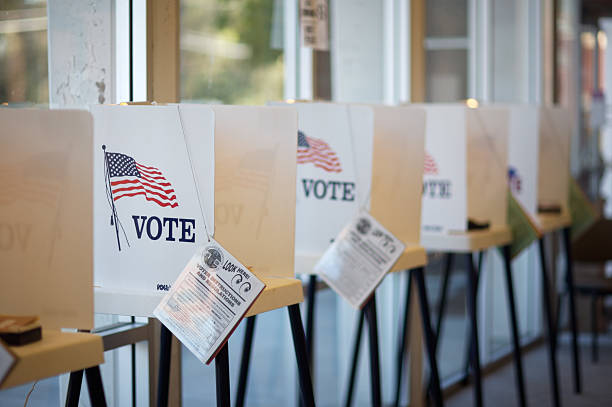
Voting booth (Photo: Shutterstock)
Arizona GOP Secretary of State Candidates Clash Over Mail Voting Policy
The disagreement centers on how Arizona should handle its early voting system, which relies heavily on mail ballots through the state’s Active Early Voter List
By Matthew Holloway, March 30, 2026 9:17 am
A dispute between Republican candidates for Arizona Secretary of State, former Arizona GOP Chair Gina Swoboda and State Representative Alex Kolodin (R-LD3), is highlighting divisions within the party over the future of mail-in voting in the state.
According to a KTAR News report, the disagreement centers on how Arizona should handle its early voting system, which relies heavily on mail ballots through the state’s Active Early Voter List.
Kolodin, a current state representative, has supported efforts to significantly change that system. He has proposed eliminating the Active Early Voter List, which allows voters to automatically receive mail ballots, as reported by VoteBeat, and replacing it with a system requiring voters to request ballots on a recurring basis and provide proof of citizenship.
The proposal, H.C.R. 2001, would also shorten the early voting period and add identification requirements for mail voting.
Swoboda, the former chair of the Arizona Republican Party, has taken a different position. In an interview on KTAR’s The Mike Broomhead Show this week she told the host she witnessed one of Governor Katie Hobbs attorneys express concerns about Kolodin during negotiations over Election reforms.
“One of the attorneys for Governor Hobbs … looked at [Rep. Kolodin] and said, ‘This looks like a bullet in the head to AEVL [Active Early Voting List],’” Swoboda told the host. “And [Kolodin] laughed in her face and said, ‘That’s because it is.’”
Swoboda’s account has not been independently corroborated. KTAR reported that she has defended Arizona’s existing mail voting framework, describing it as effective and widely used by voters across the state.
An Arizona Senate legislative summary for H.C.R. 2001 states the measure, subject to voter approval:
- Ends early voting at 7:00 p.m. on the Friday before Election Day, with mailed ballots accepted until polls close
- Requires voters to affirmatively request a mail ballot prior to each biennial election and provide proof of citizenship
- Requires government-issued identification to vote, with identification provided at state expense
- Prohibits foreign nationals from contributing to Arizona elections
Arizona’s early voting system has been in place in one form or another since at least 1991, when it was established as no-excuse early voting, renamed the Permanent Early Voting List (PEVL) in 2007, and finally the Active Early Voter List (AEVL) in 2021. The system allows voters to automatically receive ballots if they opt in to the Active Early Voter List. The system has historically been used by a large share of the electorate.
The policy divide reflects broader debates in Arizona and nationwide over election administration, particularly the balance between access and security in mail voting systems.
Legislative proposals backed by Kolodin and other Republicans would require voter approval if advanced, as some are structured as ballot referrals that bypass the governor and go directly to voters.
In a statement to KTAR, Rep. Kolodin told the outlet, “My record protecting Arizonans’ right to accessible, secure, transparent, honest, lawful elections is clear, which is why I’ve successfully passed multiple bipartisan election reforms that were signed into law by Katie Hobbs,” he said.
He added, “Unlike Fontes, I will faithfully follow the law as Secretary of State, so that all voters, regardless of political party, can have confidence in both the process and outcome of our elections.”
Swoboda’s position in the current dispute follows earlier criticism surrounding her campaign activity. In a March report by the California Globe, Swoboda faced scrutiny from conservative activists and party figures over what they described as overlapping efforts related to both a congressional bid and a potential run for Secretary of State.
The report noted that Swoboda had announced a campaign for Arizona’s 1st Congressional District in 2025 before filing a statement of interest for the Secretary of State in 2026, prompting concerns about messaging and transparency as the two efforts appeared to overlap.


- Hobbs Audio Recordings, Released After Reported Yearlong Records Wait, Renew Sunshine Questions - October 7, 2026
- TPUSA Frontlines Reporter Says Activists Assaulted Him, Slashed Tires At Arizona Border Protest - October 6, 2026
- Fontes Rejects ‘Cartel Lawyer’ Label in AZ SOS Debate Clash With Kolodin - October 2, 2026
RELATED ARTICLES
-
 October 7, 2024
 -
 January 28, 2022
 -