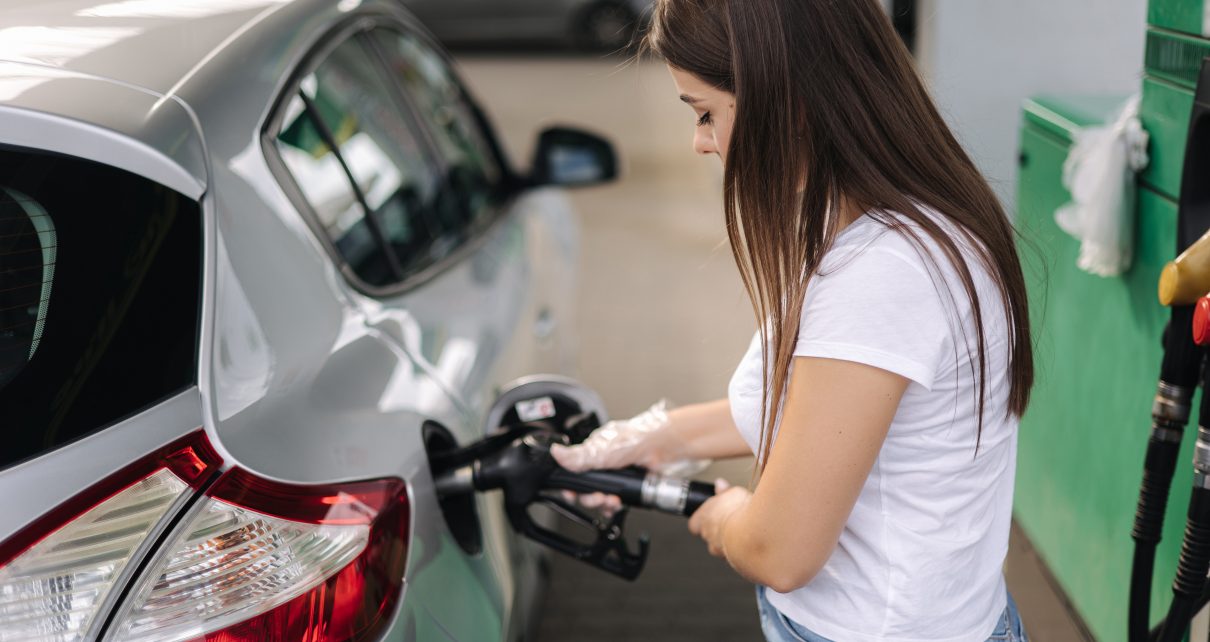
Woman refueling car at gas station using a fuel nozzle. (Photo: Hrytsiv Oleksandr/Shutterstock)
AZ Lawmaker Eyes Speed-Limiting Tech for Repeat Offenders Amid Rising Road Fatalities
State Republican Rep Quang Nguyen announced the proposal this week, targeting excessive speed as the second-leading cause of traffic fatalities in the state, behind impaired driving
By Matthew Holloway, October 31, 2025 1:19 pm
An Arizona state representative plans to introduce legislation next year that would allow courts to mandate the installation of speed-limiting devices in vehicles owned by drivers convicted of criminal speeding, offering an alternative to license suspension. State Rep. Quang Nguyen (R-Prescott Valley) announced the proposal this week, targeting excessive speed as the second-leading cause of traffic fatalities in the state, behind impaired driving.
Under the measure, set for introduction in January, judges could order the use of Intelligent Speed Assistance (ISA) technology for offenders, which uses GPS or cellular signals to detect posted speed limits and automatically restrict vehicle acceleration beyond them. The device, attachable to cars, trucks or SUVs, functions by rendering the accelerator “essentially a dead pedal” when limits are exceeded, according to Toby Taylor, executive director of the Steer Safe Partnership, a group advocating for the technology.
Studies show that around 75% of people with a suspended license drive anyway. Read further about how Arizona is considering intelligent speed‐assistance (ISA) technology as a powerful alternative. https://t.co/jcUD6EGyXa pic.twitter.com/3t2hiiI3Yj
— SteerSafe Partnership (@steersafewithus) October 24, 2025
“You can floor the car and [the] vehicle just won’t accelerate beyond what [the] posted limit is,” he explained, according to AZ Family.
Nguyen described the option as a pathway for offenders to maintain employment and daily responsibilities.
“Instead of being punished and lose[ing] the ability to keep your home, keep your job, drive to the grocery store, or take the kids to school, you now have an opportunity to have this product installed in your car, and now you can go to work and be productive again,” Nguyen said in an interview.
The push from lobbying groups like Families for Safe Streets and the Steer Safe Coalition, which includes ignition interlock makers Smart Start and LifeSafer, comes as Arizona joins a growing list of states addressing aggressive driving through tech interventions. Virginia, Washington, and Washington, D.C., enacted similar laws earlier in 2025, permitting anti-speeding devices for reckless drivers. New York, Georgia, and Florida are also slated to review ISA mandates, with Taylor predicting “several states that pass legislation next year.” In Arizona, the proposal aligns with ongoing efforts to curb speeding-related deaths, which state data links to thousands of crashes annually.
Public reactions on social media have been mixed since the announcement. Arizona Republic reporter Ray Stern highlighted Nguyen’s emphasis on productivity in a post quoting the lawmaker directly. Critics raised concerns over privacy and enforcement. One X user called it “government overreach,” noting the inclusion of GPS tracking and potential hazards on Arizona freeways where speed limits may not align with traffic flow. Another echoed the sentiment, questioning whether the anti-speeding device represents “another government overreach” in a post linking to coverage of the proposal.
“This is a serious problem, but once again, we’re not mandating anybody to do anything,” Nguyen told Capitol Media. “If you want to be able to get a limited driver’s license to get back to work, you can.”
Supporters pointed to the limitations of existing measures like speed cameras. “This is actually a good thing. These cameras don’t stop people from speeding. They just send them a bill in the mail, and a small one at that. It’s not a deterrent,” one commenter wrote, advocating for “actual deterrent, physical barriers.”
"These bills require the worst-of-the-worst reckless speeders to install Intelligent Speed Assistance (ISA) devices — speed limiters — in their vehicles, in the same way as most states require drunk drivers to install breathalyzers"#StopSuperSpeeders https://t.co/Eb4MJrbRqq
— Families for Safe Streets National (@Fam4SafeStreets) October 29, 2025
Advocacy group Families for Safe Streets National, which has lost members to traffic crashes, framed ISA as comparable to breathalyzers for drunk drivers, noting its role in bills targeting “the worst-of-the-worst reckless speeders.” The group has pushed similar measures nationwide, including in Wisconsin.
Speaking with Streetsblog, Dr. William Haddon, the founder of the National Highway Traffic Safety Administration, argued, “we’ve been miseducated that the way to solve [traffic violence] is to have more squads of police chasing Americans so that they wouldn’t drive 120 miles per hour rather than arranging cars so they can’t go that fast.”
Broader discussions on X touched on enforcement disparities, with one user referencing Arizona’s criminal speeding statutes—such as exceeding posted limits by more than 20 mph in business or residential areas, classified as a class 3 misdemeanor—and urging compliance during traffic stops to avoid escalation. Others called for wider application of limiters in urban areas to reduce fines revenue dependency.
No additional statements from Arizona legislators or law enforcement agencies were immediately available as of Thursday. Nguyen’s office did not respond to requests for further comment beyond the initial announcement. The proposal heads to the 2026 legislative session, where it could influence regional traffic safety policies, including potential cross-border implications for California commuters navigating shared highways.


- Federal Audit Reveals Backlog, Unmanageable Workloads in Missing Indigenous Persons Unit - October 17, 2026
- ‘No Kings’ Organizers Turn To Early Voting In Latest Bid For Arizona Mobilization - October 15, 2026
- Hobbs Campaign Attack On Biggs’ Sex-Offender Vote Omits His Objection To Licensing Exceptions - October 13, 2026
RELATED ARTICLES
-
 October 17, 2018
 -

-