
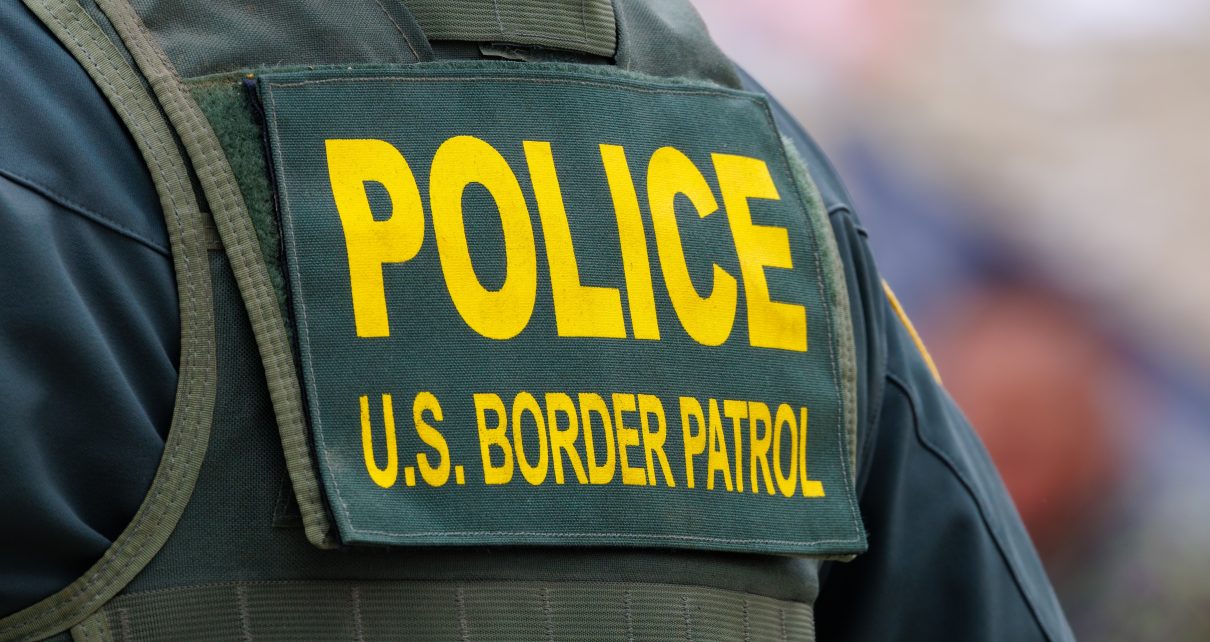
Close up of Border Patrol at the San Diego and Mexico international border wall, May 12, 2023. (Photo: Aaron J. Hill/Shutterstock)
AZ Tribal Nation Deploys Police to Stop Unauthorized Border Wall Work on Reservation
Warning escalates dispute with Trump administration as federal judge weighs challenge to 62-mile Tucson 5 Wall Project
By Matthew Holloway, August 11, 2026 12:07 pm
The Tohono O’odham Nation has posted “No Trespassing” signs and placed tribal law enforcement on alert to turn back unauthorized federal contractors attempting to enter reservation lands for work connected to a planned 62-mile border wall project, escalating an ongoing legal dispute with the Trump administration.
In a Friday public service announcement, tribal leaders said they had been informed that federal contractors hired for border wall construction and related work could attempt to enter the Nation’s lands without authorization. The Nation said contractors entering for that purpose without prior permission would be considered trespassers and announced that signs were being posted at multiple locations.
The Tohono O’odham Nation also published a warning on its official Facebook page stating that tribal law enforcement was prepared to turn back unauthorized contractors. An accompanying sign declared, “WARNING — NO TRESPASSING,” and stated that nonmembers entering or remaining on the reservation without authorization could face removal, exclusion, civil or criminal trespass proceedings, civil penalties or seizure of property.
The Nation subsequently clarified that the reservation remains open for official business and authorized visitors. Tribal members may travel normally, while nonmembers who live or work on the reservation, travel through on public roads, have been invited by tribal members or recognized entities, have authorization to work there, or are guests or employees of Desert Diamond Casino operations may continue to enter, according to the Nation’s public notice. The restrictions specifically identify unauthorized Department of Homeland Security contractors and subcontractors and people seeking access for border wall construction.
BREAKING – Tohono O’odham Nation warns DHS border wall contractors not to trespass onto sovereign tribal lands.
“If the contractors enter our lands for this purpose…they would be illegally trespassing.” pic.twitter.com/MRguraq00c
— Max Granger (@_maxgranger) August 8, 2026
The Nation said residents who encounter suspected unauthorized activity should avoid intervening and contact the Tohono O’odham Police Department.
The warning follows changes the Tohono O’odham Legislative Council made to tribal trespass law weeks after filing its lawsuit against DHS. On June 26, the council approved Resolution No. 26-196, amending the Nation’s non-member civil trespass provisions to authorize its attorney general to pursue civil trespass charges against nonmembers who enter or remain on tribal lands without authorization. The amendments authorize civil fines, removal or exclusion of unauthorized persons, seizure of unauthorized property or objects and other remedies.
That same day, U.S. Customs and Border Protection awarded SLSCO LTD the Tucson 5 Wall Project contract to construct approximately 62 miles of primary border wall system in the Tucson Sector.
The latest confrontation comes less than two months after the Nation took the federal government to court over the project.
As previously reported by California Globe, the Tohono O’odham Nation sued DHS on June 16 in the U.S. District Court for the District of Columbia, arguing that construction across land along its southern boundary would unlawfully diminish the reservation, amount to federal common-law trespass and threaten culturally significant sites. The Nation filed a motion for a preliminary injunction the following day.
The lawsuit names DHS Secretary Markwayne Mullin, Customs and Border Protection Commissioner Rodney Scott and U.S. Border Patrol Chief Rosario Vasquez in their official capacities. The Nation’s main reservation covers approximately 2.8 million acres and shares roughly 62 miles of the international boundary with Mexico.
According to the Nation’s complaint, DHS informed tribal leaders May 15 that CBP planned to solicit bids for the Tucson 5 Wall Project. Project documents described approximately 62 miles of border infrastructure, including a new 30-foot primary vertical barrier, a secondary barrier, patrol roads, cameras, lighting and other technology. The Nation alleged that CBP also provided proposed access routes extending through the reservation’s interior and conducted a bidders’ site visit involving representatives of five prospective contractors.
The federal government said in its July 7 opposition to the Nation’s preliminary injunction request that the project remained in its design phase and physical construction was not expected to begin before October. Geotechnical work, including soil borings necessary for design, could occur earlier.
The dispute centers heavily on the legal status of a roughly 60-foot strip along the international boundary known as the Roosevelt Reservation.
The Justice Department argues that President Theodore Roosevelt’s 1907 proclamation set aside public lands within 60 feet of the Mexican border for federal purposes and that the federal government retained the ability to use those lands for border security after the Tohono O’odham Reservation was established. Federal attorneys have pointed to construction of approximately 52 miles of vehicle barriers there and to earlier tribal resolutions approving border-security infrastructure.
The Nation formally rejected that interpretation earlier this year. In February, its Legislative Council approved Resolution No. 26-067, declaring that the Roosevelt Reservation “does not exist on the Nation’s 1917 Reservation” and retroactively removing references clearly recognizing its existence from several previous tribal resolutions.
The February resolution argues that President Woodrow Wilson’s 1917 executive order reserved all surveyed and unsurveyed land within designated areas extending to the Mexican border for the Tohono O’odham, then known federally as the Papago Indians. The Nation also said references to the Roosevelt Reservation in some previous tribal resolutions resulted from what it characterized as CBP’s mistaken assertion that the federal strip extends along the reservation’s international boundary.
DOJ has presented a different reading of the historical record. Federal attorneys said Congress expressly preserved the 60-foot Roosevelt Reservation when it expanded the tribal reservation in 1937. The government argues that the earlier federal reservation and the Tohono O’odham Reservation can coexist and that constructing congressionally authorized border infrastructure would not legally change the tribal reservation’s boundaries.
Justice Department attorneys also cited a 2004 Tohono O’odham Legislative Council resolution supporting construction of vehicle barriers and an all-weather patrol road. The government argues that the resolution acknowledged federal authority within the Roosevelt Reservation and only required additional easements where construction extended outside the 60-foot strip.
The Nation’s February action specifically deleted Roosevelt Reservation references from that 2004 resolution and several subsequent council actions.
President Donald Trump’s April 2025 memorandum directing a greater military role at the southern border separately directed federal agencies to make certain federal lands, including portions of the Roosevelt Reservation, available for Department of Defense use while expressly excluding federal Indian reservations.
The administration has argued that it does not need to alter the legal status of tribal lands to build the project. DOJ cited federal immigration law authorizing DHS to install physical barriers and roads along the international border and said DHS determined Tucson 5 was necessary to maintain operational control and address national security and public safety threats.
The Nation maintains that permanent pedestrian barriers and associated infrastructure would interfere with its control over reservation land, damage cultural resources and restrict longstanding religious and community ties between O’odham communities in Arizona and Sonora, Mexico. As California Globe previously reported, approximately 3,000 enrolled Tohono O’odham members live on ancestral lands in Sonora, and tribal members routinely cross the international border for family, cultural and religious purposes.
The Nation has also emphasized its cooperation with federal border authorities. Tribal officials say existing measures include vehicle barriers, CBP checkpoints, forward operating bases, surveillance towers, an ICE office and joint law-enforcement operations. The Nation reports that unlawful crossings on its lands have declined by more than 95 percent during the past two years.
The lawsuit followed damage to the Las Playas Intaglio west of Ajo during border wall work in April. CBP acknowledged that a contractor inadvertently disturbed part of the approximately 1,000-year-old cultural site and subsequently secured the remaining portion, according to previous California Globe reporting and the Associated Press.
Senior U.S. District Judge Richard Leon heard arguments July 22 on the Nation’s request for a preliminary injunction. Leon described the requested relief as extraordinary and questioned attorneys over the competing claims of tribal sovereignty and federal border-security authority.
As of Monday, both sides remained awaiting Leon’s ruling on whether the federal government may proceed while the case moves forward. No public report reviewed by California Globe indicated that contractors had been turned back by tribal police following Friday’s warning.
The Nation said unauthorized contractors who attempt to conduct border wall-related work on its lands will be warned, informed that they are trespassing, and escorted away by tribal law enforcement, with possible legal consequences under tribal law.


- Federal Audit Reveals Backlog, Unmanageable Workloads in Missing Indigenous Persons Unit - October 17, 2026
- ‘No Kings’ Organizers Turn To Early Voting In Latest Bid For Arizona Mobilization - October 15, 2026
- Hobbs Campaign Attack On Biggs’ Sex-Offender Vote Omits His Objection To Licensing Exceptions - October 13, 2026
RELATED ARTICLES
-
 October 19, 2018
 -

-
 February 6, 2019
Why? Because Trump.
They are protecting the cartels and the human smugglers. Beyond publicity, they have no authority over the US border.
The Rez made sense in the 1800’s but today the smart ones get out as soon as they can.
Fine, just build the wall on our side of the reservation, they seem to be almost the same people anyway.