
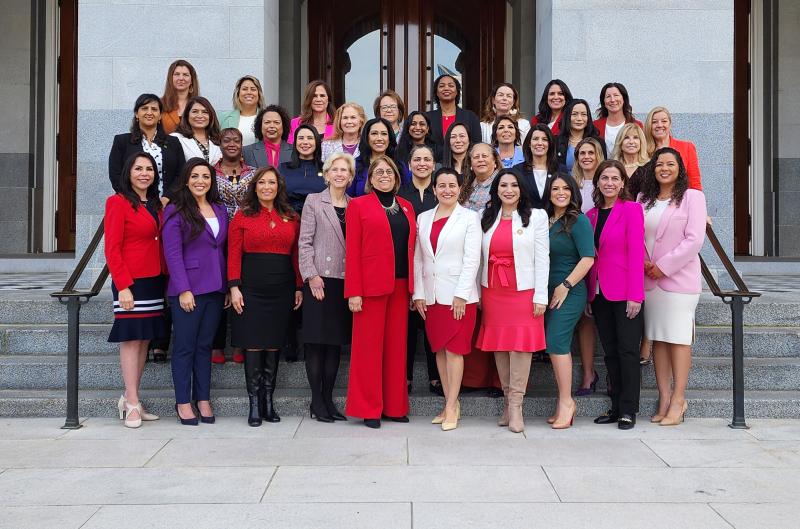
Legislative Women's Caucus Yearbook Photo, Feb. 2025. (Photo: sd22.senate.ca.gov)
California Legislative Women’s Caucus’s 2026 Priority Bills
There are no Republican-authored bills, despite that 11 of the members of the Legislative Women’s Caucus are Republicans
By Katy Grimes, March 26, 2026 5:30 am
The California Legislative Women’s Caucus announced its 2026 legislative package, and in doing so, showed us in bold colors what their priorities are. Some of the bills are fine, although probably not necessary. Others are not so fine.
The package includes 14 bills which “advances family-centered economic and social equity by supporting caregivers, strengthening women’s rights and workplace protections, expanding safety-net programs, and promoting health and stability for vulnerable families.”
There are no Republican-authored bills, despite that 11 of the members of the Legislative Women’s Caucus are Republicans.
“Our 2026 priorities are about fairness, opportunity, and safety for all Californians—especially women and families,” said Legislative Women’s Caucus Chair and Assembly Majority Leader Cecilia Aguiar-Curry (D-Winters). “This bill package, it’s focused on issues that matter to everyone, not just women. I’m proud to work with my colleagues to build a stronger, more equitable future for our communities and the state.”
They say the bill package is organized around six core pillars:
- affordability
- childcare and education
- public safety and gender-based violence
- healthcare access; support for vulnerable communities
- workplace and economic equity
Workplace & Economic Equity
AB 65 (Aguiar-Curry) – The Pregnancy Leave for Educators Act
“Right now, there’s no paid pregnancy leave for educators in California. If a teacher needs time to recover after pregnancy, they’re forced to use up all their sick leave, if they have any at all. After that, they receive differential pay on their already low salaries,” said Assembly Majority Leader Aguiar-Curry (D-Winters). “AB 65 will change that. It’ll make sure decisions about recovery time are between an educator and their doctor, not by outdated policy.”
Teachers get the summer months off, and are still paid, so perhaps that is why that in addition to their 9 personal days and 10 sick leave days (which accumulate and are carried over to the next year), there hasn’t been a special category of pregnancy leave. I know teachers who retired with months and months of accumulated sick leave, and received it as a payout.
AB 2134 (Addis) – Parental Leave for Local Elected Officials
“Californians should be able to both grow their families and serve in local office—full stop. Yet archaic laws are forcing too many moms to publicly divulge their personal health information, publicly ask for their council permission to request family leave, or choose between public service and raising a family. We can fix this,” said Assemblymember Dawn Addis (D-Morro Bay). “AB 2134 will ensure that public servants caring for and starting young families are not penalized for doing so.”
Existing law states that “If a city council member is absent without permission from all regular city council meetings for 60 days consecutively from the last regular meeting they attended, their office becomes vacant and shall be filled as any other vacancy.”
This bill says “Parental leave shall not count toward the existing number of allowed absences allotted to each council member.”
What about the constituents? Any lengthy absence leaves constituents without a voice.
SB 1237 (Blakespear) – Pay Equity Enforcement
“California has led the nation on equal pay, but our laws are only as strong as their enforcement. SB 1237 ensures employers can’t treat pay data reporting as optional by increasing penalties and giving the Civil Rights Department the tools it needs to effectively combat wage discrimination, a critical step toward ending persistent wage disparities and delivering real pay equity for women,” said Senator Catherine Blakespear (D-Encinitas).
From the bill – once again we had to read the bill to see what exactly was in it:
Existing law requires certain private employers to annually submit a pay data report to the department that includes, among other information, the number of employees by race, ethnicity, and sex, as specified, and, within each job category, for each combination of race, ethnicity, and sex, the median and mean hourly rate.
(Isn’t this a violation of Proposition 209?)
Upon request from the Civil Rights Department, existing law requires a court to impose a civil penalty not to exceed $100 per employee upon any employer who fails to file the required report and not to exceed $200 per employee upon any employer for a subsequent failure to file the required report. Existing law requires these penalties to be payable to the fund described above.
This bill would increase the penalty for subsequent failures to file the report described above to an amount not to exceed $1,000 per employee.
Cha-ching.
Gender Violence & Public Safety
AB 788 (Quirk-Silva) – Rehabilitation and Safety for Incarcerated Women
“California’s prison system still fails to address the unique needs of incarcerated women, who face violence, trauma, neglect, and too often are forgotten. AB 788 is a declaration that incarcerated women will no longer be overlooked, requiring that the California Department of Corrections take action to ensure safer conditions, better policies, and stronger leadership. This is about accountability, respect, and changing the future for women who deserve a second chance,” said Assemblywoman Sharon Quirk-Silva (D-Fullerton).
This bill would create “the Division of Female Programs and Services. The bill would require the director of this division to be responsible solely for female adult institutions and community facilities housing female offenders.”
It “would require the department to establish the Gender Responsive Strategies Commission to develop active partnerships, involving the community, treatment experts, and related agencies, in its efforts toward gender-responsive practice.”
AB 2434 (Bonta) – Visitor Protections and Safety Act
“When a mother drives hundreds of miles to visit her child and is turned away without so much as a written explanation, we have failed her, we have failed her child, and we have made our communities less safe. The Visitor Protections and Safety Act is about basic dignity: no family should be denied a visit without transparency, and no department that claims to prioritize rehabilitation can afford to shut families out. Decades of research confirms what families already know: in-person connection heals, and AB 2434 puts that truth into law,” said Assemblymember Mia Bonta (D-Oakland).
Funny how nowhere in Mia Bonta’s description of the Visitor Protections and Safety Act is this a visit to an inmate in prison. You actually have to read the bill to see what’s in the bill.
SB 1192 (S. Rubio) – The Reclaim Act
“As a survivor, I know firsthand that leaving an abuser does not always mean the abuse ends. Too many survivors are retraumatized when the court system is used as a weapon against them. The Reclaim Act is about restoring dignity, safety, and freedom—and making sure the justice system protects survivors, not their abusers. Survivors should never have to choose between their safety and their right to justice. The Reclaim Act makes clear: our courts are not tools for abuse,” said Senator Susan Rubio (D-Baldwin Park).
This bill would create a process for victims of domestic violence, as defined, to seek protection from abusive litigation by a person who abused them by requesting a prefiling order.
Boom. Good bill.
Healthcare & Health Equity
AB 1570 (Wilson) – Healthcare Coverage: Diagnostic Imaging
“I am proud AB 1570 has been chosen as priority legislation by the California Legislative Women’s Caucus,” said Assemblywoman Lori D. Wilson (D-Suisun City). “AB 1570 will eliminate the patient’s out-of-pocket costs for medically necessary diagnostic and supplemental breast imaging such as breast MRIs and ultrasounds, allowing for individuals to receive continued treatment to confirm a cancer diagnosis or rule it out. Currently, the out-of-pocket costs associated with breast imaging procedures can range from hundreds to thousands of dollars, deterring individuals from continuing their screenings as they must make significant financial sacrifices. This leads individuals to forgo further testing that can confirm or rule out cancer and in some cases is life-saving treatment.”
Is this bill necessary because health insurance plans are charging record high premiums and limiting the servcices that patients need?
From the bill:
This bill would require a health care service plan contract, a policy of health insurance that provides hospital, medical, or surgical coverage, or a self-insured employee welfare benefit plan issued, amended, or renewed on or after January 1, 2028, to provide coverage without imposing cost sharing for, among other things, screening mammography and medically necessary diagnostic breast imaging, including diagnostic breast imaging following an abnormal mammography result and for an enrollee or insured indicated to have a risk factor associated with breast cancer, except as specified.
Okay. This may be necessary. Do we need to legislate all medically-necessary procedures?
AB 2066 (C. Rodriguez) – Pregnancy – Qualifying Life Event
“Pregnancy shouldn’t be a barrier to receiving care. AB 2066 ensures people can access prenatal coverage when they need it—not when an enrollment window allows it. This bill is about supporting healthy pregnancies and healthy families,” said Assemblywoman Celeste Rodriguez (D-San Fernando).
“This bill would make pregnancy a triggering event for purposes of enrollment or changing a health benefit plan. Because a willful violation of this provision by a health care service plan would be a crime, the bill would impose a state-mandated local program.”
Usually employment is a triggering event for enrollment of a health insurance plan. If a woman does not have health coverage through an employer, she can get Medi-Cal through the government. Is this redundant?
Vulnerable Communities
AB 1628 (M. Rodriguez) – The Keeping Infants from Danger (KID) Act
“As our understanding of postpartum recovery continues to deepen, it’s clear our laws must reflect that experience. AB 1628, or the Keeping Infants from Danger (KID) Act, expands the Safe Surrender window to 30 days, giving mothers the time to make thoughtful decisions while navigating the physical and emotional challenges after childbirth,” said Assemblymember Michelle Rodriguez (D-Ontario).
From the bill:
Under existing law, a parent or other individual with lawful custody of a minor child 72 hours old or younger who voluntarily surrenders physical custody of the child to personnel on duty at a safe-surrender site cannot be prosecuted for child abandonment.
I am not sure this is needed. Who would turn away an infant from a woman in distress?
Curiously, this is also in the bill:
51934.(a) Each school district shall ensure that all pupils in grades 7 to 12, inclusive, receive comprehensive sexual health education and HIV prevention education from instructors trained in the appropriate courses. Each pupil shall receive this instruction at least once in junior high or middle school and at least once in high school. This instruction shall include all of the following:
(1) Information on the nature of HIV, as well as other sexually transmitted infections, and their effects on the human body.
(2) Information on the manner in which HIV and other sexually transmitted infections are and are not transmitted, including information on the relative risk of infection according to specific behaviors, including sexual activities and injection drug use.
This went on for 11 paragraphs.
AB 1602 (B. Rubio) – Foster Youth: Disaster Aid Assistance
“Natural disasters affect entire communities, but foster youth and their caregivers face unique disruptions and instability in crisis. While the state is responsible for meeting the needs of children in foster care, this population rarely receives additional support for unexpected expenses following a disaster. AB 1602 helps ensure that resources are available immediately to reduce additional trauma, mitigate unnecessary stress and maintain stability for these young people,” said Assemblywoman Blanca Rubio (D-Baldwin Park).
From the bill:
This bill would require, upon appropriation by the Legislature, moneys in the Child Welfare Disaster Response Account to be used for purposes of the program and to support the needs of foster children and youth, as defined, and their caregivers during a disaster. The bill would require the department to determine eligibility criteria for applicants and would authorize county child welfare agencies, county probation departments, or Indian tribes, as specified, to apply for funds. The bill would require funds awarded pursuant those provisions to be available to meet the housing, clothing, transportation, and other tangible needs of foster children and youth and their caregivers that occur within 180 days of a local emergency proclamation by a local government or a state of emergency proclamation by the Governor.
Is this a bill in search of a crisis?
Childcare & Education Equity
AB 1590 (Ransom) – Career Technical Education Full Funding
“Every state approved dollar that goes unallocated to Career Technical Education is a disservice to our students. I want to thank the Legislative Women’s Caucus for making this a priority and for their leadership in supporting our students’ success. CTE programs provide meaningful, hands-on experiences that expose students to a wide range of career paths. As California continues to prioritize career readiness, CTE is a critical investment proven to prepare students for both college and the workforce. AB 1590 simply ensures that when the state appropriates funding for CTE, those dollars are fully directed to that purpose,” said Assemblymember Rhodesia Ransom (D-Tracy).
From the bill:
Existing law establishes the California Career Technical Education Incentive Grant Program, administered by the State Department of Education, with the purpose of encouraging, maintaining, and strengthening the delivery of high-quality career technical education programs. Existing law provides, for the 2021–22 fiscal year and each fiscal year thereafter, that $300,000,000 shall be available to the department, upon appropriation by the Legislature, for the program. Existing law requires an applicant to demonstrate a proportional dollar-for-dollar match and sets that amount for the 2021–22 fiscal year, and each fiscal year thereafter, at $2 for every $1 received from the program. Existing law prohibits an applicant from being awarded an amount higher than the amount that the allocation formula determines them to be eligible to receive under the program.
The State Department of Education can’t seem to improve math and English scores in K-12 education. California is hovering at the bottom of the country in test scores. Perhaps focus on those very necessary educational disciplines and improve test scores so students can read, speak proper English, and do basic math.
AB 1981 (Aguiar-Curry) – The True Cost of Child Care Act
“Childcare is essential to our workforce and economy, yet too many families are struggling to afford it while providers are underpaid,” said Assembly Majority Leader Cecilia Aguiar-Curry (D-Winters). “AB 1981 creates a clear path forward to make sure reimbursement rates reflect the true cost of care, so our families can access the care they need and providers are fairly compensated.”
Existing law requires the State Department of Social Services, in collaboration with the State Department of Education, to implement a reimbursement system plan that establishes reasonable standards and assigned reimbursement rates for subsidized childcare and development services, and to develop and conduct an alternative methodology for ratesetting.
Could we be funding more “Learing Centers” with this bill? The state already has a vast, subsidized childcare system.
Addressing Poverty & Affordability
AB 1755 (Sharp-Collins) – Ending CalWORKs Work Hour Restrictions
“AB 1755 is about standing up for women and families who are doing everything right and still being punished. The 100-hour eligibility rule punishes working mothers and destabilizes households by cutting off support simply because a parent works more. With rising costs, people are still struggling to survive. If we truly value families, we must end this outdated policy and build a CalWORKs system that supports women, protects children, and recognizes the realities of today’s economy,” said Assemblywoman LaShae Sharp-Collins (D-San Diego).
Proposing to continue state subsidies to women who obtain work?
From the bill:
Existing federal law, the Personal Responsibility and Work Opportunity Reconciliation Act of 1996, replaced the federal Aid to Families with Dependent Children (AFDC) program with the federal Temporary Assistance to Needy Families (TANF) block grant program. Existing federal law provides for allocation of federal funds through the federal TANF block grant program to eligible states. Existing law establishes the California Work Opportunity and Responsibility to Kids (CalWORKs) program, under which, through a combination of state and county funds and federal funds received through the TANF program, each county provides cash assistance and other benefits to qualified low-income families.
Isn’t the idea to get women and families off of welfare?
SB 1030 (Smallwood-Cuevas) – CalWORKs “Man in the House” Statute Repeal
“The unrelated adult male rule is part of a long legacy of punitive welfare policies rooted in harmful stereotypes. These policies have disproportionately harmed families of color and reinforced stigma, rather than addressing real barriers such as wage inequity and housing instability. SB 1030 represents a critical step toward dismantling these outdated practices and advancing a more equitable, dignity-centered safety net that genuinely supports family stability and economic mobility,” said Senator Lola Smallwood-Cuevas (D-Los Angeles).
From the bill – more CalWORKS:
Existing law provides for the California Work Opportunity and Responsibility to Kids (CalWORKs) program under which, through a combination of state and county funds and federal funds received through the TANF program, each county provides cash assistance and other benefits to qualified low-income families. Existing law requires an unrelated adult male who resides with a family who is applying for or receiving aid from the CalWORKs program to make a financial contribution to the family, as specified.
This bill would repeal those provisions requiring an unrelated adult male who resides with a family applying for or receiving aid from the CalWORKs program to make a financial contribution to the family. By expanding eligibility for the CalWORKs program, the bill would impose a state-mandated local program.
This bill would excuse a male living in the household to contribute financially, and instead extend CalWORKS welfare to the mother, further tying her to welfare, i.e. “wage inequity” and “housing instability.”
This is outrageous. Another gift to the SEIU. Keeping women dependent on government… they sound more like women haters.

A California native and Navy mom, Katy lives in Sacramento, CA.
- California Voters: Howard Jarvis Taxpayers Association’s 2026 Voting Guide - October 23, 2026
- Newsom Gaslights Over California’s Bad Student Test Scores - October 22, 2026
- How the DMV Enabled Voter Fraud in California - October 21, 2026
RELATED ARTICLES
-
 September 12, 2023
 -

-
 September 11, 2024
Why are there are any Democrats in the California Legislative Women’s Caucus when they can’t define what a woman is?
Some of them don’t even look like women and some are downright scary?
Take Democrat Assemblyperson Mia Bonta for example, the mannish looking “wife” of Democrat Attorney General Rob Bonta who was probably installed with voter fraud to succeed him in the 18th Assembly District (Oakland, Alameda, Emeryville), and her ridiculous Visitor Protections and Safety Act. As usual, she’s more concerned about criminals and their families rather than the safety of law abiding citizens in her crime infested district.
Anyone else noticed that hyphenated-surnamed women tend to be shrill, TDS-infested shrews???
And mostly brain-dead, hysterical progressives???