
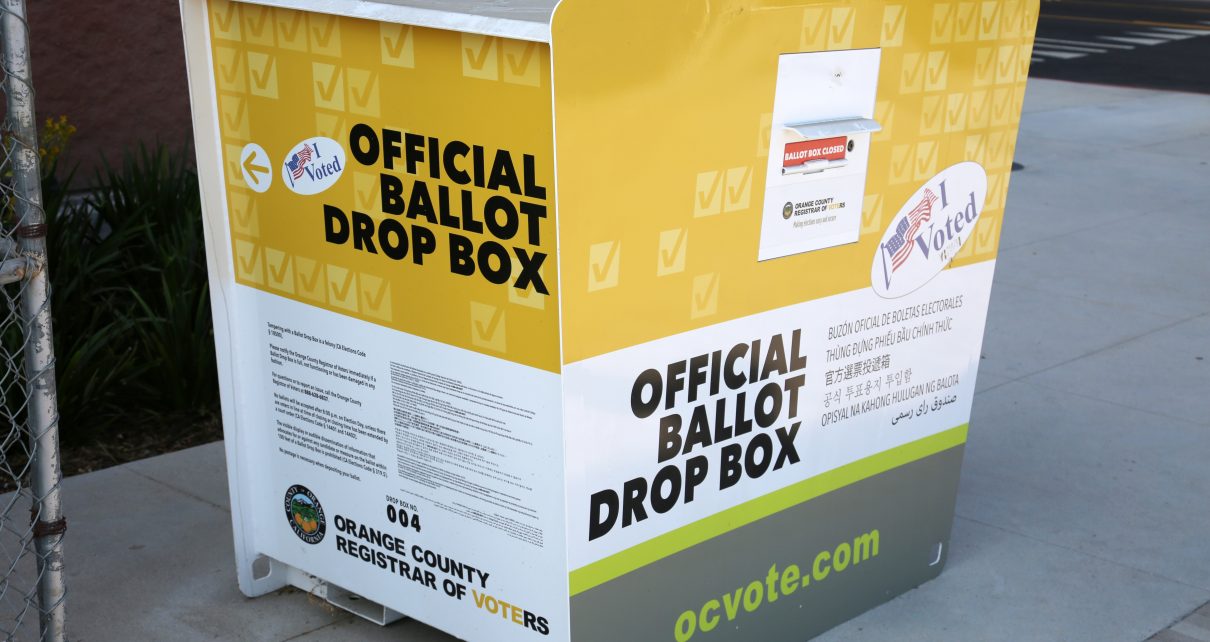
Official Ballot Drop Box placed ready to accept Voting Ballots for the upcoming election. Santa Ana, CA, Sept. 23, 2020. (Photo: mikeledray/Shutterstock)
California’s Ballot Petition Racket Just Got Caught
What prosecutors describe is petition signature fraud, identity theft wearing a civic costume
By Jay Rogers, September 11, 2026 12:24 pm
Somewhere in Sacramento a legislative staffer is drafting a press release about “the will of the people.” Down on Skid Row, the will of the people goes for two or three dollars a signature, cash, no questions asked, and you don’t even need to be a registered voter. You just need to be willing to sign somebody else’s name.
That is the plain reading of a federal indictment unsealed this week in Riverside against James Brass, 47, of Victorville, who goes by “Lord.” Brass and two associates, Courtney Price and Jateisha Herron, are charged with pulling the identities of registered California voters from a database, then paying homeless residents of downtown Los Angeles to copy those names onto ballot initiative petitions and sign them as if they were the actual voters. Brass and Herron allegedly then signed sworn declarations claiming they had personally watched real, registered voters put pen to paper. Brass reportedly collected roughly $41,600 from a petition management company for his trouble. He was arrested Thursday morning and made his initial appearance in federal court that afternoon.
I have spent three decades in financial services, much of it as an expert witness untangling who knew what and when in fraud cases. My first reaction to this story is not outrage theater but a professional observation: this is what happens when a system rewards volume and punishes almost nothing.
Get the terminology right. What prosecutors describe is petition signature fraud, identity theft wearing a civic costume, not the separate practice known as ballot harvesting, where a designated third party collects a voter’s sealed, completed mail ballot. But don’t mistake that distinction for an endorsement of harvesting. California lets nearly any designated person haul in someone else’s ballot. A growing list of states doesn’t trust the practice at all. Alabama and Wisconsin require voters to return their own ballots, with only narrow exceptions. Arizona made third-party collection a felony in 2016, and the U.S. Supreme Court upheld that law in 2021. Georgia followed with its own felony ban. A federal court upheld Texas’s ban on paid ballot harvesting this year. If ballot harvesting were the harmless civic courtesy its defenders describe, half the country wouldn’t have criminalized it.
Here is why California keeps producing cases like Brass. Qualifying a statutory initiative requires 546,651 valid signatures. A constitutional amendment needs 874,641. Nobody hits those numbers with a clipboard outside the grocery store. Campaigns hire petition management companies, who subcontract to coordinators, who subcontract to circulators paid by the signature. Every link in that chain is a place to cut a corner, and a corner cut at six-figure volume gets cut a lot of times before anyone notices.
This is not an isolated actor. In May, federal prosecutors charged longtime California circulator Brenda Lee Brown Armstrong after she admitted paying Skid Row residents two to three dollars, plus cigarettes and prepaid phone cards, to register to vote and sign petitions, something she had done off and on for two decades. She pleaded guilty in June. Now Brass. Two federal cases out of the same three-block radius in a single year is not bad luck. It’s a business model.
The other side will tell you this sort of thing barely happens, that “voter fraud” is a talking point, not a pattern. Two federal indictments from the same neighborhood in four months say otherwise. It’s the same story we’ve watched for years with stolen Social Security numbers used to secure jobs for people not authorized to hold them: real identities, quietly borrowed, doing work the actual owner never agreed to, discovered only when someone finally goes looking. Nobody would call that a coincidence in immigration enforcement. It isn’t one here either, and the pattern keeps surfacing in the same handful of blue-state cities.
To be fair, neither case proves a specific initiative sponsor knew about or directed the fraud. Federal authorities have not named the measure Brass was allegedly working to qualify, and the government built its case around circulators, not campaigns. It’s possible the sponsor here is a victim of its own subcontractor too.
But that defense is the design flaw. Everyone at the top can claim ignorance, because the sponsor hired a company, who hired a coordinator, who hired Brass, and Brass hired people with every reason to take three dollars and not ask questions. Registrars catch invalid signatures after the petition is filed and the “grassroots momentum” headlines already ran.
California licenses hairstylists, manicurists, and used car dealers. It regulates nearly every trade that touches the public. Petition circulation, which touches the state constitution itself, gets none of that scrutiny. License and bond circulators and coordinators the way we license contractors, with a record that follows them from job to job. Hold sponsoring campaigns jointly liable for fraud in their subcontracting chain, the way a general contractor answers for a subcontractor who steals copper pipe. Flag statistically anomalous signature batches for automatic referral instead of a quiet rejection letter. Stop paying circulators strictly by the signature. And restrict who gets to return someone else’s ballot to family, household members, and caregivers, the way most states that still permit any collection at all already do.
Reagan liked to say trust but verify. California’s initiative system manages neither half of that sentence. It trusts blindly on the front end and verifies badly, and late, on the back end, which is how the FBI ends up arresting a man who goes by “Lord” for running a forgery operation out of one of the poorest zip codes in America. Self-government rests on the premise that the people asked for this. When the people supposedly asking turn out to be homeless men and women paid a few dollars a name, that premise collapses, and so does anyone’s claim that the resulting law reflects the will of anybody at all.


- Sacramento Flunks Civics Again - October 19, 2026
- Class President by Appointment - October 14, 2026
- Fewer Kids, More Payroll: LAUSD’s Math Problem - October 11, 2026
RELATED ARTICLES
-
 February 8, 2022
 -
 January 30, 2022
 -
 February 24, 2024
Im sure the paper these down on their luck people were signing slanted in every way, to the Democrats. Tip of the Ice berg. We have two more years of going after these clowns then if the Democrats get back in, it will be back to business as usual. Too bad someone can’t go a few layers deeper and bust the real criminals. What is wrong with these people?
I have volunteered for over a dozen citizens’ initiatives over the years. the Sec of State goes over conservative initiatives with a fine tooth comb; disqualifies signatures if someone registered to vote with their middle initial included in the signature and didn’t on the petition; they have changed the ballot title and summary of more than 3 ballot measures I worked hard to get on the ballot, causing two to fail. it got so bad that petition organizers now have to hire staff to “preview” petitions prior to submitting to the S.O.S, at a huge labor cost.
Meanwhile, liberal causes with the same homeless person’s illegible scrawl showing up hundreds of times have gotten a rubber stamp. if they are cheating on the unionization of every industry known to man, tax hikes, job killers, and various other unpopular “petitions” that made it, you can bet they are cheating with ballot harvesting too. makes you wonder what the results of CA elections would look like if it was honest!
I disagree that volunteers would need to be licensed by the state. the process is one of the few ways that we get to petition the gov (We the People) for redress of grievances. the problem is CA is corrupt from top to bottom.
Democrats in Sacramento have legalized election stealing.
The criminal Democrat thug mafia has been stealing elections for years in California with impunity.
#SaveCalifornia
#VoteRepublican2026
#Vote4SteveHilton
#Vote4MichaelGates
#Vote4GloriaRomero
TAKE BACK OUR STATE!