
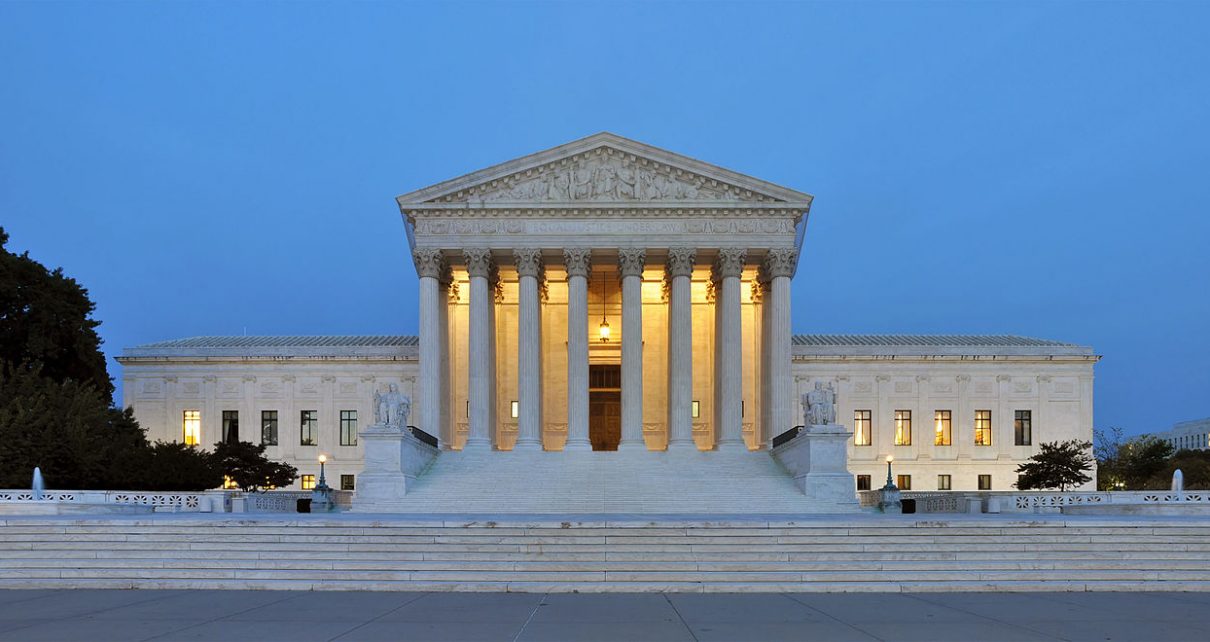
Supreme Court of the United States. (Photo: U.S. Supreme Court)
Trump DOJ Takes Chattah Appointment Fight to the Supreme Court
Solicitor General says Ninth Circuit ruling ‘threatens to inject mass confusion’ into five U.S. Attorney’s Offices handling more than 8,000 cases a year
By Megan Barth, September 11, 2026 12:12 pm
The Trump administration on Tuesday asked the U.S. Supreme Court to reverse a Ninth Circuit ruling that Nevada’s top federal prosecutor, Sigal Chattah, was unlawfully kept in office after Senate Democrats vowed to block her confirmation, the same vacancies maneuver used to keep former Assemblyman Bill Essayli running the nation’s largest U.S. Attorney’s Office in Los Angeles.
Solicitor General D. John Sauer’s petition in United States v. Devonte Devon Jackson, et al. targets an August 17 decision holding that then-Attorney General Pam Bondi could not keep Chattah in charge by accepting her resignation as 120-day interim U.S. Attorney and, the same day, naming her First Assistant so the Federal Vacancies Reform Act would make her Acting U.S. Attorney.
“These cases presented the question whether the Attorney General can make someone an Acting U.S. Attorney—bypassing the usual requirement that a U.S. Attorney be confirmed by the Senate—by designating that person as the first assistant to an already-vacant office,” Judge Eric Miller, a Trump appointee, wrote for a unanimous panel. “The panel held that the Attorney General cannot do so.”
Miller added the Attorney General also cannot “create a de facto Acting U.S. Attorney by delegating all of the functions and duties of the U.S. Attorney to someone else.”
Sauer told the justices the executive branch has used this succession tool “without meaningful objection for 25 years,” including after presidential transitions when no first assistant is already in place.
The ruling, he wrote, “threatens to inject mass confusion into five U.S. Attorney’s Offices in the Ninth Circuit that collectively handle over 8,000 civil and criminal cases annually” and leaves administrations “with few good options for acting officers to safeguard critical posts.”
That is California’s problem too. Essayli was sworn in as interim U.S. Attorney for the Central District of California in April 2025 under the same 120-day statute. When the clock ran out in July, Bondi redesignated him First Assistant and Special Attorney.
A visiting judge later said he was not lawfully Acting U.S. Attorney but left him as First Assistant. Defense lawyers in Los Angeles have already cited the Chattah opinion to try again to knock him off cases.
Tuesday’s petition is the Justice Department’s vehicle to the high court. Biden-appointed U.S. Attorney Jason Frierson resigned January 17, 2025. Bondi appointed Chattah interim U.S. Attorney effective April 1. The day before the 120-day term expired, Chattah resigned while saying she “look[ed] forward to continuing to lead” the office. Bondi named her Special Attorney and First Assistant and claimed the vacancies law did the rest.
Federal public defenders moved to disqualify her and dismiss indictments. U.S. District Judge David G. Campbell ruled in September 2025 that she was “not validly serving as acting U.S. attorney.” The Ninth Circuit affirmed the disqualification but would not throw out the charges.
Chattah has stayed on as First Assistant.
Chattah, a Las Vegas attorney and former Republican National Committeewoman for Nevada, previously ran unsuccessfully as the Republican nominee for Nevada Attorney General in 2022 on a campaign platform of rooting out public corruption.
Nevada’s Democratic U.S. Sens. Catherine Cortez Masto and Jacky Rosen strongly opposed any permanent nomination of Chattah, issuing public statements describing her in derogatory terms as an “extremist,” “deeply unfit,” an “election denier who has advocated for political violence,” and citing alleged past statements involving racism, conspiracy theories, threats of violence, and promises to target political opponents.
Rosen explicitly pledged not to return a “blue slip” if Chattah were nominated to a permanent role.
The blue-slip tradition is a longstanding but informal Senate Judiciary Committee custom (dating to 1917 and not codified in law or the Constitution) under which home-state senators are asked for their approval of certain nominees, including U.S. Attorneys, via a blue-colored form.
A senator’s refusal to return a positive blue slip has historically been treated as a potential veto that can delay or block consideration. The practice has drawn repeated bipartisan criticism for effectively granting individual senators outsized power to obstruct a president’s nominees on partisan or personal grounds, prompting calls—particularly from Republicans in recent years—to reform or eliminate it for certain positions.
In Chattah’s case, the senators’ public statements made clear they would use the tradition (and any available Senate tools) to prevent confirmation.
President Donald Trump nominated longtime Las Vegas attorney George Kelesis to the permanent U.S. Attorney post in February 2026, the day before oral argument in the case. The nomination is still sitting in the Senate.
Similar appointment fights have hit Alina Habba in New Jersey, John Sarcone in New York, Lindsey Halligan in Virginia, and Essayli in Los Angeles. If the Court denies review, the Ninth Circuit’s rule will sit on federal prosecution across Nevada and California.
If the U.S. Supreme Court takes the case, the question will not be whether Cortez Masto and Rosen like Sigal Chattah. It will be whether an Attorney General may keep a U.S. Attorney’s Office running when the Senate has decided not to.


- DOJ Charges 15 in Massive $2 Billion LA Medical Fraud Case - October 22, 2026
- LA County Registrar Confirms California Doesn’t Verify Citizenship of Registered Voters — and Most States Don’t Either - October 21, 2026
- Aaron Ford Appeals Dismissal of Nevada Alternate Electors Case After Judge Faults His Office for Withholding Evidence - October 20, 2026
RELATED ARTICLES
-
 September 8, 2025
 -

-