

Governor Gavin Newsom Gaslights his Way Through the May Budget Revision
‘Now he’s increasing taxes on employers by $5 billion in a move that will devastate our beleaguered business community’
By Katy Grimes, May 14, 2026 2:27 pm
“Governor Newsom’s revised budget proposal is a fiscally disciplined, balanced plan that cuts the long-term deficit by more than half and tightens Sacramento’s belt — while supporting our most vulnerable Californians amid Donald Trump’s cruel assault on the state,” says Governor Newsom. “As Trump attacks healthcare, education, and working families, California is staying focused on protecting essential services while advancing fiscal responsibility and affordability.”
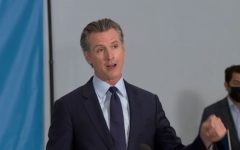
California Governor Gavin Newsom unleashed his Trump Derangement Syndrome Thursday during his May budget revise press conference for the first 10 full minutes, blaming the President’s policies–especially tariffs– for contributing to a worsened budget outlook.
But hey! Gov. Gavin Newsom’s final May budget revise is “miraculously balanced,” he says.
Gov. Newsom said he was not only handing off a balanced budget for next year to a new governor, his two-year budget will be balanced in 2028 as well.
Pardon my snicker.
Newsom proposed roughly $322 billion in total spending and about $226 billion General Fund spending. His budget revise projected a $12 billion deficit for 2025-26.
It is important to note that the Legislative Analyst’s Office (LAO) warns, “deficits have persisted even as the state’s economy and revenues have grown, underscoring that the problem is structural rather than cyclical.”
The May budget revise updates his January budget proposal and incorporates the latest revenue forecasts from April tax receipts.
Newsom described this budget as fiscally disciplined and claimed that it eliminates the projected deficit, reduces spending, builds reserves, and protects core services amid economic uncertainty and federal policy pressures.
Here is his X post touting zero deficits:
California’s fiscal future is on a stronger footing for the years to come.
$0 deficit THIS budget year.
$0 deficit NEXT budget year.
$0 structural deficit through July 2028.
Long-term deficit: Cut by more than half.
California’s fiscal future is on a stronger footing for the years to come.
$0 deficit THIS budget year.
$0 deficit NEXT budget year.
$0 structural deficit through July 2028.
Long-term deficit: Cut by more than half. pic.twitter.com/Ssq8jDGbGB— Governor Gavin Newsom (@CAgovernor) May 14, 2026
SacCPA retorted, “ANYTIME a politician adds a modifier in a sentence you know they are hiding something. The modifier here is ‘structural.’ We know there was a projected deficit in the billions just a month ago.”
He’s right.
Senate Minority Leader Brian W. Jones (R-San Diego) summed up the Governor’s shenanigans nicely:
“This budget just further illustrates what we already know: this governor is a fiscally irresponsible tax-and-spend grifter who cares only about growing his own financial and political capital, not about serving the people of California by boosting or protecting our quality of life.
He’s defied the voters and destroyed public safety by defunding Prop. 36. Now he’s increasing taxes on employers by $5 billion in a move that will devastate our beleaguered business community – a business community teetering already thanks to his refusal to pay off the state’s federal unemployment insurance debt. But sure, let’s just keep spending and taxing with nothing to show for it in the end but a decimated economy and highest in the nation cost of living.”
California’s nonpartisan LAO also directly contradicts Newsom’s claims from their January budget analysis, showing “chronic” multiyear budget deficits.
The LAO directly highlights large multiyear deficits in its January 2026 analysis of Governor Newsom’s proposed 2026-27 budget.
Key LAO Projections (Under Governor’s Revenue and Budget Assumptions)
- 2027-28: ~$27 billion operating deficit.
- 2028-29: ~$22 billion deficit.
- 2029-30: ~$23 billion deficit.
These are the years Newsom claims deficits are $0.
These figures come straight from the LAO’s Overview of the Governor’s Budget, published January 12, 2026. The LAO notes this is the fourth consecutive year of projected multiyear shortfalls, even with recent revenue gains, largely from stock market and AI-related income taxes.
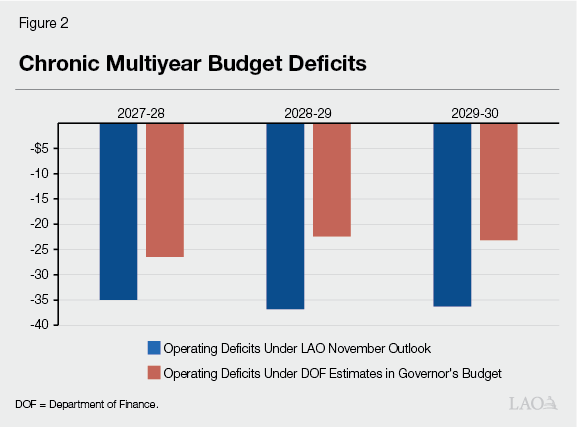
The LAO was even kind enough to make a pretty graphic, highlighting their realistic projections, and the Department of Finance’s rosy projections:
Notably, the Department of Finance works exclusively for the Governor.
The LAO reports:
Chronic Multiyear Budget Deficits Remain. For the fourth year in a row, our office and the administration are forecasting multiyear budget shortfalls. Under the administration’s proposed budget and revenue assumptions, the state faces operating deficits of $27 billion in 2027‑28, $22 billion in 2028‑29, and $23 billion in 2029‑30, as seen in Figure 2. In November, our office projected the state faced deficits around $35 billion per year, with much of the difference attributable to our lower revenue estimates.
The LAO says deficits persist “even as revenues grow” — meaning it’s structural by definition.
The LAO also has some serious concerns:
Stock Market Poses Serious Risk to Revenues. As we discussed in our Fiscal Outlook, several historically reliable signs suggest the stock market is overheated and at high risk of reversing course into a downturn in the next year or so. Should a stock market downturn occur, income tax revenues would fall considerably. These risks are severe enough that not incorporating them into this year’s budget, as the Governor proposes, would put the state on precarious footing. Further amplifying this precariousness, even under the administration’s more optimistic revenues, the budget is only roughly balanced in the near term.
Multiyear Budget Deficits Alarming. Both our office and the administration expect the state to face multiyear deficits, with estimates ranging from $20 billion to $35 billion annually. These deficits are concerning for three reasons. First, after four years of projected deficits and a cumulative total of $125 billion in budget problems solved so far (see Figure 4), the state’s negative fiscal situation is now chronic. Second, as we pointed out in our Fiscal Outlook, structural deficits have grown—our November outlook is the most negative forecast of the budget’s position since the pandemic. Finally, deficits have persisted even as the state’s economy and revenues have grown, underscoring that the problem is structural rather than cyclical. Taken together, these trends raise serious concerns about the state’s fiscal sustainability.
Republican lawmakers weighed in:
“The governor missed the opportunity to finally present a sustainable and transparent budget,” said Senator Roger Niello (R-Fair Oaks), vice chair of the Senate Budget Committee. “Rather, his final performance today was a magic show full of tricks to fool the people. The governor may tout the increase in revenue all he wants, but if he and the Democratic party do not address the seriousness of continued deficits, Californians will pay the price for years of fiscal irresponsibility.”
“Despite record revenues this year, California’s long-term fiscal outlook remains deeply concerning,” said Assemblyman David Tangipa (R-Fresno), vice chair of the Assembly Budget Committee. “This budget reflects a pattern of deferred decision-making — kicking structural problems down the road for the next governor and legislature to inherit. Governor Newsom appears to define fiscal success narrowly: if the budget doesn’t collapse on his watch, it’s a balanced one. This boom-and-bust approach to budgeting is simply not sustainable.”
“Since Newsom became governor, state spending grew by 76%, from $140 billion to the $247 billion proposed for 2026-27. This major imbalance, known as a structural deficit, will continue for the foreseeable future.”
“The May Revise failed to adequately address the budget priorities Senate Republicans have been advocating for all year.”
“This budget just doesn’t do it. We’re spending billions on the wrong priorities while we can’t even fully fund the basic things Californians actually need: wildfire prevention, funding Prop. 36 to get people the help they need, fixing our roads. We need to pass a budget that actually gets those things done,” said Assembly Republican Leader Heath Flora (R-Ripon).
The Legislature must pass a balanced budget by June 15, 2026, with the new fiscal year starting July 1. Negotiations will now intensify. For the full details:
- Governor’s May Revise press release: gov.ca.gov/2026/05/14/may-revise/
- Official factsheet (PDF): May-Revise_Factsheet.pdf
- Complete budget documents: ebudget.ca.gov
Here is Gov. Newsom’s one-pager “factsheet”:
May-Revise_Factsheet
A California native and Navy mom, Katy lives in Sacramento, CA.
- California Taxpayers Are Paying for Welfare Benefits for Illegal Immigrants - September 26, 2026
- Supreme Court Clears Trump Admin to Use Voter Citizenship Verification - September 25, 2026
- Two More Hospitals Close Youth Transgender Clinics in Settlement With Trump DOJ - September 25, 2026
RELATED ARTICLES
-
 November 10, 2018
 -
 November 10, 2018
 -
 November 6, 2021
“As Trump attacks healthcare, education, and working families, California is staying focused on protecting essential services while advancing fiscal responsibility and affordability.””
Did this come from the Babylon Bee? This state can’t even keep the roads in decent condition. How is that affordable electricity coming along Newscum?
Maybe Newscum expects the next Governor to be a Republican, and is delivering a big pile of manure.
manure, democratic breath mint
I think Gov Gav the boy wonder might be practicing “fuzzy math’”.
Hard to do that with a 960 SAT…
ESPECIALLY with a current Controller that has no formal Accounting training or auditing experience…
That’s probably by design and intentional as Newsom doesn’t WANT someone competent to oversee his systematic looting of the State Treasury, or his market-maker payments from the CCP-related businesses like BYD (“Build Your Dreams”)
And his “break glass plans” as recently reported in the California edition of the NY Post likely involves using Dominion/”Liberty” electronic voting machines to switch votes for Republicans to Democrats during the “adjudication” process of tabulating cheat-by-mail ballots during the signature comparison process.
You heard it here first….
Well, his mouth was moving so what does that mean? Yup, lying and more lying. These clowns actually think ALL of us are stupid. Sigh.
We are, for not challenging these liars, cheats and thieves….
Herb Morgan will fix this, along with Michael Gates and Stacy Hawks…..
And Chad Bianco to enforce the laws and remove the electronic vote cheating machines….
As the campaign to expose Medi-Cal fraud gets up to full speed, we are witnessing the effects of Govenor Newsom’s Medi-Cal “quackery” as demonstrated by this accounting of his folly. He speaks of the affordability, the “customer satisfaction” and the inherent safety of this healthcare insurance plan at the same time he steals all of the funds earmarked for it and stays in power because of those misdirected funds. So how do we obtain fiscal responsibility, limited Constitutional government, and safety for ALL Californians? We take note of the pitch called “Trump-care” and provide the funds from our personal savings accounts, called tax-exempt medical savings accounts, or TEMSA’s. That is the way of the capitalist. We need to purge our economics of quackery and make California golden again! MCGA! Let’s get to work, friends!
Trump and the feds gaslighting too.
Newsom and California merely an indications of budget breakdown and fiscal chaos rampant in America
https://www.sandiegouniontribune.com/2026/05/14/fleet-wide-money-shortage-could-interrupt-training-at-san-diego-navy-bases/
he’s full of more pies than a dairy farm