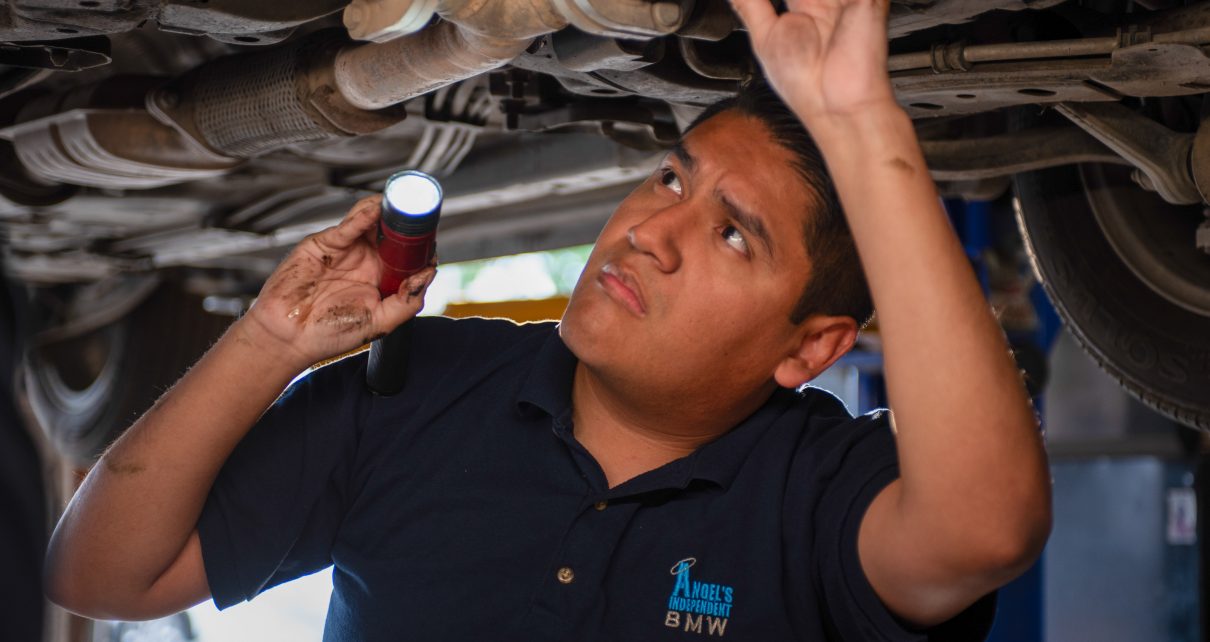
Randy Villegas looking for white supremacy Campaign photo)
Randy Villegas’ Mechanic Branding Masks Radical Academic Record and Socialist Agenda
Mechanic image, Marxist record: The real Randy Villegas
By Megan Barth, July 31, 2026 11:09 am
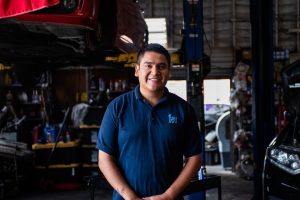
Randy Villegas, the Democratic Socialist who upset the party establishment to become the nominee against Republican Rep. David Valadao in California’s competitive 22nd Congressional District, campaigns as a working-class auto shop owner who understands the struggles of Central Valley families. Campaign images frequently show him under the hood of cars or talking about economic pressures facing ordinary people.
What the campaign does not emphasize is Villegas’ actual published academic record: a body of work that treats university research as an explicit tool of Marxist-style political organizing, rejects neutral fact-finding as an “ethical violation,” and frames the Central Valley through the lens of critical race theory, “white supremacist violence,” and the “prison industrial complex.”
As California Globe previously reported, Villegas advanced past the DCCC-backed moderate Assemblymember Jasmeet Bains in the June top-two primary despite national Democrats spending against him, drawing endorsements from Sen. Bernie Sanders and the California Democratic Socialists of America.
His victory highlighted internal Democratic fractures, with some lawmakers threatening to withhold dues after the DCCC’s initial “faceplant.” The Globe has also documented Villegas’ ties to the same socialist-aligned campaign vendors used by figures like Zohran Mamdani and members of “the Squad.”
In his 2022 UC Santa Cruz doctoral dissertation, “Voices from the Valley of Vulnerability,” Villegas argues that his personal political activism made his research more rigorous.
“It is because of my activism and commitment to the region that I was able to build rapport,” he writes (pp. 34-35). He contends that researchers’ political “biases can actually be assets that help us produce more rigorous, reliable, and relevant research” (p. 35). This is no isolated claim.
In the 2021 peer-reviewed article “Ethical Complexities of Civically Engaged Research,” which he co-authored, Villegas and colleagues insist political scientists must redistribute power through the research process, treat community organizing partners as “equal contributors” in shaping research agendas, and constantly monitor their own “positionality” (p. 734). Research that merely seeks to neutrally display facts is repeatedly labeled an “ethical violation.” The proper goal, they argue, is providing “tangible benefits” and mobilizing people politically; otherwise, scholars are seeking to “control” vulnerable communities (pp. 734-736). That commitment to mobilization, however, appears selective.
In the same dissertation, Villegas describes the Central Valley as a site of “white supremacist violence” rooted in the Ku Klux Klan (p. 87). Other work characterizes the region’s working-class White voters as perpetuating a “White-dominated political structure” and bringing “politics fueled by racism and solidified through [the] Ku Klux Klan.” He invokes the “prison industrial complex” and calls for an “intersectional” framework drawn from Kimberlé Crenshaw and Patricia Hill Collins, foundational theorists of critical race theory.
He positions himself as a “scholar activist” whose role includes lobbying for open-border immigration legislation while conducting research. The dissertation also contains an extended critique of Republicans, including then-House Majority Leader Kevin McCarthy, whom Villegas portrays as right-wing extremists. He links a 2016 hate crime in Bakersfield to “seeing Trump in the White House” (p. 94).
Villegas’ affinity for socialism dates back years. He has fondly recounted being suspended in sixth grade in 2006 for skipping class to join a May Day celebration, and later helping Dolores Huerta organize another May Day event in 2017. That history informed one of his signature professor projects in 2019: the taxpayer-supported “Central Valley Freedom Summer.” Documented in a paper of the same name, the program combined workshops in “ethnic studies, gender studies, and LGBTQ studies” aimed at empowering youth “around their multiple identities” and building “local movements by people of color to change society.”
Students were then indoctrinated and embedded in left-leaning organizations advocating causes ranging from “stolen land” Native advocacy to efforts to remove statues of Gandhi over alleged racism. Alumni of the program have gone on to run youth drag shows in the Central Valley.
His peer-reviewed work frequently references “undocu-queer youth leaders who utilized their multiply marginalized identities to spur intersectional and inclusive mobilization efforts,” opens with scenes of youth shouting “Black Trans Lives Matter,” and relies on frameworks of “intersectionality,” “positionality,” “horizontal political socialization,” and “civically engaged research.” The National Association of Scholars has described the broader “civic engagement” movement in higher education as having turned college-level civics into progressive political training.
These Marxist themes carry into Villegas’ campaign platform.
He calls to “expand healthcare access to all,” which in California means defending and extending Medi-Cal’s full-scope expansion illegal aliens. That expansion took full effect January 1, 2024, and now covers nearly 1.7 million undocumented enrollees. Under current state policy, Medi-Cal covers gender-affirming care, including hormone therapy and surgeries, regardless of immigration status.
Villegas has publicly endorsed The Source LGBT+ Center in Visalia, which in June 2024 received a $600,000 California Department of Public Health grant to serve “LGBTQ+, gender non-conforming, Latinx, and non-English speaking communities” in Tulare, Kings, and Fresno counties—the heart of CA-22.
The Dolores Huerta Foundation, with which he has long been associated and by which he is endorsed, runs an explicit “LGBTQIA+ Equality” program targeting youth in the same district.
As a professor at the College of the Sequoias, Villegas earned $171,141 annually, including a $44,175 benefit package—compensation far removed from the mechanic image his campaign projects. His LinkedIn lists early work as a drum instructor and reporter beginning around 2013.
RNC Spokesman Nick Poche offered a blunt assessment: “Randy Villegas spent over a decade using taxpayer dollars to fund his personal mission to open the border and indoctrinate children into his radical socialist beliefs. Nothing about this guy is real, except that he’s a real nutcase.”
California Globe has previously covered Villegas’ silence amid sexual assault allegations against Maine Senate candidate Graham Platner—another Sanders-backed communist whose campaign shared the same management firm—and the confidential multimillion-dollar sex-abuse settlements approved by the Visalia Unified School District board while Villegas served as a trustee.
Those earlier reports underscored a pattern: a candidate who markets authenticity and accountability while advancing an agenda rooted in radical academic theory and socialist organizing. Voters in CA-22 will decide in November whether the gap between the mechanic branding and the far-left reality of his scholarly record matters.


- Aaron Ford Appeals Dismissal of Nevada Alternate Electors Case After Judge Faults His Office for Withholding Evidence - October 20, 2026
- Foreign Nationals Arrested in California for Illegal Voting and Registration - October 19, 2026
- Randy Villegas Called for Defunding the Police and Abolishing Prisons Years Before the National Movement - October 19, 2026
RELATED ARTICLES
-
 November 21, 2025
 -

-

-