
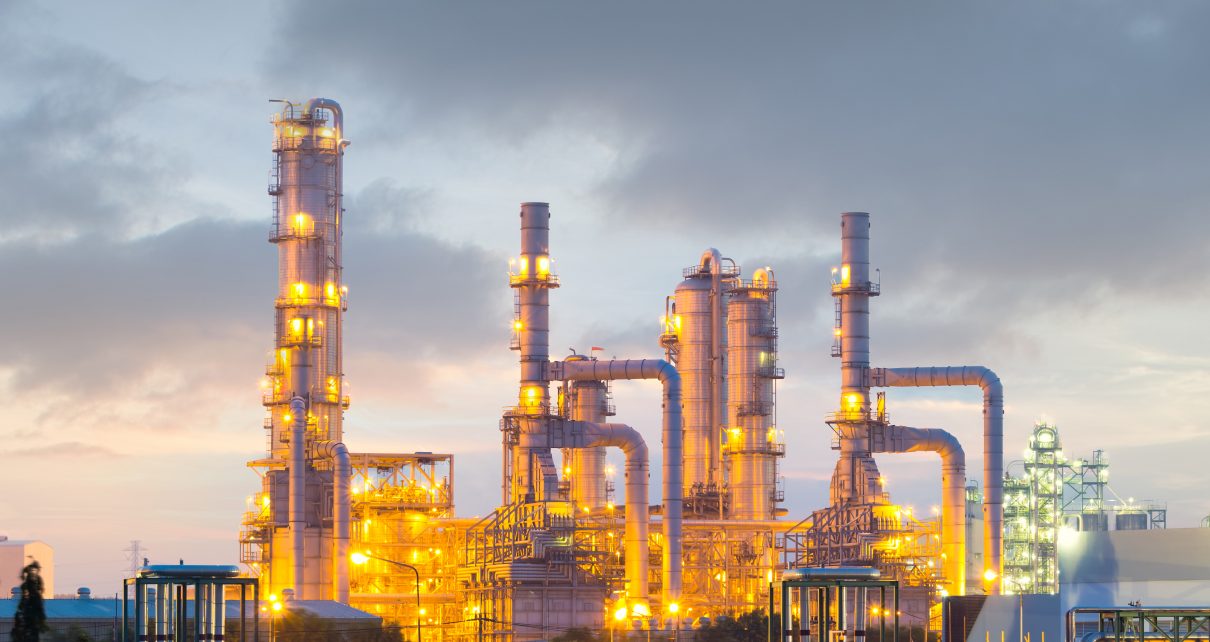
Oil Refinery Plant (Photo: chuyuss/Shutterstock)
Ringside: Can Oil Industry Lawsuits Compel Rational Energy Policy?
Layer upon layer of legislation and regulations have reduced California’s oil industry to a quarter of its former production
By Edward Ring, May 7, 2026 7:00 am
 When asked in a recent interview why California has the highest gasoline prices in the nation, Jodie Muller, the President of the Western States Petroleum Association, began by stating the following:
“You can’t point a finger at one particular person, because, unfortunately, it is decades of policies layered on top of one another. You have local air districts, you have our State of California Air Resources Board, you have legislative action that has taken place, you also have taxes; a lot of regulatory programs that have led us to this point.”
Muller went on to describe in more detail why California went from producing over 400 million barrels of crude oil per year in the 1980s to barely more than 100 million barrels per year in 2025. It wasn’t because of declining reserves, because according to multiple reports, California is sitting on over 30 billion barrels of recoverable crude. It’s also not due to declining demand. California’s appetite for crude oil in 2025 was 484 million barrels, and 77 percent of that had to be imported.
Layer upon layer of legislation and regulations have reduced California’s oil industry to a quarter of its former production. But litigation has also been a factor. In September 2023, California Attorney General Rob Bonta filed a lawsuit against Exxon Mobil, Shell, Chevron, and ConocoPhillips for allegedly “engaging in a decades-long campaign of deception and creating statewide climate change-related harms in California.” As Bonta said, “California taxpayers shouldn’t have to foot the bill for billions of dollars in damages — wildfires wiping out entire communities, toxic smoke clogging our air, deadly heat waves, record-breaking droughts parching our wells.”
There is irony in the fact that despite Bonta’s litigious grandstanding, it is regulatory mismanagement of California’s forests and water supplies that has played a far more decisive role in causing wildfire damage and water scarcity. And it is preposterous to claim oil companies knowingly deceived the public, when even now the consequences of CO2 emissions remain a topic of serious scientific debate. Or, that even if they had believed CO2 emissions were harmful, anyone back then possessed alternative energy technologies that still today are not affordable, scalable, or sustainable.
Litigation, however, can cut both ways. And the oil industry, driven to the brink of elimination in California, has tough choices. They can fight defensively against legislation, never logging more than incremental gains against an unrelenting trend. They can also defend against a barrage of offensive litigation – not only Bonta’s People of the State of California v. ExxonMobil (2023), but City of Oakland v. BP et al, Center for Biological Diversity et al v. Chevron USA Inc. et al, and many others – or they can themselves go on offense. Of these three options, oil companies have turned to offensive litigation as not only a last resort, but one that may hold the highest probability for justice.
The most consequential of the cases filed by oil industry interests are those that challenge Senate Bill 1137, which requires oil wells to be located at least 3,200 feet from any human occupied structure, what they deem to be a “sensitive receptor.” Within these “health protection zones,” no new wells may be drilled, and only minimal work may be done to maintain existing wells. This effectively kills oil production in all but the most remote and uninhabited areas of the state. It is also an exercise in absurdity, since California’s oil wells are strictly regulated and emit negligible quantities of methane and volatile organic compounds, whereas upwelling reserves of underground gas and oil leak naturally to the surface in prodigious quantities thanks to California’s seismically active geology. The only way to stop this leakage is to deplete the reservoirs with drilling and extraction.
Four active lawsuits challenge SB 1137. They are NOPEC v. California, Monte Beard Sr. et al. v. State of California, Morgan v. Ito, and United States v. California. These lawsuits seek to overturn SB 1137 on various grounds. They challenge the claim that methane and VOCs cause health harm, especially at a distance of 3,200 feet. They assert the economic harm caused by prohibiting wells within the setback radius is an unconstitutional taking without compensation. And the U.S. lawsuit seeks to invalidate SB 1137 because it is preempted by federal law and, where applicable, is an unconstitutional interference with leases of federal land.
In another set of lawsuits the oil industry is challenging the ongoing state ban on well stimulation, or fracking. The ban is enforced despite the fact that California’s geology often requires fracking to extract oil and is structured so the underground impacts of fracking are tightly contained in close proximity to the well. These lawsuits include Chevron U.S.A. Inc. v. Governor Gavin Newsom, TRC Cypress Group v. DOC and CalGEM, and others.
Also consequential are the lawsuits attempting to reverse the City of Los Angeles’s new Oil and Gas Drilling Ordinance that prohibits new oil and gas extraction and makes existing activities a “nonconforming use” in all zones. Los Angeles County, with an estimated 5 billion barrels of recoverable crude still underground, has the highest density of oil per square mile in the world. And as previously noted, the only way to prevent natural seeps of methane and VOCs is to drill for that oil and deplete those reservoirs. In what ought to be a public service in the interests of improving air quality in the Los Angeles Basin, the following lawsuits are active: Warren E&P Inc, et al v. City of Los Angeles, and Termo Company, Matrix Oil, NOPEC v. LA County.
There’s much more active litigation, both for and against California’s oil industry, but these are some of the most significant cases. It may be in the courtroom, instead of the legislature, where the possibility of California returning to a rational energy policy may find its greatest potential.


- Ringside: Can Oil Industry Lawsuits Compel Rational Energy Policy? - May 7, 2026
- Ringside: California’s Self-Destructive War on Oil - April 29, 2026
- Ringside: The Abundance Alliance - April 23, 2026
RELATED ARTICLES
-
-
 February 5, 2026
 -
October 1, 2025
The contempt toward oil dewels in the minds of the manipulated minions whose paramount goal is to ensure the system and taxpayers fund their folly.
Those who contribute to their local public television station should stop now.
The PBS station in LA (KCET) continually airs promos for a series they promote that attacks oil harvesting and paints same as the most damaging issue affecting one’s health, never mind the junk food addiction.
Nothing replaces oil in terms of safe power yeild: Oil is the lifeblood of our existence.