

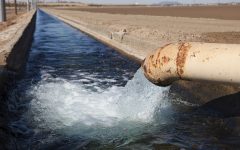
San Luis Reservoir water, 4/27/2026. (Photo: Katy Grimes for California Globe)
Ringside: Fine Tuning the Environmentalist’s ‘Water Renaissance’ Plan for California
There is no reason why California’s coastal megacities should have to import water
By Edward Ring, May 27, 2026 2:11 pm
 The recently released “Water Renaissance” plan, a product of “conservation groups and tribes,” gets a very big idea right. There is no reason why California’s coastal megacities should have to import water. With that one visionary presumption, this report has made a major contribution. In fact, it doesn’t go far enough. With massive, targeted investments, California’s coastal cities might even be positioned to export water. Push the annual surplus east. Dump it in the Salton Sea.
Beyond the big idea, however, this “new vision for a sustainable water future” scores hits and misses. One big hit is their claim that California’s coastal cities could produce up to 800,000 acre feet per year through wastewater recycling, and another 600,000 acre feet per year through stormwater harvesting.
Those numbers may actually be on the low side. In 2022 the Pacific Institute in a similar analysis concluded that “the reuse potential of municipal wastewater is 1.8 million to 2.1 million AFY, and the stormwater capture potential is 580,000 AFY in a dry year to as much as 3.0 million AFY in a wet year.” Even if their conservative estimate for stormwater capture is used, the Pacific Institute’s numbers suggest achieving an additional 3 million acre feet per year is a reasonable objective through urban wastewater recycling and runoff harvesting.
Where the Water Renaissance vision misses the mark is when they claim “conservation and efficiency” will “yield” 500,000 acre feet per year, at an estimated cost of $1 billion. It is misleading to conflate reductions in water use with an increase in water supply. And it is unrealistic, if not outright misanthropic, to suppose Californians are going to accept recent “conservation as a way of life” legislation that is on track to restrict indoor water use to 42 gallons per day.
Never acknowledged in calls to use less is that Californians have already done a fine job of conserving water. Urban water use peaked in 2004 at nearly 10 million acre feet per year, with most recent data putting that total under 8 million acre feet per year despite the state’s population (94 percent urban) over the past 22 years growing by 3.8 million.
If people want to have water-guzzling trees, shrubs, and lawns, just regulate pesticide and herbicide use, and get out of the way. They’ll become percolating, purifying assets, they’ll cool the air, and they’ll even look nice. As for indoor water use, if it’s all recycled, it can’t be wasted. As it is, water rationing has already been so successful that many urban water districts have to inject water into their sewer system merely to maintain flow.
Another big miss regards the cost to implement strict rationing. Millions of dual-meters and ongoing enforcement will not be cheap. An independent 2023 study estimated the cost to “supply” 400,000 acre feet of water through additional rationing at $7.4 billion. Hardly a bargain.
Which brings us to the most glaring omission of all, which is the potential for large scale desalination to decisively transform California’s coastal cities from water importers to water exporters. Redirecting $7.4 billion would pay for seawater desalination plants with a capacity approaching 400,000 acre feet of freshwater per year. And it would be perpetually deliverable, impervious to drought.
Critics of desalination point to its cost, ignoring that building wastewater recycling plants to modern standards costs virtually the same amount per acre foot of output as desalination plants. We should do both. And in both cases, it is possible that water agencies in Phoenix or Las Vegas will be happy to help pay construction costs in exchange for water from the Colorado River that currently flows to California cities.
The energy necessary to desalinate is consistently overstated. The operating cost for electricity to desalinate, even at California’s ridiculously high retail price of $.30 per kilowatt-hour, is still only around $1,000 per acre foot. Compare this to the wholesale cost of treated water from the Metropolitan Water District of Southern California, already $1,500 per acre foot, and projected to nearly double within the next ten years.
Moreover, the day of cheap and abundant electricity is not far away. SMRs and enhanced geothermal are going to change the electricity game forever. And, hardly an afterthought, note that robotics is going to significantly lower the cost of major infrastructure projects. Nearly 40 million acre feet of freshwater per year is now produced worldwide via desalination. Discharging the brine and managing the intakes are manageable challenges. California should do it right, and lead the way.
Finally, another big miss in the Water Renaissance recommendations is one of its underlying themes, which is that the more water we allow to flow unimpaired through our rivers and the delta, the better the chances that threatened and endangered species will recover. While more water and habitat restoration will probably help more than it hurts, it’s not enough. For example, we need to dredge 50 years’ worth of accumulated silt out of the delta. Stagnant, shallow channels are major reasons why water temperatures have increased, subsurface vegetation has gotten out of control, salmon have struggled, and existing flows have been less effective in limiting salt intrusion.
But for the most part, the problems with the Water Renaissance are errors of omission, not of commission. Think even bigger, and acknowledge the environmental upside of projects that ought to be less controversial, dredging and desalination in particular. Demand priority funding to remove nitrogen from over 400,000 acre feet of effluent discharged into the San Francisco Bay each year, and then agree on a suitable maximum flow through the delta in wet years. Examine creative new ways to safely divert water from the delta that is in excess of that maximum, such as fish friendly diversion channels.
We have the means to make water in California truly abundant. If so, refilling Mono Lake would only be the beginning. We could also blow up the O’Shaughnessy Dam, and give life back to Yosemite’s inundated twin, the Hetch Hetchy Valley. With enough surplus, we might even restore the Salton Sea. Yes, California has massively engineered its water from “wetter parts of the state to drier parts,” but we cannot turn back. We have the wealth and ingenuity to go further, leveraging everything we’ve learned since the first great projects broke ground. When it comes to water in California, we can create sustainable abundance, even excess, and that is the vision that should inspire us.


- Ringside: Induced Demand is a Prerequisite for Abundance - October 14, 2026
- Ringside: Observations as a New Water Year Begins - October 8, 2026
- Ringside – Geothermal Energy: A Huge Wildcard - October 1, 2026
RELATED ARTICLES
-
 January 16, 2023
 -
-
 August 8, 2022
NO DAMS BUILT SHOULD NCE 1984
So much more RAIN
STOP SENDING IT TO OCEAN
DESALT THE OCEAN GALLONS IF WATER
FOR PLANS FARMS