
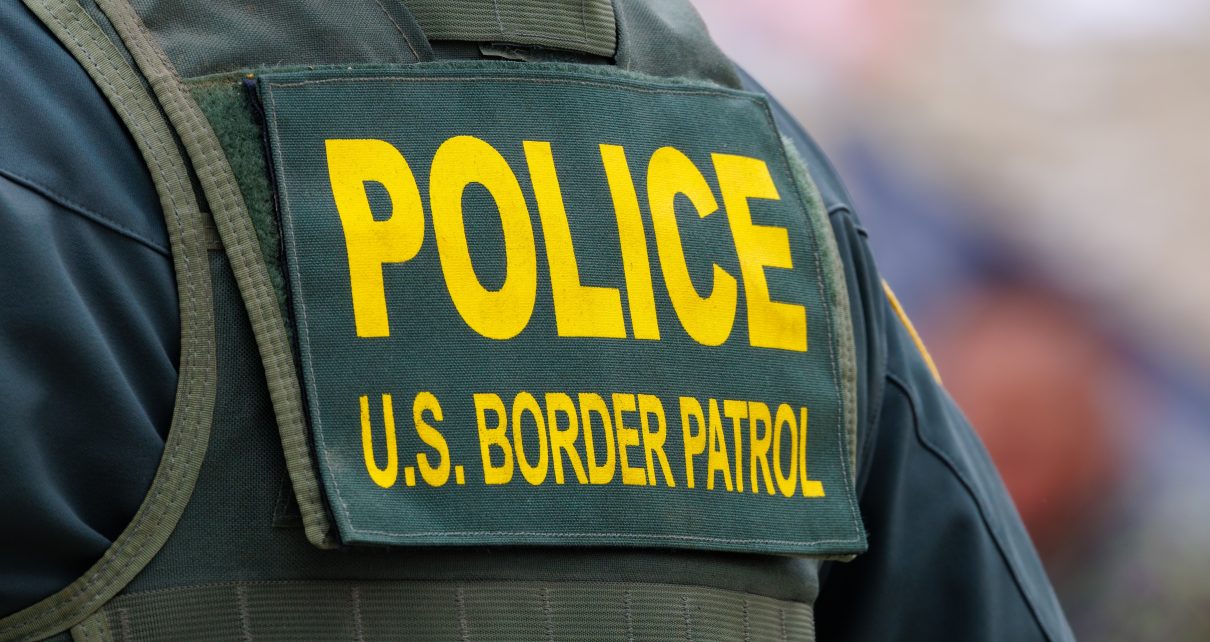
Close up of Border Patrol at the San Diego and Mexico international border wall, May 12, 2023. (Photo: Aaron J. Hill/Shutterstock)
Sanctuary Officials Should Face Personal Liability for the Crimes They Enable
Seven of the 10 safest U.S. cities cooperate fully with federal immigration enforcement; sanctuary policies correlate with higher recidivism among criminal aliens
By Jay Rogers, March 27, 2026 3:17 pm
In 2025, local officials across the United States refused to honor 17,864 ICE detainer requests – a figure entered into the congressional record during House Judiciary Committee testimony on March 4, 2026. Each declined detainer represents an individual already flagged by federal authorities with criminal convictions or pending charges. Among those released: 31 suspected homicide offenders in California alone, according to a February 5, 2026 Department of Homeland Security report. The constitutional question is not whether these officials acted in bad faith. The question is why they bear no legal consequences when Americans die as a result.
To be precise about what a detainer means: ICE had already identified these individuals as unlawfully present and flagged them with criminal convictions or pending charges. Sanctuary officials were not protecting dreamers who overstayed student visas. They were releasing convicted murderers, rapists, child predators, and gang members – knowingly, and without legal consequence.
That is not compassion. That is complicity.
The constitutional framework here is not ambiguous. Federal supremacy over immigration enforcement was reaffirmed in Arizona v. United States (2012). When a local official adopts a sanctuary policy that conflicts with federal immigration law, he is not exercising principled federalism. He is nullifying federal statute, and doing so with taxpayer dollars. The Framers were not ambiguous about which government controls the nation’s borders, and no amount of local sanctimony changes that.
The accountability gap is real and measurable. Laken Riley. Kate Steinle. An endless roster of American families burying children whose deaths were preventable. According to the Department of Homeland Security, seven of the ten safest U.S. cities cooperate fully with federal immigration enforcement, while sanctuary policies correlate with higher recidivism among criminal aliens. The data are not ambiguous. The choices are.
In November 2025, I wrote and submitted the Safe Streets and Sovereign Borders Act to members of Congress. The March 4 House Judiciary hearing provides the ideal moment to advance it. The Act closes this accountability gap not through rhetoric but through three legally calibrated mechanisms tied directly to the constitutional authorities that sanctuary jurisdictions have been flouting.
First, it revokes qualified immunity for any official who knowingly enforces a sanctuary policy that subsequently enables a covered crime – murder, rape, human trafficking, DUI homicide, or gang violence. The days of hiding behind ‘local policy’ as a complete civil defense are over. If your deliberate choice foreseeably released the offender, you answer in civil court.
Second, it establishes criminal accomplice liability under 18 U.S.C. §2. Knowledge of the risk is inferred the moment a jurisdiction ignores the Attorney General’s formal notice of non-compliance. Where a covered crime results in death or serious bodily injury, the responsible official faces an additional ten years of federal exposure.
Third, it conditions Byrne Justice Assistance Grants and federal highway funding on certified compliance with detainer requests. The Spending Clause of the Constitution provides Congress with precisely this authority. Jurisdictions that choose sanctuary choose it without American taxpayer subsidy.
Critics will call this draconian. They will invoke due process, cite immigrant communities, and reach for every rhetorical fire extinguisher available to avoid the central question: if a public official knowingly releases a convicted violent criminal who then kills an American citizen, why does that official bear none of the legal consequences the rest of us would face for the same foreseeable harm? There is no satisfying answer to that question, which is precisely why the opposition will not attempt one.
The families of Laken Riley and Kate Steinle did not have the option of hiding behind a policy memo when tragedy arrived. Neither should the officials whose deliberate choices made those tragedies possible. The Safe Streets and Sovereign Borders Act does not ask sanctuary officials to abandon their principles. It simply asks them to assume, for the first time, the legal consequences of exercising them.
Pass it. Enforce it. Make it personal – because for the families burying their children, it already is.


- Newsom’s Green Dreams Meet Reality - April 20, 2026
- The Inconvenient Truth About Fraud in Los Angeles - April 8, 2026
- DEFUND THE CHAOS: Congress Finally Pulls the Pin on Sanctuary City Funding - April 6, 2026

I don’t understand why no one seems to care that merely using the legal teeth in US Code Title 8 Section1325 is enough to send a massive horde of sanctuary entity politicians, bureaucrats, NGO directors/employees/volunteers and other aiding and abetting dirtbags to prison for a long, long time. A whole lot of big talk around the issue and no do.
If state and local officials have adopted sanctuary policies that conflict with federal immigration law, then they’re nullifying federal statute, in violation of the Constitution, and doing so with taxpayer dollars. When will the DOJ go after these officials and prosecute them? Where is Pam Bondi?
That would be “rayciss”, TJ….
@TJ and CriticalDefense9, It might be that at this time the nests of rats and snakes are so numerous with only so many resources it would take indiscriminate scorched earth rather than reasoned case by case enforcement.