
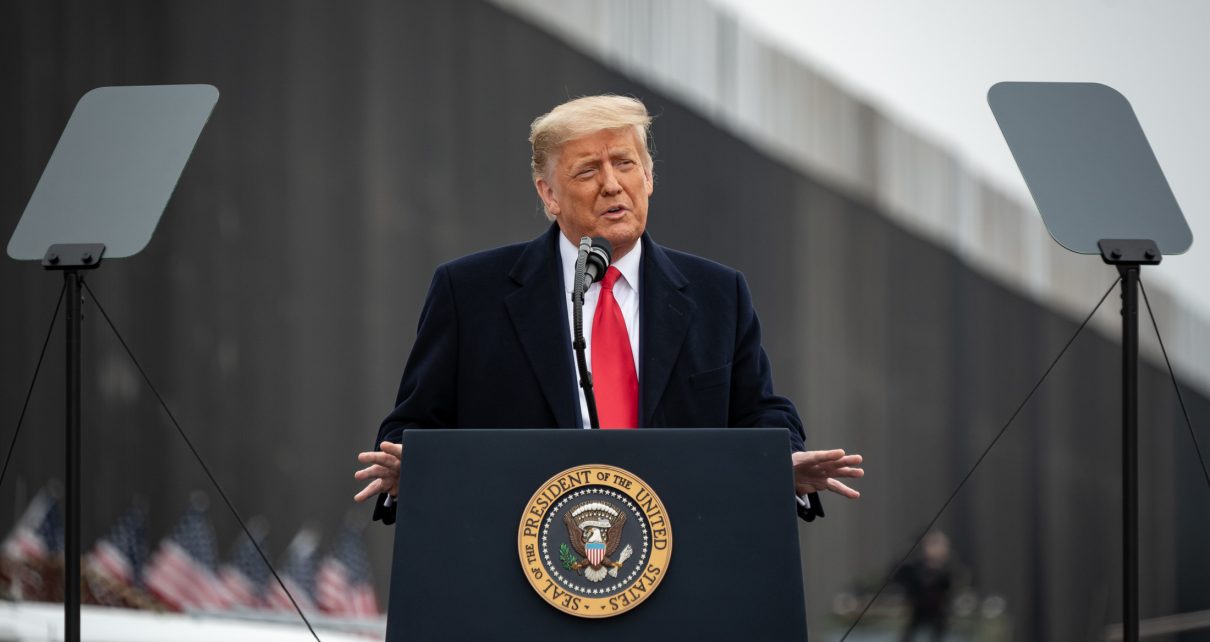
President Donald J. Trump concludes his remarks at the 450th mile of the new border wall Tuesday, Jan. 12, 2021, near the Texas-Mexico border. (Official White House Photo by Shealah Craighead)
Federal Judge Denies Tohono O’odham Bid To Halt 62-Mile Arizona Border Wall
Court finds federal Roosevelt Reservation likely exists along international boundary; tribe says it is considering further legal action
By Matthew Holloway, August 18, 2026 12:41 pm
A federal judge has denied the Tohono O’odham Nation’s request to temporarily block construction of a planned 62-mile border wall along its southern Arizona reservation, finding the Nation has not shown it is likely to prevail on claims that the project would unlawfully diminish its reservation or constitute federal trespass, according to the court’s memorandum opinion.
U.S. District Judge Richard J. Leon of the District of Columbia denied the Nation’s motion for a preliminary injunction in an 18-page memorandum opinion filed Friday. The ruling allows the Trump administration to continue preparations for the Tucson 5 Wall Project while the Nation’s underlying lawsuit remains pending.
The decision follows an escalating dispute previously reported by California Globe in which the Nation posted “No Trespassing” signs and placed tribal law enforcement on alert to turn away federal contractors attempting to enter reservation lands without authorization for border wall work.
The Nation sued the Department of Homeland Security and senior border officials June 16 and sought a preliminary injunction the following day, according to Leon’s recitation of the case history. Customs and Border Protection awarded SLSCO LTD a contract June 26 to construct approximately 62 miles of primary border wall system under the Tucson 5 Wall Project, according to CBP’s Smart Wall project information.
According to the federal government’s representations cited by the court, design work remains underway and CBP does not anticipate physical construction beginning before Oct. 12.
At the center of the dispute is the legal status of a roughly 60-foot strip running along the international boundary known as the Roosevelt Reservation. Leon’s opinion traces the strip to President Theodore Roosevelt’s 1907 proclamation reserving public lands within 60 feet of the Mexican boundary for federal purposes.
The modern Tohono O’odham Reservation was created by executive order a decade later. The Nation has argued that its aboriginal title predates Roosevelt’s proclamation and that the land therefore was not public land available for inclusion in the federal reservation, an argument detailed in both the court’s opinion and the Nation’s June announcement of its lawsuit.
Leon concluded that the historical record weighs against that argument at this stage of the litigation.
“The Roosevelt Reservation likely exists along the international border,” Leon wrote in the opinion, pointing to a 1934 Interior Department opinion, a 1937 act of Congress and a 2004 tribal resolution acknowledging the 60-foot federal strip.
Congress’ 1937 legislation modifying the Nation’s reservation boundaries expressly stated that the change would not affect the 60-foot strip created by Roosevelt’s 1907 proclamation. Leon also cited a 2004 Tohono O’odham Legislative Council resolution approving a vehicle barrier and patrol road that described the work as occurring within the Roosevelt Reservation. Those records and Leon’s analysis are reproduced in the court’s ruling.
As California Globe previously reported, the Nation’s Legislative Council moved earlier this year to reject that interpretation and retroactively removed references acknowledging the Roosevelt Reservation from several previous tribal resolutions.
Leon also found that even if the Nation ultimately proves the Roosevelt Reservation does not extend through the area, it has not shown that constructing a border wall along the existing international boundary would legally diminish the Tohono O’odham Reservation. The judge noted that Congress alone has authority to diminish an Indian reservation and said he was unaware of precedent establishing that border infrastructure interfering with a tribe’s use or occupancy necessarily changes reservation boundaries.
The Nation’s separate trespass claim also failed to support preliminary relief. Leon concluded that the federal government’s sovereign immunity likely bars the claim because the Nation had not identified a statute waiving that immunity. He also found uncertainty over whether federal common law permits an Indian tribe to obtain an injunction against the United States based on trespass under the circumstances presented in the case.
The government has represented that contractors have been instructed to confine the project footprint to the 60-foot Roosevelt Reservation. Leon wrote that “significant uncertainties remain” over the precise scope of construction and the extent to which activities may interfere with tribal land outside that corridor.
The judge additionally rejected the Nation’s argument that the threat of cultural, environmental and religious harm justified an immediate injunction. The Nation has warned that construction could damage sacred sites, culturally significant locations and traditional practices, concerns it outlined in its August court-case update.
Leon acknowledged the claimed harms but found the Nation had not made the showing required for preliminary relief and ultimately concluded that the government’s border-security interests outweighed the potential harms demonstrated at this stage.
“The Government’s interests in securing the border, enforcing immigration laws, and ensuring public safety outweigh any surviving irreparable harms at this juncture,” Leon wrote in the opinion.
The judge nevertheless made clear that he expects DHS and CBP to work with the Nation as the project proceeds. Leon wrote that the international boundary holds great importance to both the federal government and the Tohono O’odham and “I fully expect the Government in the months ahead to follow through on its guarantees of consultation and cooperation with the Nation.”
Tohono O’odham Chairman Verlon Jose told the Associated Press that tribal leaders strongly disagree with the decision and are considering additional legal options.
“Too many critical issues were not adequately addressed,” Jose said, citing impacts to tribal land and the permanent destruction of sacred sites. He said the Nation would consider “all possible options for moving forward.”
The Nation has repeatedly maintained that it supports border security while opposing a permanent pedestrian wall across its lands. In its June press release announcing the lawsuit, tribal officials cited decades of cooperation with federal agencies, including vehicle barriers, patrol roads, surveillance towers and two Border Patrol operating bases.
The latest ruling does not resolve the Nation’s lawsuit on the merits. It denies the request for preliminary relief while the legal fight over federal authority, tribal sovereignty, and the Roosevelt Reservation continues.


- Federal Audit Reveals Backlog, Unmanageable Workloads in Missing Indigenous Persons Unit - October 17, 2026
- ‘No Kings’ Organizers Turn To Early Voting In Latest Bid For Arizona Mobilization - October 15, 2026
- Hobbs Campaign Attack On Biggs’ Sex-Offender Vote Omits His Objection To Licensing Exceptions - October 13, 2026
RELATED ARTICLES
-

-
 October 19, 2018
 -

One thought on “Federal Judge Denies Tohono O’odham Bid To Halt 62-Mile Arizona Border Wall”