
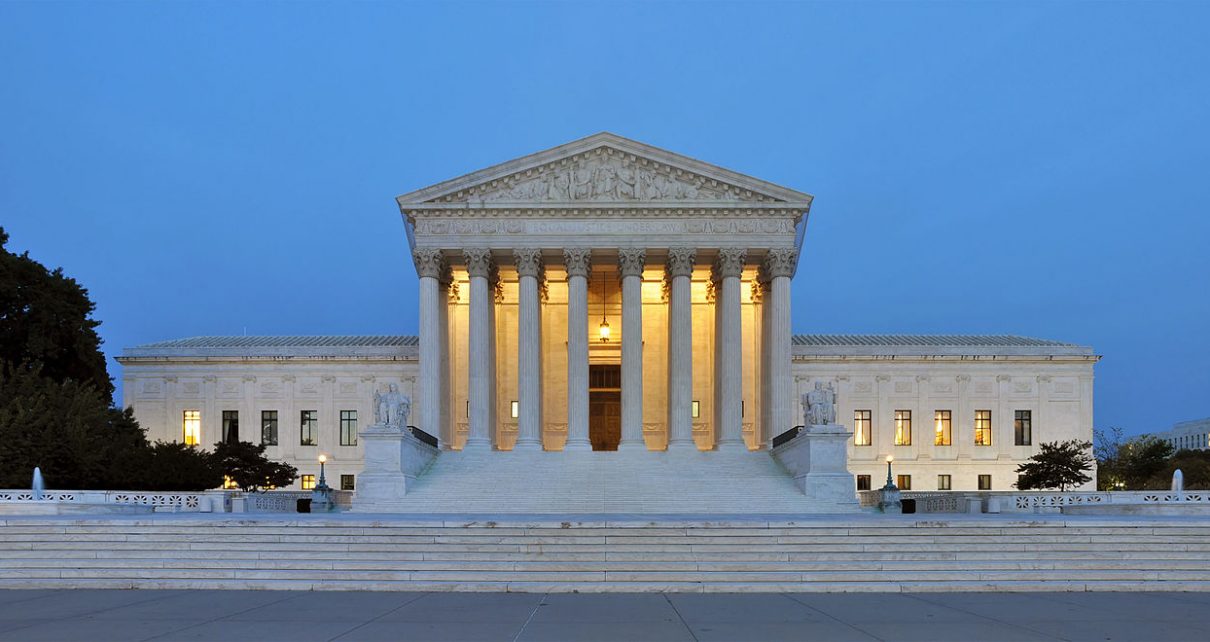
Supreme Court of the United States. (Photo: U.S. Supreme Court)
SCOTUS Unanimously Upholds Deference to Immigration Agencies in Asylum Denials
The ruling makes it significantly harder for activist judges to overturn denials and prolong deportations
By Megan Barth, March 6, 2026 7:55 am
In a unanimous 9-0 decision (see below) delivered by Justice Ketanji Brown Jackson, the Supreme Court ruled on Wednesday, that federal appeals courts must apply a deferential “substantial-evidence” standard when reviewing immigration agency determinations of whether undisputed facts constitute “persecution” under the Immigration and Nationality Act (INA). This ruling in Urias-Orellana et al. v. Bondi, Attorney General affirms the authority of immigration judges (IJs) and the Board of Immigration Appeals (BIA) in asylum cases, making it significantly harder for activist judges to overturn denials and prolong deportations.
The case centered on petitioners Douglas Humberto Urias-Orellana, his wife Sayra Iliana Gamez-Mejia, and their minor child, all natives of El Salvador who entered the United States illegally in 2021. Urias-Orellana claimed he was targeted by a hitman who had killed two of his half-brothers and threatened his family with extortion and violence. Despite finding his testimony credible, the IJ determined that the threats did not rise to the level of “persecution” under INA standards, as they did not cause “significant actual suffering or harm.” The BIA affirmed this, and the First Circuit Court of Appeals upheld the decision under the substantial-evidence standard, which deems agency findings conclusive unless a reasonable adjudicator would be compelled to conclude otherwise.
The petitioners argued for de novo review—essentially allowing courts to reexamine the facts from scratch—contending that the persecution determination is a mixed question of law and fact not fully covered by the INA’s deferential language. The Court rejected this, relying on precedent from INS v. Elias-Zacarias (1992) and the 1996 Illegal Immigration Reform and Immigrant Responsibility Act (IIRIRA), which codified the substantial-evidence standard to limit judicial overreach. As Justice Jackson wrote for the Court: “The INA requires application of the substantial-evidence standard,” ensuring that immigration agencies’ expertise in these fact-intensive matters is respected.
This decision is a resounding victory for border security and the rule of law, particularly under the Trump administration’s renewed focus on enforcement and deportations. By curbing the ability of liberal-leaning appeals courts to second-guess agency decisions, it streamlines deportations and closes loopholes that have allowed millions of illegal immigrants to game the system during the Biden-Harris era. U.S. Attorney General Pam Bondi, the respondent in the case, has been a fierce advocate for federal supremacy in immigration matters, and this ruling bolsters her efforts to crack down on sanctuary jurisdictions.
In California, where sanctuary policies have long clashed with federal law, this SCOTUS decision has profound implications. As the California Globe has extensively reported, Governor Gavin Newsom and Attorney General Rob Bonta have repeatedly defied federal immigration enforcement, prompting warnings and legal actions from the Department of Justice. Just last year, AG Bondi directly warned Newsom and Bonta against violating federal immigration laws by prioritizing illegal aliens over American citizens, stating, “If you are a state not complying with federal law, you’re next. Get ready.” This followed the DOJ’s lawsuit against California to protect federal immigration officers from state interference as detailed here.
The ruling also aligns with recent federal court victories against California’s obstructive laws. In February, the Ninth Circuit blocked the state’s entire “No Secret Police Act,” a major win for the Trump DOJ that prevented California from hindering ICE operations. Similarly, federal actions have targeted sanctuary policies more broadly, with California’s indefensible stance inviting multiple DOJ lawsuits. And in a stark reminder of the stakes, Huntington Beach’s challenge to California’s sanctuary law, though ultimately unsuccessful, underscored the growing frustration among local communities with state-mandated protection of illegal immigrants.
With this SCOTUS decision, such state-level resistance faces even steeper hurdles, as federal agencies gain stronger backing to deny frivolous asylum claims and expedite removals.
The unanimous nature of the ruling—crossing ideological lines—signals a broader consensus on the need for deference to expert immigration adjudicators. It also complements initiatives like DHS’s new webpage featuring the “worst of the worst” criminal aliens arrested by ICE, aimed at transparency and deterrence. As House Republicans push reconciliation bills to ban illegal aliens from welfare benefits, this decision fortifies the administration’s comprehensive approach to restoring order at the border.
For Californians burdened by the costs of unchecked illegal immigration—from insolvent public services to heightened crime—this SCOTUS win offers hope that federal enforcement will finally prevail over Democrat’s progressive obstructionism.


- Former Biden Official and Reno Mayoral Candidate Kate Marshall Hit with Dual Complaints Over Campaign Finance and Hatch Act Violations - May 6, 2026
- Department of Education Launches Title IX Investigation Into LAUSD for Union Deal That Shields Alleged Sexual Predators From Termination - May 6, 2026
- DCCC Drops Thumb on Scale in Heavily Latino CA-22 Primary, Sparking Open War Among Democrats - May 5, 2026
RELATED ARTICLES
-
-
 November 1, 2018
 -
 January 31, 2024
Strike 2 for Communists Newsom and Bonta.