
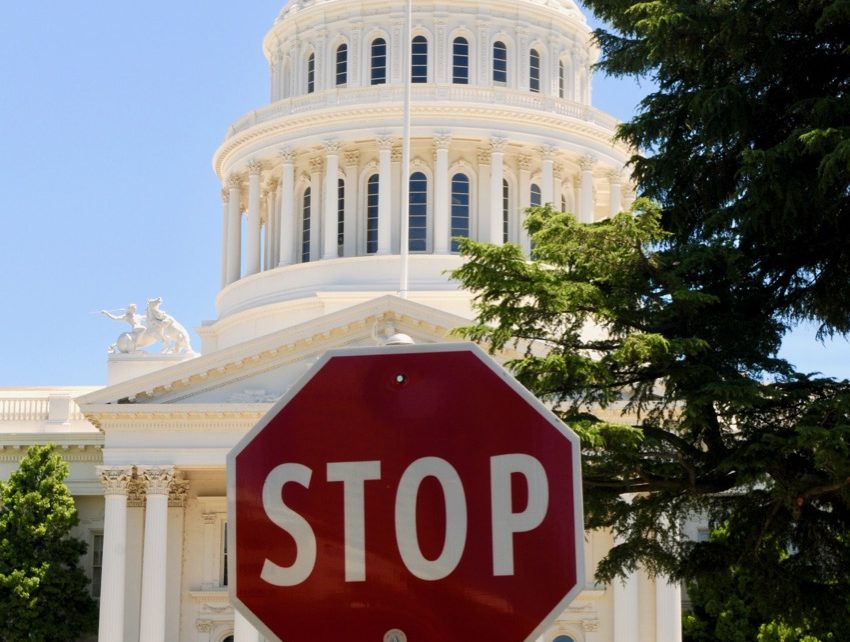
California State Capitol. (Photo: Kevin Sanders for California Globe)
Unions & California State Workers Fighting Return to In-Office Work 4 Days Per Week
This would be a good time for state government to consider moving certain state agencies out of downtown
By Katy Grimes, May 18, 2026 12:48 pm
We are six years after Governor Gavin Newsom’s original Covid lockdown order, sending nearly the entire state workforce of “non-essential” workers packing in 2020. Last March 2025, Gov. Newsom issued a “get back to the office” order… but not until July 1, 2025, and only 4 days a week.
That didn’t go over so well with state workers and their labor unions. CalHR last year negotiated agreements with the state worker labor unions to delay the return-to-the-office until July 1, 2026.
Remember, Newsom’s original Covid lockdown order also locked down private sector businesses, K-12 schools, and colleges and universities, most of which were already back at work and school by the time he lifted his original lockdown order February 28, 2023 – three years later.
It’s May 2026, and California state workers are still working from home in flannel jammies and slippers… some of who are very clearly still “non-essential.”
For what it is worth, the news never takes a day off, and I am assuming government services don’t either. Could there be so much redundancy in state government that Fridays off won’t matter?
Newsom’s executive order requires “all agencies and departments within his Administration to update their hybrid telework policies to a default of at least four days per week by July 1, 2025. The order establishes a four-day-per-week in-office expectation, with further telework flexibilities granted on a case-by-case basis in light of individual circumstances, consistent with the executive order and existing family-friendly employment policies and legal obligations.”
“To further enhance the state’s workforce needs, the Governor is also directing CalHR to streamline the hiring process for former federal employees seeking employment in key roles, including firefighting, forest management, and weather forecasting.”
However, and once again, the tail is wagging the dog in California. SEIU is pushing back hard.
SEIU Local 1000, representing nearly 100,000 state employees, is fighting back through legal, legislative, and organizing efforts.
- SEIU filed Unfair Labor Practice charges with the Public Employment Relations Board, alleging the state failed to bargain in good faith over mandatory subjects like work location, schedules, and telework impacts. They claim unilateral imposition interferes with union representation. A May 12, 2026, charge followed the latest memo.
- SEIU is Pushing Assembly Bill 1729, a bill to protect telework options for state workers, along with other unions.
- Bargaining demands in 2026 contract talks for stronger telework: up to 100% full-time remote where feasible (state must prove otherwise), free parking, commuter stipends ($25/day), high-crime site stipends, clean workspaces, and downtown investment stipend
Caltrans reports it has 22,396 employees, plus thousands of intermittent employees.
Statewide, California has nearly 17,000 active intermittent employees across all agencies, as of April 2026 payroll data.
As of the April 2026 pay period, there are 227,357 active full-time California state employees, according to the State Controller.
The Globe has learned that Caltrans gave up a significant amount of office space, as well as entire buildings during the Covid government shutdown, and there is nowhere for thousands of the workers to go.
Many state workers are frustrated about having to commute downtown again, and pay exorbitant parking rates – if they can find parking.
Yet the governor appears adamant that his order restore full time state workers back in the office.
This would be a good time for state government to consider moving certain state agencies out of downtown, like Caltrans, which really have no need to have such a large physical presence near the Capitol. Natomas, Elk Grove and Rancho Cordova have plenty of room to build, or for agencies to take over vacant office buildings.
Additionally, there are some departments within state agencies which do not need to be physically present all 5 days a week.
Why the governor’s office did not spend the year planning and orchestrating the return, and/or start planning with agencies for moving out of downtown, is anyone’s best guess.
During the 2024 election, Donald Trump pledged to relocate roughly 100,000 federal positions out of the Washington, D.C. area, including Northern Virginia and Maryland, to “places filled with patriots who love America,” continuing efforts from his first term like moving parts of the Bureau of Land Management to Colorado.
In February 2025, President Trump directed agencies to submit plans by mid-April 2025 for reorganizations, reductions in force, and relocations of bureaus/offices to lower-cost areas outside the National Capital Region, with the goal of downsizing the federal real estate footprint, significantly cut costs, reduce bureaucracy concentration, and make agencies more responsive to stakeholders nationwide. This ties into broader efficiency initiatives, workforce optimization, and selling/repurposing federal buildings, the Federal News Network reported last year.
With the SEIU driving this bus, it will be interesting to see what actually happens July 1st.


A California native and Navy mom, Katy lives in Sacramento, CA.
- American Academy of Pediatrics Doubles Down on Infant/Child Covid Vaccine - October 10, 2026
- Sacramento’s Own Radical Congressional Candidate has Upcoming Event Hasan Piker - October 9, 2026
- What? Sacramento Ranks in Top 10 Asthma Locations in the US? - October 8, 2026
RELATED ARTICLES
-

-
 November 13, 2024
 -

They can get right-to-the-point: “They Don’t Want To WorK !!!”
These democrat dependents can’t even justify their “jobs”, so they can’t “return” to a place that they’ve never been (work).