
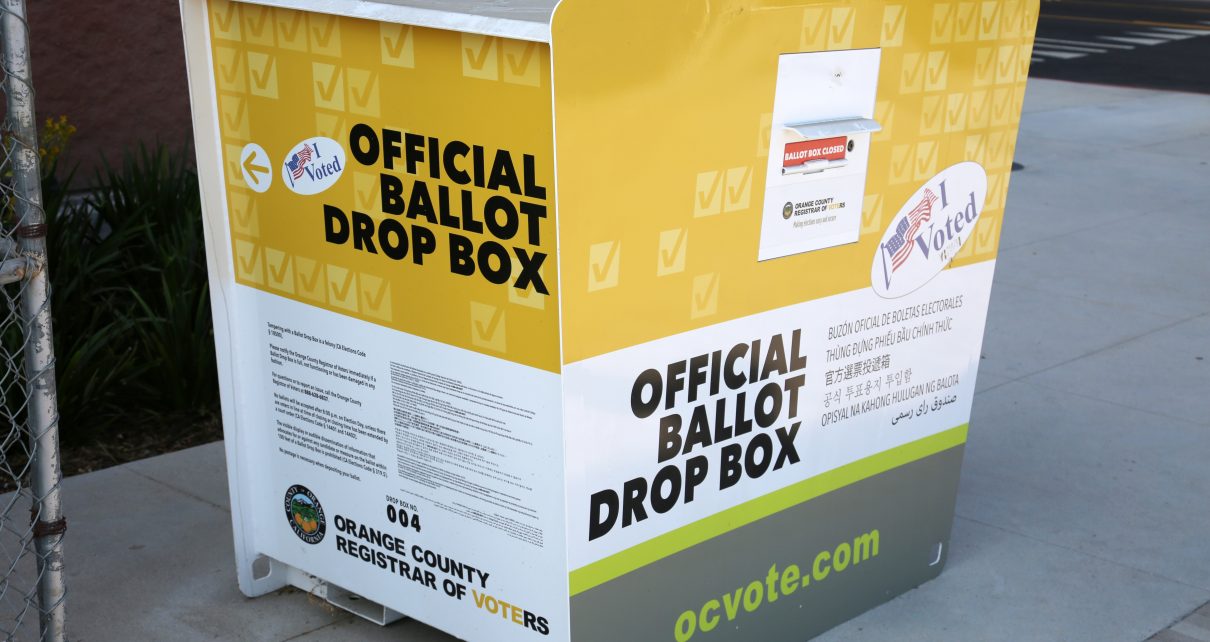
Official Ballot Drop Box placed ready to accept Voting Ballots for the upcoming election. Santa Ana, CA, Sept. 23, 2020. (Photo: mikeledray/Shutterstock)
What Do the State’s November Ballot Measures Propose to Do?
There will be 14 ballot initiatives on the November 3 statewide ballot
By Chris Micheli, July 18, 2026 2:00 pm
By Chris Micheli and Vincent Micheli
California voters will have to decide the fate of 14 measures on the November 3 statewide ballot. Nine of them were placed on the ballot by voters, while five were placed on the ballot by the Legislature. What do these fourteen measures do?
Below is a brief description and the proposition numbers that have been assigned to the ballot measures by the Legislature (Props. 1– 5) and the Secretary of State (Props. 37 – 45) that are on the November 3, 2026, General Election.
Prop 1 The Veterans and Affordable Housing Bond Act of 2026
The Veterans and Affordable Housing Bond Act of 2026 (Senate Bill 417) is an $11.25 billion bond measure on the November 3, 2026 California general election ballot. It features $10 billion in general obligation bonds for affordable housing (these GO bonds rely on taxpayer dollars to pay back debt with interest) and $1.25 billion in revenue bonds for veteran home loans (these are self-supporting revenue bonds repaid exclusively through mortgage payments rather than the state’s general fund.). This measure was placed on the ballot by the Legislature.
Prop 2 Save for California’s Future Act
The Save for California’s Future Act aims to strengthen the state’s fiscal stability by increasing the constitutional cap on the state’s “rainy day” fund (the Budget Stabilization Account) from 10% to 20%. It mandates greater set-asides for state savings accounts during high-revenue years (especially during capital gains tax surges); excludes deposits into the Rainy Day Fund from the Gann Limit; and, extends the requirement that state funds be dedicated to paying down various state liabilities, including federal Unemployment Insurance loans and obligations to public schools. This measure was placed on the ballot by the Legislature.
Prop 3 Provides Permanent Funding for Schools and Healthcare by Extending Existing Tax on High Incomes. Initiative Constitutional Amendment
The initiative would make permanent the higher marginal income tax rates on income above $361,000 for single filers and $721,000 for joint filers. The initial tax rate in 2012 applied to incomes above $250,000 for single filers and $500,000 for joint filers. Prop. 3 would increase the threshold and tie it to inflation. This measure was placed on the ballot by voters.
Prop 4 Political Reform Act of 1974: public campaign financing: California Fair Elections Act of 2026
The initiative would repeal the ban on public funding of campaigns, which has been in effect since the enactment of Prop. 73 in 1988, thereby allowing the state or local governments to establish programs for the public funding of election campaigns. Current state law only allows charter cities to provide public financing for campaigns, and prohibits the state, counties, districts, and general law cities from adopting these programs. This measure was placed on the ballot by the Legislature.
Prop 5 Elections: recall of state officers
The initiative would change the recall process for state officers (and not local officials) by eliminating the election to pick a successor at the time of the recall election and providing that any vacancies due to a successful recall be filled according to the state constitution and state statute. It would also allow the recalled officer to run again for the same office at the special election, if one is held, but the measure would prohibit the recalled officer from being appointed to fill the vacancy. This measure was placed on the ballot by the Legislature.
Prop 37 Creates Loan Program for Middle-Income Buyers of Qualified New Homes. Initiative Statute
The California Middle-Class Homeownership and Family Home Construction Act is a proposed $25 billion state bond initiative. It authorizes the California Housing Finance Agency (CalHFA) to issue revenue bonds for fixed-rate second mortgages covering up to 17% of the purchase price for qualified new homes. It has rules for home qualifications, buyer qualifications, and financial requirement. The bonds are to be repaid by the borrowers’ mortgage payments, rather than the state general fund. This measure was placed on the ballot by voters.
Prop 38 Authorizes Bonds for Immunology Research. Initiative Statute
The initiative would issue $8.4 billion in general obligation bonds to fund immunology and immunotherapy research. The initiative would require at least $4.2 billion in bond revenue to be used for research related to cancer, heart disease, and Alzheimer’s disease. The initiative would also authorize the state to enter into an agreement with a nonprofit institute dedicated to researching immunology and immunotherapy. This measure was placed on the ballot by voters.
Prop 39 Establishes Additional Voter Identification and Citizenship Verification Requirements. Initiative Constitutional Amendment
The initiative would require voters to present government-issued identification to vote in person or the last four digits of a unique government-issued identifying number with a mail-in ballot. Currently, California does not require voters to present identification before casting a ballot in most cases. This measure was placed on the ballot by voters.
Prop 40 Imposes One-Time Tax on Certain Individuals and Trusts. Initiative Constitutional Amendment and Statute
The initiative would enact a one-time tax of 5% on the accumulated wealth of taxpayers and trusts with covered assets valued over $1 billion, including shares of capital stock, bonds or other evidences of indebtedness, and any legal or equitable interest. The tax would be retroactive and apply to taxpayers residing in the state as of January 1, 2026. The initiative would fund Medi-Cal and other health coverage programs for low- and moderate-income individuals; health care access, benefits, and services; public education from K-14; and food assistance programs such as CalFresh, CalFAP, CalFood, or California’s Universal Meals Program for school meals. This measure was placed on the ballot by voters.
Prop 41 Requires Audits of Programs Funded by New State Special Taxes. Prohibits New State Taxes That Are Excluded From Existing Voter Approved State Spending Limit. Initiative Constitutional Amendment
The initiative would require state laws or ballot initiatives levying a new special tax enacted after January 1, 2026, to undergo state audits every four years to determine program effectiveness and cost-saving measures; and prohibit the state from enforcing any tax that is exempted or excluded from the state spending limit enacted or effective on or after January 1, 2026. This measure was placed on the ballot by voters.
Prop 42 Prohibits New State Personal Property Taxes and Certain Retroactive State Taxes. Initiative Constitutional Amendment
The initiative would prohibit future provisions of the state constitution enacted on or after January 1, 2026, from imposing, enacting, or authorizing taxes on the ownership or control of retirement holdings, individually-owned assets, and other forms of personal savings, whether held directly or indirectly. The initiative would also prohibit retroactive taxes that authorize a tax on conduct, activities, or status that occurred or was present prior to the effective date of the state law or constitution. This would also apply to taxes based on residency. This measure was placed on the ballot by voters.
Prop 43 Local Taxes: Limitation
The initiative would require that local ballot measures proposing, extending, or increasing special taxes initiated by citizens receive a 2/3 vote to be enacted. Currently, due to the Supreme Court’s Upland decision, local special tax measures referred to the ballot by local governing bodies require a two-thirds vote, while local special taxes proposed by initiative petitions need only a simple majority vote for approval. This measure was placed on the ballot by the Legislature.
Prop 44 Requires Community Health Clinics Spend 90% of Revenue on Program Services. Initiative Statute
The initiative would require nonprofit federally qualified health centers (FQHCs) and FQHC Look-Alikes to spend at least 90% of their annual total revenue on expenses that advance the FQHC’s mission. The initiative defines this as the mission spend ratio, which would be calculated annually by the Attorney General. This measure was placed on the ballot by voters.
Prop 45 Modifies Environmental Review for Certain Projects. Initiative Statute
The initiative would amend the California Environmental Quality Act (CEQA) and Permit Streamlining Act. It establishes strict deadlines for environmental reviews (e.g., 365 days for Environmental Impact Reports) and judicial proceedings (270 to 360 days) for essential infrastructure, such as housing, water systems, clean energy, medical facilities, broadband, education, transportation, and public safety infrastructure projects. This measure was placed on the ballot by voters.
Vincent Micheli is a registered lobbyist and an associate at Snodgrass & Micheli, LLC.


- Commentary on Federal Constitutional Executive Branch Provisions - October 8, 2026
- How Many Bills Historically Get to the Governor’s Desk? - October 8, 2026
- Artificial Intelligence and Legislative Drafting - October 8, 2026
RELATED ARTICLES
-
 June 30, 2024
 -
 June 26, 2026
 -

Yes on 41, 42, 43
NO ON EVERYTHING ELSE!!!
STOP THE FRAUD AND GRIFT!!!