
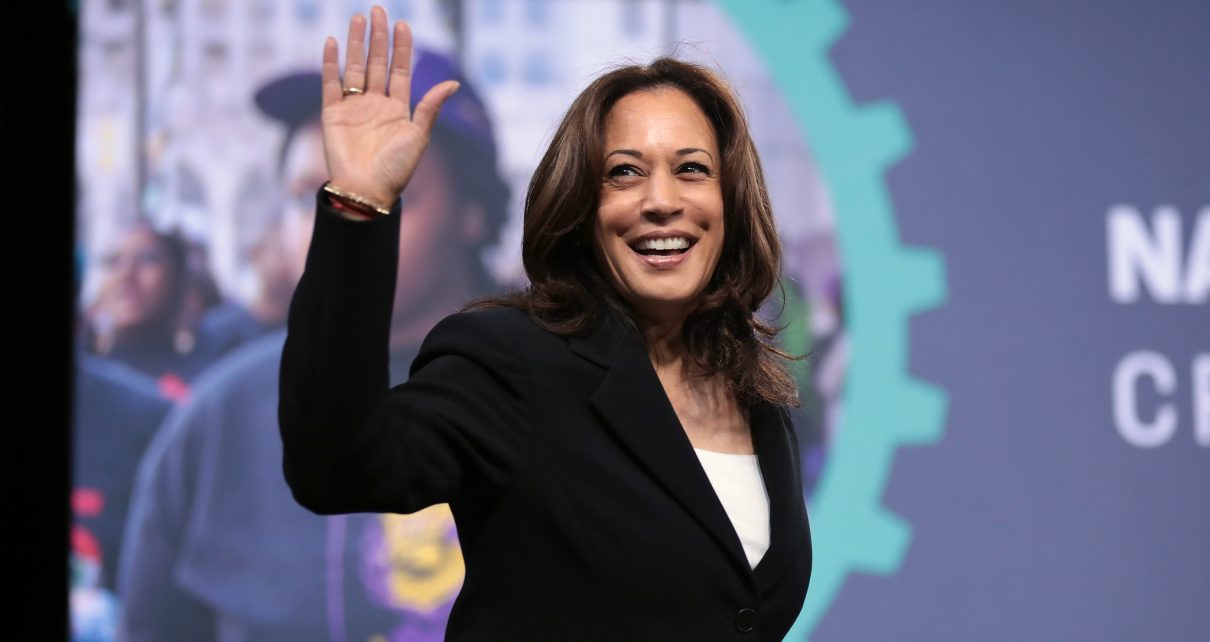
U.S. Senator Kamala Harris speaking at National Forum on Wages and Working People in Las Vegas, NV, April 27, 2019. (Photo by Gage Skidmore)
Greenberg: Kamala Harris Decides Against Run for Governor in 2026
Is this a strategic pivot comparable to Joe Biden’s 2015 amid implications for a 2028 Presidential Run?
By Richie Greenberg, July 30, 2025 5:02 pm
Today, former Vice President Kamala Harris announced she would not run for California governor next year, a decision that echoes Joe Biden’s 2015 choice to forego a presidential run in 2016, only to reverse course and win the presidency in 2020. Both Harris’s and Biden’s decisions reflect strategic calculations shaped by personal, political, and time factors, with Harris’s move possibly positioning her for a potential 2028 presidential bid once gain.
In October 2015, then-Vice President Joe Biden announced in a Rose Garden speech that he would not seek the Democratic presidential nomination for 2016. His decision was personal, following the death of his son Beau from brain cancer. Strategically, he acknowledged the political window had closed: “I believe we’re out of time, the time necessary to mount a winning campaign for the nomination.” The Democratic primary was already dominated by Hillary Clinton and Bernie Sanders, and Biden’s late entry would have faced logistical and financial hurdles. His statement was specific to 2016, not a permanent rejection of any future elected office, leaving room for his eventual 2020 run.
Similarly, Kamala Harris’s announcement today declared, “After deep reflection, I’ve decided that I will not run for Governor in this election.” Like Biden, her decision was strategic rather than a complete exit from politics. Kamala emphasized her love for California but says she’ll focus on national issues, stating, “For now, my leadership — and public service — will not be in elected office.” Her crushing 2024 presidential loss to Donald Trump (312-226 electoral votes, narrowly losing the popular vote) left her with mixed support; some Democrats questioning her campaign’s performance and her association with Biden’s administration. So, by opting out of next year’s governor’s race, Harris avoids a state-level campaign that could limit her national profile, much like Biden sidestepped a 2016 run to preserve his appeal, though delayed.
Biden’s decision came as a sitting vice president -under Obama- with high approval ratings but a crowded primary field. At 72, he faced skepticism about his age (even then) and electability against Clinton’s powerful establishment machine. By him stepping back, he maintained his political capital, which proved crucial later in 2020 when Trump’s presidency and the Democratic Party’s desire for a unifying figure propelled Biden to the nomination. His decision allowed him to focus on family and advocacy, keeping him relevant until the right time, when the political landscape shifted.
Harris, also a previous vice president, faces a parallel context in 2025. She was a front-runner for California governor, given her name recognition and fundraising ability (her 2024 campaign raised $1.5 billion). However, the current gubernatorial field includes allies like Lt. Gov. Eleni Kounalakis and former Rep. Katie Porter, and throwing her name in the hat risked splitting Democratic resources. Her 2024 presidential campaign loss, coupled with criticisms (former LA mayor Antonio Villaraigosa’s claim that she concealed Biden’s cognitive decline), created real skepticism among some Democrats. By now skipping the governor’s race, Harris avoids a “consolation prize” perception and keeps her focus national, critical for a 2028 bid in a potentially crowded Democratic primary featuring Gov. Gavin Newsom, Transportation Secretary Pete Buttigieg, and others.
Joe Biden’s 2015 announcement was carefully crafted: “While I will not be a candidate, I will not be silent.” This signaled desire for continued engagement, paving the way for his 2020 campaign, as a “battle for the soul of this nation” in response to Trump’s presidency and events like the 2017 Charlottesville riots. Harris’s statement is similarly open-ended: “I look forward to getting back out and listening to the American people, helping elect Democrats across the nation who will fight fearlessly.” Her decision does keep the door open for 2028, and her plans for a political action committee (PAC) or nonprofit mirror Biden’s post-2015 advocacy work to stay relevant. Both avoided permanent pledges against future runs, reflecting a shared understanding that political circumstances can shift dramatically.
Biden’s 2015 announcement 10 years ago was met with respect but little surprise, given his personal loss and the late primary stage. Democrats then turned to rally around Clinton, though some saw Biden’s absence as a missed opportunity for a moderate candidate. His strong approval ratings aided his 2020 comeback.
Harris’s decision today has elicited mixed reactions. Some California Democrats welcomed it, as it clears the field for allies like Kounalakis, while others expressed disappointment, seeing her as a strong counter to Trump’s policies. Nationally, Harris leads 2028 contenders with 34% support (Morning Consult poll, June 2025), but rivals like Buttigieg (16%) and Newsom (11%) are gaining ground.
Harris’s decision to forego the 2026 gubernatorial race positions her to focus on a 2028 presidential bid. She could approach it like this: Harris plans to launch a 501(c)(4) organization focused on empowering younger voters and rethinking democratic institutions, or a PAC to support 2026 midterm candidates. These efforts, like Biden’s post-2015 advocacy, will keep her in the spotlight. She could embark on a book tour for a memoir to allow her to reframe her 2024 loss and create a new vision. Harris’s 2024 presidential campaign struggled with younger voters and Black voters. A 2028 campaign would require targeted policies on housing affordability, student debt, and criminal justice reform.
The 2028 Democratic primary, should Kamala Harris choose to enter, will be competitive, with Newsom, Buttigieg, Gretchen Whitmer, JB Pritzker, Josh Shapiro, and Cory Booker all as potential rivals. Harris’s 34% support gives her an edge, but Newsom’s California base and Buttigieg’s rising profile pose challenges. Avoiding the governor’s race preserves her resources. She’ll need to run as a moderate with progressive credentials, emphasizing abortion rights, gun control, and climate change while addressing economic concerns like cost of living, a top issue for California voters. This will of course be a hard sell to much of the rest of America.


- Sanctuary Policies Must Be Challenged By All Means - April 7, 2026
- Greenberg: A Novice Congressional Candidate Blows it on Energy Politics - March 25, 2026
- The Vietnam Mirage: Why Claims of a U.S. Quagmire in Iran Are Fundamentally Misguided - March 21, 2026
RELATED ARTICLES
-
 December 17, 2024
 -

-

No surprise here, the Democrat party memory has been scrubbed of honest, free and fair campaign method.
Kind of like Kamala Harris’ brain has been scrubbed of any honest, original thought.
Not that she ever had any to begin with.
thought.
I hope she runs in 28. Nothing will make me happier to see her humiliated after another crushing loss.
And let’s not forget that we still,have “Javier Bockhorrhea” still in the dumb Dem slate to replace Newscum….
Chad Bianco
Leo Zacky
Steve Hilton
Rick Caruso
John Moorlach
I can wish….