
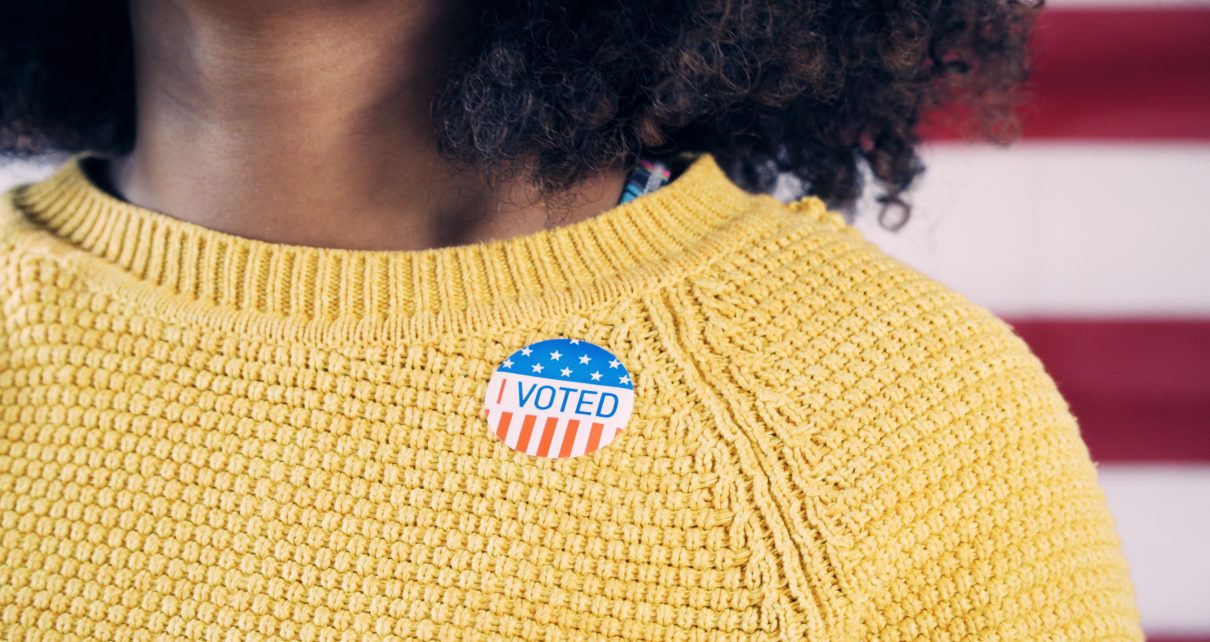
Young person wearing sticker after voting. (Photo: Made360/Shutterstock)
Nevada Primary Election Day: Dismal Early Voting Turnout Undermines Democrats’ ‘Expanded Access’ Claims
The dismal 13-14% early turnout underscores a key reality: simply flooding mailboxes with ballots does not equate to higher voter participation
By Megan Barth, June 9, 2026 2:57 pm
Today is Primary Election Day in Nevada, yet early voting turnout has been dismal despite the state’s universal mail-in ballot system — one of the most expansive “barrier-free” voting regimes in the nation and on par with California’s. With ballots automatically mailed to roughly 2 million active registered voters, total turnout after the in-person early voting period (May 23–June 5) reached just 13.6%, delivering a stark rebuttal to repeated Democratic claims of “expanded access” championed by Secretary of State Cisco Aguilar and Nevada Democrats.
Hundreds of thousands of mail ballots remain outstanding as polls close today.
Nevada is a national leader in election administration, ranking #2 out of all 50 states for voter access, ballot processing and more.
This reflects strong, consistent performance across Nevada’s election system.
Learn more: https://t.co/MOkgaHv27c pic.twitter.com/EuyGLX43DZ
— NV Sec of State (@NVSOS) April 24, 2026
Democrats have long insisted that policies like automatic mail ballots, extended early voting, and reduced ID requirements would dramatically boost voter participation, particularly among low-propensity voters, yet the numbers from current and past elections paint a very different picture.
In Nevada, the opposite of their prediction has played out. Despite years of “reforms” expanding access, overall voter turnout has stagnated or declined in non-presidential cycles since the shift to universal mail voting. Post-2020 data shows no sustained surge attributable to “voter access.”
The 2022 midterm turnout sat at roughly 45.8% of eligible voters–comparable to or below prior midterms, while primary participation remains chronically low. Nevada’s 2024 general election turnout reached about 65.8%, but much of that was driven by presidential enthusiasm rather than statutory changes. Earlier cycles without universal mail voting often saw comparable or higher engagement in key races.
Under the guise of the pandemic, numerous states removed voting safeguards that impacted the 2020 general and 20222 midterm elections. Nevada law, passed and signed by the Democratic majority, automatically sends a mail ballot to every active registered voter unless they opt out. Early in-person voting runs for about two weeks before Election Day, with same-day registration available.
Nevada Democrats tout the rule that mail ballots must be postmarked by Election Day and received by county election offices by 5 p.m. on the fourth day after “Election Day.” Yet the very law Democrat lawmakers passed also allows ballots with no legible postmark to be counted if received by the third day after Election Day. Adding to the absurdity of “Election Day,” the Nevada Supreme Court has ruled that ballots with missing or illegible postmarks received within those grace periods must be counted.
Why even bother having an “Election Day” if dates and postmarks don’t matter? That is exactly the argument now before the U.S. Supreme Court in a landmark case challenging the counting of mail ballots received after Election Day, as previously reported by the California Globe
Trends have shown that expansive mail-in systems increase convenience for reliable voters but fail to mobilize the disengaged, while introducing risks of lost, delayed, or unreturned ballots. In the current primary, tens of thousands of mail ballots remain unaccounted for, raising familiar integrity questions that Democrats dismiss as conspiracy theories.
Even actively registered voters are encountering issues. This reporter, registered and residing at a confirmed address with the Nevada Secretary of State, has not received the original or replacement mail ballots sent by county officials. This snafu is not an isolated anecdote but emblematic of documented problems with Nevada’s mass mailing system, where ballots go missing, arrive late, or fail to reach intended recipients despite “guaranteed” delivery.
This latest development aligns with ongoing concerns about Nevada’s election administration. The California Globe has previously reported on massive voter roll cleanups in the Silver State, with over 315,000 registrations inactivated or canceled in recent months, a sign of dirty rolls that fuel doubt in elections, not access.
The U.S. Department of Justice has also taken action, suing Nevada’s Secretary of State Cisco Aguilar (D) over access to unredacted voter rolls to ensure compliance with federal election integrity requirements. Democratic officials falsely claim that the DOJ would be accessing protected and private data–like social security numbers, yet the federal government is the entity who assigns social security numbers.
Nevada Attorney General Aaron Ford (D), who is running for governor, has publicly stated to this reporter that Voter ID is unconstitutional and vowed he “will not abide by an unconstitutional act like voter ID here in this state.”
Despite Ford’s stance, Nevada voters overwhelmingly approved Question 7, the Voter Identification Initiative, in November 2024 by a resounding 73.23% to 26.77% margin. The measure, which requires photo ID for in-person voting and identifying information for mail ballots, must pass again in November 2026 to amend the Nevada Constitution. Early indications suggest strong support for a second approval.
As Nevada voters head to the polls or return outstanding mail ballots today, the dismal 13.6% early turnout underscores a key reality: simply flooding mailboxes with ballots does not equate to higher voter participation. It often leads to wasted resources, uncounted votes, and persistent doubts about the system’s reliability. True voter engagement stems from competitive races, clear choices, and trust, not administrative tweaks that prioritize volume over verification and “Election Day” certification.
The California Globe will continue tracking final turnout and any irregularities as results are certified.


- California Democrats Call Omar Home Search ‘Fascism’ After Cheering Mar-a-Lago Raid as Rule of Law - October 12, 2026
- ‘Game Over’: Clark County Teachers Union, Democrat DA Line Up Behind Lombardo - October 7, 2026
- White House Calls LA Times ‘Buffoons’ as Selectively Edited Trump Clip Fuels Manufactured Outrage - October 6, 2026
RELATED ARTICLES
-
-
 September 14, 2021
 -
 September 20, 2022
We planned to retire to the Reno area from California but it sounds like Nevada elections are becoming just a compromised as California’s elections with universal mail-in ballots and other dubious voting schemes. Wake up Nevada voters! You don’t want to become a Democrat hellhole like California!
There is hope, Samantha! We have Voter ID on the ballot in November and it will likely pass–overwhelmingly. So, don’t put your Reno retirement plans on the back burner! We need all the help we can get 🙂
@samatha
20 + year resident of the Silver State, Reno and Las Vegas are lost to the masses of Californians who have transplanted and have not changed their wicked ways. The AG running for Governor is a defund the cops Labor union flunky. You might want to retire elsewhere.
Democrats are like a cancer. They infect, spread, and then kill the host.