
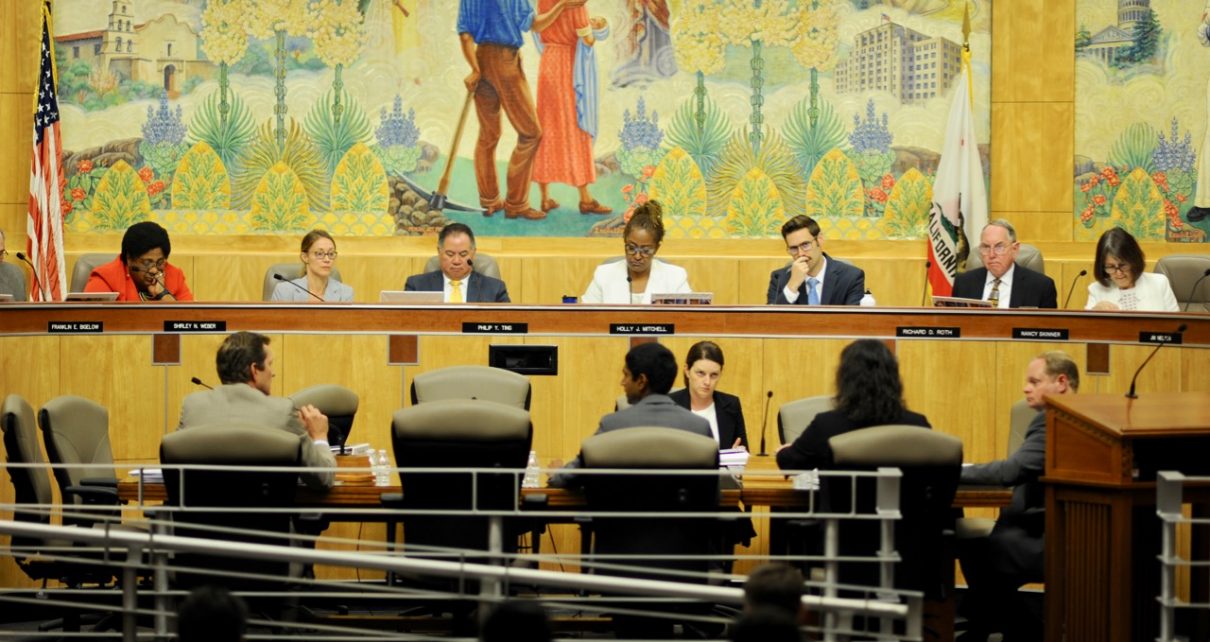
Committee Room. (Photo: Kevin Sanders for California Globe)
Public Testimony and the Suspense Files
The topic today is how public participation takes place on Suspense File bills
By Chris Micheli, May 6, 2026 2:00 pm
With the 2026 Suspense Files being considered on May 14, several colleagues have asked about public testimony on these items.
When I first began lobbying, legislators presented their bills regardless of whether the measures were slated for the Suspense Files. In fact, there were many Senate and Assembly Appropriations Committees that lasted most of the day as authors, witnesses, and committee members debated the fiscal and policy implications of a bill that was presented for consideration.
Over the last two decades, bills slated for the respective Suspense Files have almost always had no author presentation. In fact, some fiscal committee chairs in the past have openly discouraged authors from presenting their bills that are Suspense File candidates. Whether this is a good approach or not is subject to debate.
The topic today is how public participation takes place on Suspense File bills. In both committees, authors are free to waive presentation or to present their bills. When an author presents his or her bill slated to be sent to the Suspense File, the committee handles the bill just like policy committees do.
In other words, the bill’s author presents the measure, and then up to two primary witnesses are allowed to present for no more than two minutes, followed by “Me Too” testimony where those individuals simply state their name, affiliation, and whether they support the bill.
Thereafter, up to two primary opposition witnesses testify for up to two minutes each, followed by the “Me Too” comments from individuals. Finally, committee members may or may not ask questions of the author and offer any comments. And then the bill is sent to the Suspense File for a vote at a later date.
However, what happens when an author chooses not to present his or her bill in the fiscal committee? Is there still public testimony before the fiscal committees? The answer is yes, but with differences between the Senate and Assembly Appropriations Committees. How does each committee handle those bills, which represent probably 99% of the bills on the respective Suspense Files (i.e., authors waiving presentation and not appearing at the hearing)?
In the Assembly Appropriations Committee, all of the Suspense File bills are read by the Committee Secretary in numeric order. Once that action is concluded, the Committee Chair allows members of the public to state their name, affiliation, and position on one or more bills.
In the Senate Appropriations Committee, each Suspense File bill is announced in file order and all of the author’s bills are done at the same time. The Committee Chair then allows members of the public to testify in support, followed by those in opposition. Individuals are advised to only address fiscal concerns on the bill, and not discuss policy arguments, or be repetitive in their comments.
In both fiscal committees, public testimony is allowed on all measures, albeit in different ways.


- Tension Between Legislative and Judicial Branches on Statutory Interpretation - October 11, 2026
- Job Listing Services - October 10, 2026
- Commentary on Federal Constitutional Judicial Branch Provisions - October 10, 2026
RELATED ARTICLES
-
 February 6, 2025
 -
-
 February 5, 2024