

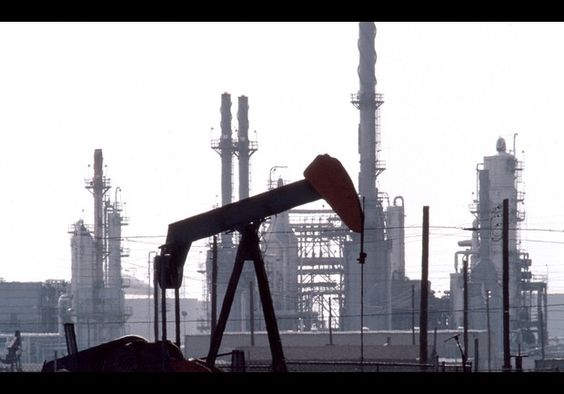
Oil pumpjack, Hwy 101, San Ardo, CA, Monterey County. (Photo: Katy Grimes for California Globe)
SB 237: Is it Having its Expected Impact on Gasoline Supplies?
SB 237 was doomed from the start – it did nothing to promote light oil development outside of Kern County
By Michael Mische, May 6, 2026 3:04 pm
by Professor James Rector, Professor Michael Mische, and Joseph Silvi
After signing Senate Bill 237 in September 2025, Governor Newsom said of the bill:
“we’re stabilizing the state’s gasoline supply to avert severe price spikes at the pump.”
The key provision in the bill was the accelerated permitting of up to 2,000 new oil wells annually in Kern County. The California Energy Commission presented a graph demonstrating their, and the Governor’s conviction that with SB 237 California oil production would increase and remain constant for years to come, thereby averting any future pipeline or refinery closures.
We had serious concerns about the validity of the assumptions used in the CEC’s forecast, and in December 2025 we published a paper with our own far more pessimistic forecast. Our own analysis suggested that new production driven by these permits would not be enough to even stem the natural decline of Kern County production, much less meet the state’s needs. While it is still too early to fully assess the long-term impact of SB 237, initial numbers are worse than we predicted in 2025, making the CEC forecasts and the Governor’s narrative was more reflective of wishful thinking than realistic science.
The reality is that as of late April 2026, approximately 290 permits had been issued, which was at the low end of our forecast, even though oil prices have risen dramatically which, in theory, should have stimulated interest in more permits.

We do not believe that the stated goals of the bill will ever be met. As we noted in the December 2025 paper, the challenge with Kern County is that most reserves are heavy oil, which require long term high oil prices to justify infrastructure spending. Even with current high prices, there is little confidence that these prices will be sustained. In fact, on a long-term fundamental level, much lower worldwide oil prices than today are more likely in the future.
SB 237 was doomed from the start because did nothing to promote light oil development outside of Kern County, which requires less infrastructure and doesn’t need sustained high prices to justify development. SB 237 did not address the only viable ways to stabilize production without relying on long term high oil prices—namely the rescission of SB 1137, allowing well stimulation in Kern County, and changing state agency policies that are hopelessly obstructionist today.
What Needs to be Done to Stabilize Fuel Supplies.
With some the largest crude reserves in the U.S., California has the resources to address its energy needs and dependency on foreign suppliers…the issue is whether it has the political will to do so.
Below are some steps that California could immediately adopt to stabilize its crude oil production and reduce gasoline prices.
Rescind SB 1137.
Justification for SB 1137 was based on studies that indicated negative health consequences for people living near oil and gas fields. While this may have been true decades ago, aggressive regulation has all but eliminated emissions from equipment in operating in California oil fields today. Moreover, a recent study (Rector, et al., 2026) may have found the real reason for these present-day proximity/health impacts in California—toxic gas emissions from natural seeps and orphaned wells.
Oil and methane, and sometimes volatile organic compounds like benzene and toluene often leak upwards from the deep reservoir to the surface along faults and orphaned wells within the boundaries of oil fields. In fact, many early California oil fields were discovered beneath seeps.
Emissions from these seeps makes it appear like the act of producing the field is causing emissions when in fact this is not the case today. Airborne monitoring often cannot effectively discern between natural emissions and equipment leaks. In fact, producing oil and gas may reduce emissions near oil fields by lowering pressures reducing the volume of oil and gas available to leak from the reservoir. Conversely, halting oil production near health protection zones may, in fact, increase emissions and expose residents to dangerous toxins that responsible production would abate.
With a rescission of SB 1137, approximately 25,000-35,000 bpd of incremental production could be realized within 12 months driven by reactivation of shut-in wells, re-completions, sidetracks and new wells. Continued redevelopment of the several billion barrels of stranded, low-cost light oil reserves through directional drilling from existing sites in known fields, without expanding surface footprints, could yield 125,000-200,000 bpd of additional production within five years.
Clarify SB 4 and Allow Well Stimulation in Kern County.
While much of the impact of SB 1137 lies outside Kern County, there is a significant resource within the Diatomite reservoir in the county that is currently un-developable due to SB 4, which, along with agency actions, put a de facto halt to production requiring well stimulation. This resource is estimated to contain on the order of at least 2-3 billion barrels of reserves. By restoring SB4 to its original function rather than a roadblock to development, approximately 20,000–40,000 bpd of production could be restored within 12 months driven by recompletions, restimulation of existing wells, and completion of already drilled or readily drillable locations in Kern County. Over a longer horizon, the impact is more substantial.
With predictable permitting and the ability to systematically develop low-permeability intervals, operators can reestablish a sustained drilling and stimulation program. Within five years, this supports 60,000–80,000 bpd of stable incremental production, reflecting both new well development and improved recovery from existing assets.
Stop Oil and Gas Obstruction at State Agencies.
An additional 20,000-30,000 bpd of production could also be restored within 12 months by rapidly processing the dozens of Underground Injection Control (UIC) well permits and aquifer exemptions that have been languishing in CalGEM, the State Water Resources Board, and EPA permitting purgatory for nearly a decade. On a five-year time horizon, an additional 75,000-100,000 bpd of oil production could be brought online.
Concluding Thoughts
In practice, the disappointing early outcomes of SB 237 elucidate how existing regulations and administrative barriers are the primary constraints on in-state production. Lengthy and uncertain permitting timelines, restrictions on routine well interventions, limits on proven recovery techniques, and overlapping agency oversight have created an environment where even low-risk, incremental projects struggle to move forward. As a result, capital that would otherwise be deployed to maintain or modestly grow California production is sidelined.
The consequence is not reduced demand, but increased reliance on imported crude and refined products, often sourced from jurisdictions with much weaker social and environmental standards and significantly higher pollution intensity. This dynamic not only exports economic value—jobs, investment, and tax revenue—but also undermines the state’s environmental objectives by shifting production to regions with less stringent oversight. Without addressing these structural barriers, policies like SB 237 risk accelerating the very outcomes they were intended to prevent: declining in-state supply, greater price volatility, and a growing dependence on more pollution-intensive imports.
The opinions, conclusions and representations herein are those exclusively of the authors and do not reflect, directly or indirectly, the opinions, conclusions, and policies of the University of California, Berkely, or the University of Southern California.
For further information, please contact:
Professor James Rector Professor, University of California, Berkeley, Email: jwrector@berkeley.edu
Michael Mische, University of Southern California, Email: mische@marshall.usc.edu
Joseph Silvi, Graduate Assistant, University of California, Berkeley, josephbsilvi@gmail.com


RELATED ARTICLES
-
 September 25, 2024
 -

-
VERY informative! Thankyou!