

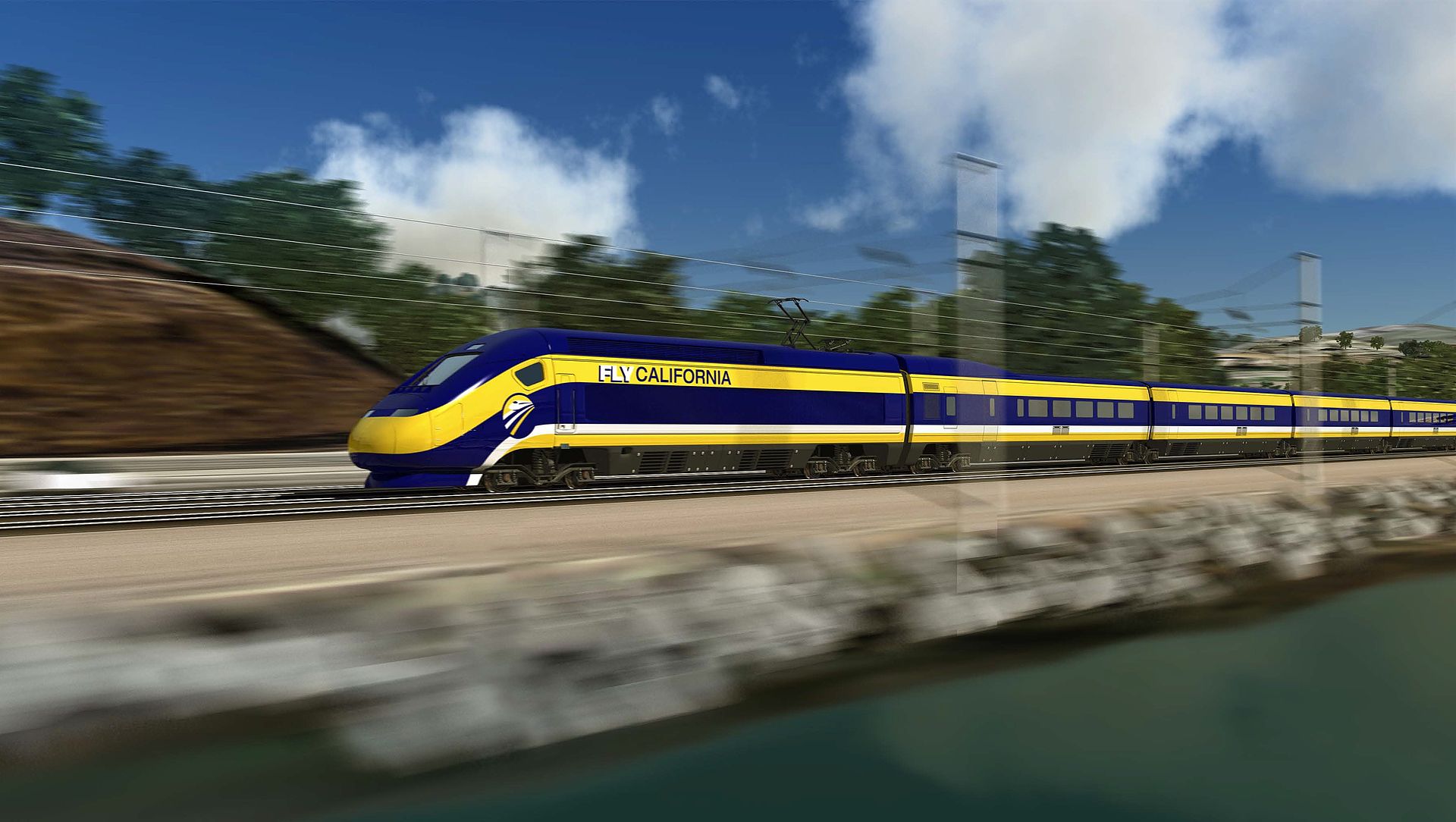
California high speed rail proposed train (Photo: hsr.ca.gov)
Following High Speed Rail CEO Resignation, Board Appoints Finance Director Who Approved Rail Spending
‘They’ve put the guy who certified the non-compliant boondoggle in charge of running it’
By Katy Grimes, October 31, 2026 6:30 am
California high-speed rail CEO Ian Choudri resigned on Thursday, citing a need to focus on personal and family priorities, a few weeks after he was stripped of contract authority after a damning audit.
Choudri’s resignation followed a rocky tenure marked by a recent Inspector General investigation into nearly $600,000 in unallowable travel expenses to “questionable locations that appear unrelated to state business,” including trips to gyms, a nightclub, an escape room, a tiki bar and a cigar lounge over a two-year period, according to an investigation released by the inspector general that oversees the agency.
His replacement was announced after the Globe reported on the resignation. The California High-Speed Rail Authority board named state Finance Director Joe Stephenshaw Interim CEO.
Joe Stephenshaw has been California’s Director of Finance since July 2022, and was appointed by Gov. Gavin Newsom.
But there is a conflict of interest question burning – Stephenshaw is the state official who has been authorizing the High Speed Rail payments to contractors.
“Joe Stephenshaw spent years as Finance Director rubber-stamping that this high-speed rail mess complies with Prop 1A—when it clearly doesn’t,” Herb Morgan, a CPA and candidate for State Controller, told the Globe Friday. “Now they’ve put the guy who certified the non-compliant boondoggle in charge of running it. That’s not an appointment; that’s the single most conflicted person on the planet taking the wheel. No more taxpayer payments until it actually meets the law.”
The Department of Finance and Director of Finance works solely for the Governor.
According to the High Speed Rail Authority, under the Prop 1A bond act, which authorized the creation of High Speed Rail, the Director of Finance must review funding plans for usable segments and determine that “the plan is likely to be successfully implemented as proposed” before Prop 1A construction bond funds can be spent. Required certifications include that planned passenger service “will not require a local, state, or federal operating subsidy.” A 2022 funding plan for the Central Valley segment received that approval from the Department of Finance under Stephenshaw.
Newsom’s office and the board have highlighted Stephenshaw’s budget experience as a qualification. However, the appointment puts the official whose department previously certified High Speed Rail funding plans in charge of the agency spending the money. That is a clear appearance of conflict.
The same person who greenlit the fiscal certifications will now run the High Speed Rail project those certifications enabled. The revolving-door optics look bad on a project defined for years by cost overruns, delays, consultant bloat, and questions about whether it still matches the legal terms of Prop 1A.
Notably, the State Controller is the final sign-off on payments to High Speed Rail.
“High speed rail has been bilking the taxpayers since 2008, and we still don’t have a train,” I wrote three years ago.
In 2012, only 4 years after passage of Proposition 1A which authorized California High Speed Rail, polls showed that voters wanted a re-do, and would have voted to kill high-speed rail if given the chance.
As I explained in 2012, 14 years ago, the governor, legislators and the High Speed Rail Authority were (and still are) violating the law:
Prop. 1A states:
The California High-Speed Rail Authority must have all of the funding ahead of time, before any construction starts on a new segment.
The high-speed train system must operate on its own entirely, and in the black. That means operating profitably, and includes caveats of no government subsidy. The plan relies heavily on a projection of 100 million users by 2030, a notion that was created with manipulated data, and is absurd.
The project voters approved in 2008 was roughly an 800-mile San Francisco-to-Los Angeles system, in under 2 hours 40 minutes, and at speeds of 200 mph. There were no operating subsidies. The rail plan would be funded by $10 billion in bonds, with total cost estimates of $33 billion to 45 billion, and with a completion target of 2020.
What exists now is a plan focused on a 171-mile Merced to Bakersfield rail segment in the Central Valley, with partial cost estimates of $126 billion to $231 billion, with no operational high-speed service.
According to Marc Joffe at the California Policy Center, High Speed Rail Authority business plans have projected annual operating shortfalls on the initial segment in the $110 million to $140 million range, which is directly at odds with the no-subsidy rule embedded in the bond act.
Earlier court rulings blocked some Prop 1A spending until statutory requirements were met. Critics have argued the scaled-back plans no longer satisfy the statutory conditions voters locked in.
Remember What Voters Approved in 2008:
California voters approved Proposition 1A in 2008, the “Safe, Reliable High-Speed Passenger Train Bond Act for the 21st Century.” Here are some details:
* $33.5 billion cost. They approved a total cost of $33.5 billion for a high-speed rail system. The $33.5 billion was to be made up of a combination of 1/3 federal funds, 1/3 state funds and 1/3 private funds. Importantly, the investment from California taxpayers was limited to a $9.95 billion bond.
* S.F. to L.A. Voters approved a system connecting San Francisco to Los Angeles, with a trip time of two hours and 40 minutes, at a cost of $55 per ticket. But the plan has veered sharply inland from San Francisco to Los Angeles, over to the Central Valley, with a leg from Fresno to Bakersfield. And the cost of the trip jumped to $105.
* Ridership: 95 million. Even ridership numbers have been toyed with. Voters were told that there would be a ridership of 95 million passengers by 2030. Ridership estimates have decreased nearly three times since 2008, and they are still absurdly inflated. In the new report, they’re estimated to be as high as 36 million passengers by 2060 (page 5-17). That’s about a third of the Prop. 1A promise.
* Bond repayment. Repaying high-speed rail bonds will cost the state’s General Fund $647 million per year for 30 years, or approximately $20 billion for the $9.95 billion bond.

A California native and Navy mom, Katy lives in Sacramento, CA.
- Following High Speed Rail CEO Resignation, Board Appoints Finance Director Who Approved Rail Spending - October 31, 2026
- New California Climate Report Warns of ‘Climate Whiplash’, Extreme Heat, Longer Summers, Eroded Beaches - October 30, 2026
- Steve Hilton is the Real Immigrant in California’s Gubernatorial Race - October 30, 2026
So, the wolf is now guarding the hen house???
Herb Morgan and Michael Gates must be elected to find and prosecute those who steal from the state…
That’s the essence of Tuesday’s election. If the status quo is allowed to remain, we will seek shelter in a more intelligently run state…
The time for choosing is upon us….
Hilton
Morgan
Gates
Wagner
Shaw
Romero
Allen
No on 40
Yes on 39, 41,42,43,45
Period… Full Stop…
(Gavin, you a-hole)
Thank you to Katy Grimes and California Globe for pointing out the disturbing fact that Newsom installed state Finance Director Joe Stephenshaw, his stooge who certified the non-compliant train to nowhere boondoggle, in charge of running it. Meanwhile the rest of the lamestream propaganda media ignores the story.
It’s just more Democrat corruption, grift and graft.