
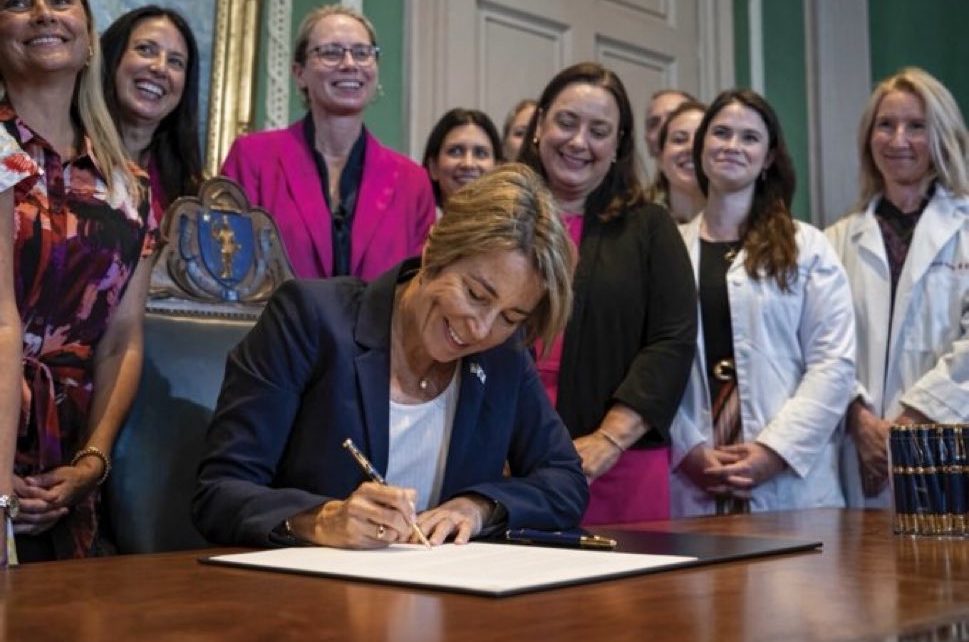
MA Governor Maura Healey signs bill allowing abortion up to birth (Screenshot)
NV Democrats’ Abortion Initiative Puts New Massachusetts Late-Term Law to Shame
Nevada’s Question 6: no doctor, dangerous clinics, no parental consent or even notification required
By Megan Barth, August 13, 2026 7:14 am
Nevada’s Question 6, the “Right to Abortion Initiative” returning to voters this November, goes far beyond constitutionalizing the state’s existing 24-week statute. In fact, it allows abortion through all nine months even on healthy moms with healthy babies.
According to Nevada Right to Life Executive Director Melissa Clement, the measure strips core safeguards that even Massachusetts still retains—despite Gov. Maura Healey’s recent expansion of late-term abortion to the point of birth—leaving Nevada women and girls with fewer protections than their counterparts in the Bay State.
Current Nevada law (NRS 442.250, voter-protected since 1990) requires abortions to be performed by a licensed physician. After 24 weeks, they are permitted only to preserve the life or health of the pregnant woman and must occur in a licensed hospital, with the physician documenting the medical necessity.
Parental notification for minors has been a longstanding point of contention; a decades-old law briefly took effect before the Nevada Supreme Court blocked it in May 2026 after Planned Parenthood sued, citing vagueness.
Question 6 changes that framework. The proposed constitutional amendment creates a “fundamental right to abortion performed or administered by a qualified health care practitioner until fetal viability, or when needed to protect the life or health of the pregnant patient, without interference from the state or its political subdivisions.”
The ballot language changes it to “qualified health care professional” and is undefined in the measure. Under Nevada’s broader definitions of health-care providers (NRS 439A.0195 and related statutes), that category can encompass physicians, nurses, chiropractors, dentists, school nurses, or practitioners of Oriental medicine.
In a discussion with the Globe, Clement highlighted the practical risks: “A school nurse can administer abortion pills which can put a girl into labor and the parents won’t know about it unless the girl delivers a dead baby at home.”
The amendment’s “without interference” clause, paired with a narrowly defined “compelling state interest” limited to the patient’s own health under clinical standards, would bar the state and local governments from regulating, inspecting, or imposing facility standards.
“I think abortion clinics should be as regulated as my nail salon and they won’t be,” Clement said.
In contrast, Massachusetts’ newly signed law, which eliminated the 24-week gestational limit, still centers decision-making on a physician’s professional judgment and retains medical oversight for later procedures. “Women in Massachusetts will be better protected in abortions up to birth; women in Nevada will have no protection,” Clement argued.
Late-term abortions in Nevada currently require a hospital setting and are non-elective. Question 6 removes the physician and hospital mandates entirely and leaves fetal viability up to a “healthcare practitioner,” otherwise known as an abortionist.
Supporters, including Nevadans for Reproductive Freedom and Democratic leaders, including state senator Nicole Cannizzaro who is running for Attorney General, insist Question 6 merely locks in the status quo at the constitutional level so a future Legislature cannot restrict access. They describe it as aligning with Roe-era standards and necessary after Dobbs.
Clement and opponents counter that the day after ratification, existing statutes requiring physicians, hospitals for later abortions, informed consent elements, or any remaining parental involvement become vulnerable. Immediate lawsuits or legislative “cleanup” would follow to strike provisions deemed unconstitutional under the new fundamental-right standard—mirroring patterns elsewhere. In Kansas, after voters preserved constitutional abortion protections in 2022, courts and lawmakers moved to dismantle informed-consent requirements and other regulations.
Nevada’s recent parental-notification fiasco lays bare exactly how this plays out. The law protected girls for a one-year period after a multi-year federal injunction was lifted; Planned Parenthood then sued in state court. The Nevada Supreme Court found it unconstitutionally vague for doctors.
Attorney General Aaron Ford’s office defended the statute, yet Clement notes the defense never once mentioned parents’ rights, child sex trafficking risks, or the vulnerability of minors—allowing Planned Parenthood to prevail and reinstate barriers to parental involvement.
The ballot question’s softer “healthcare professional” phrasing masks the amendment’s broader “practitioner” language and the near-total bar on any state oversight or regulation.
Opponents direct voters to resources such as Defeatsix.com to examine the full text and implications before the November 3 vote, which requires a second majority for the constitutional change to take effect. If approved, Nevada would constitutionalize a regime more permissive on provider qualifications, facility standards, and post-viability access than the recently liberalized Massachusetts statute—while stripping the very medical and parental guardrails that currently exist under state law.
“Nevada will be a haven for abortion for all nine months, no doctor required, in unsafe clinics. And parents will be cut out completely if their underage daughter chooses abortion. Not there to hold her hand. Not there to help her make up her mind. Not there during her recovery.”
“I never thought I would say this, but let’s at least keep it safe, legal, and rare. How far we have fallen,” Clement observed.
Editors note: The original version of this post did not correctly clarify the difference between Question 6, the constitutional amendment, and Question 6’s revised language. The paragraph has been corrected.


- California Democrats Call Omar Home Search ‘Fascism’ After Cheering Mar-a-Lago Raid as Rule of Law - October 12, 2026
- ‘Game Over’: Clark County Teachers Union, Democrat DA Line Up Behind Lombardo - October 7, 2026
- White House Calls LA Times ‘Buffoons’ as Selectively Edited Trump Clip Fuels Manufactured Outrage - October 6, 2026
RELATED ARTICLES
-
 March 23, 2022
 -

-

-
-

The blue creep from California has ruined Nevada. Hopefully Ford will not become Governor, or the state is really cooked.
with no oversight, if the gestation person dies on the table, no charges are filed, right.
sounds like a cure for wokies.
These late term abortions are absolutely gross. I don’t see how people can support this.
People —– meaning human beings —– DON’T support this abomination, but these evil female freaks of nature and their spirit sisters do. Nothing on earth could induce me to spend any time at all in the same room with these females.
Having a lot of experience in this area, I’m not sure there a lot of late term abortions of healthy babies. Adoptive parents are willing and able to adopt newborns. They are even willing to pay all the baby moms medical and pregnancy costs (questionably legal). The adoptive parents do have to wait at least a year after birth until the adoption is finalized. The adoption industry does make it very difficult to adopt a newborn baby.
Unfortunately, late term abortions do occur especially when the unborn child is seriously ill, deformed, hydrocephalic, or a danger to the mother. This is not a causal decision. I get the impression that some people think it is. They do not know what they are talking about and ironically, the first one’s to deny benefits to children once they are born.