
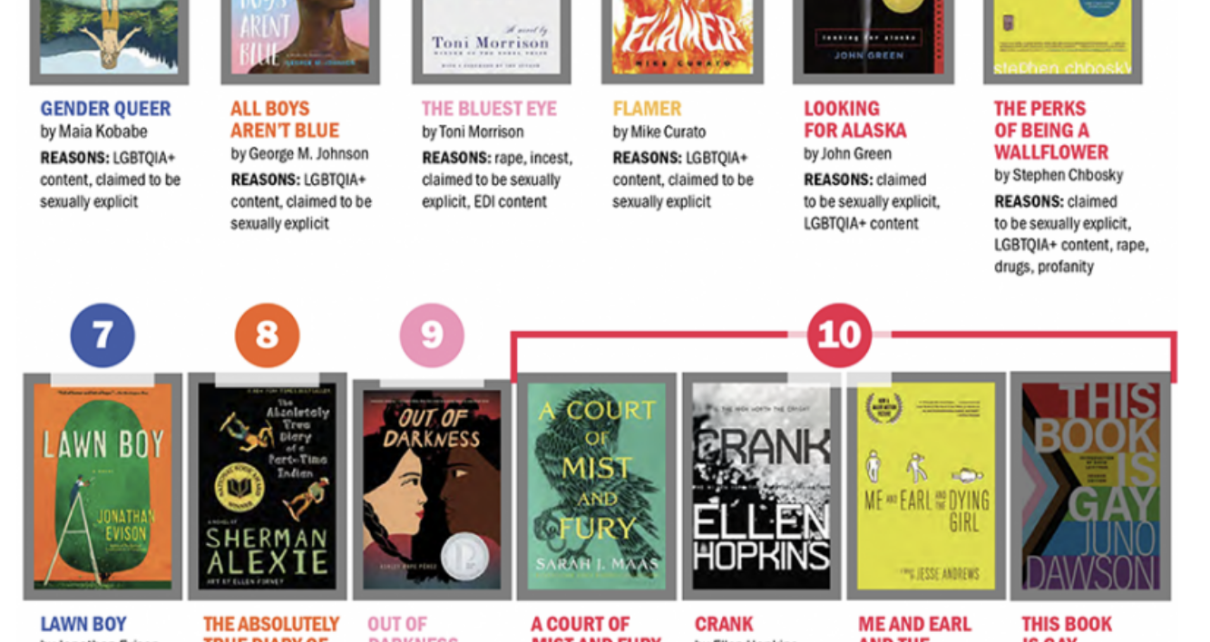
American Library Association's list of the most challenged books. Photo: (CRI.org)
Sex and Porn in California Schools: One Million Sexually Explicit Books in School Libraries and English Lit Classes
When did encouraging children to read porn in a textbook or library book become part of the public education system?
By Katy Grimes, May 12, 2026 6:00 am
There are more than 1 million sexually explicit books in K-12 public schools across the country. These books aren’t just “sexually explicit,” they are boldly pornographic – lewd, obscene, salacious. And children not only have access to them, they are encouraged to read these books.
Anyone – parents, teachers or school board members – who challenge sexually explicit curriculum and library book-selections, find themselves the recipients of rabid political hatred.
In California, the Globe has been documenting this bizarre but exceedingly dangerous practice for several years, and wondering aloud who or what is behind it.
What is being taught as sex ed to California school children ironically cannot be discussed on television or radio. The Federal Communications Commission’s Obscene, Indecent and Profane Broadcasts rules state, “Federal law prohibits obscene, indecent and profane content from being broadcast on the radio or TV.”
Yet we ask our children to read this obscene, indecent and profane content.
The state curriculum changes stem from the 2015 Healthy Youth Act (AB 329) by then-Assemblywoman Shirley Weber (D), which was sold as “updating the HIV and AIDS prevention education to reflect today’s understanding of HIV and AIDS.”
Because parents were so outraged that the California State Board of Education approved highly controversial changes to the state’s health and sex education framework including teaching children about bondage, anal sex, pederasty, sex trafficking, sexual orientation and transgender and non-conforming students back in 2019, many ran for school boards across the state to get a handle on the sexual garbage being peddled to their kids, the Globe has reported.
Notably, California has the nation’s lowest literacy rate, yet the radicalized California State Board of Education is focused on teaching inappropriate sexuality to young children.
As for library books, the American Library Association makes the recommendations, and librarians across the country place their orders.
Two of the most challenged books on the American Library Association’s (ALA) top 10 list have been in the news often: Maia Kobabe’s graphic novel memoir about sexual identity, “Gender Queer,”and Jonathan Evison’s “Lawn Boy,” a coming-of-age novel narrated by a young gay man.
The number of book titles targeted for censorship at public libraries increased by 92% over the previous year, while school libraries saw an 11% increase over 2022 numbers, the ALA reports. “The most common justifications for censorship provided by complainants were false claims of illegal obscenity for minors; inclusion of LGBTQIA+ characters or themes; and covering topics of race, racism, equity, and social justice.”
Capitol Resource Institute has posted the American Library Association’s list of the most challenged books annually. They note the American Library Association is not on parents’ side. “The ALA’s goal is to use your child in their social experiment meant to indoctrinate the next generation.”
Parents should not have to worry that school libraries are stocked with graphic sexual material or pornographic books, CRI says. Their site lets parents search school districts and flag books based on explicit sexual scenes. Their eye-opening website, Take Back the Classroom, and The Kitchen Table Activist, are for parents to learn how to research and act upon their findings.
These frequently involve sexual content, LGBTQ+ themes, gender/sexuality exploration, or other mature topics – like a woman having sex with a donkey on a stage? (more on that below)
Despite the explicit nature of the American Library Association’s 2025 Most Challenged Books List (below), the ALA frames challenges as censorship threats to intellectual freedom. A child too young to drive or vote, is not risking “intellectual freedom” by avoiding sex and porn in their school library.
“The American Library Association condemns censorship and works to defend each person’s right to read under the First Amendment and to ensure free access to information,” the ALA claims, neglecting to note that we are talking about children, not adults.
Many of these books are not just available in the school library, they are assigned reading in English Literature, Karen England with CRI told the Globe. She said last year, in a Texas school district, the book “Sympathizer” was assigned reading, and described one explicit sexual scene in it, where a randy teen boy finds fresh squid in his family refrigerator and masturbates using it, then puts it back for his mother to cook.
This isn’t sexuality, and asking a school to remove the book from the library is not censorship.
So for CRI to be exposing these books as pornographic isn’t a stretch. These are extremely legitimate concerns about age-appropriateness in K-12 settings. These are hardly “coming of age” books, as so many are labeled.
The House of Sky and Breath by Sarah J. Maas, which is described by Amazon as “sexy, action-packed sequel to the number one best seller House of Earth and Blood, Sarah J. Maas weaves a captivating story of a world about to explode – and the people who will do anything to save it,” painstakingly describes with Hustler-level descriptions of a young woman performing oral sex on a young man.
I verified with Grok the many sexually explicit scenes in this book, described as “Standard passionate Maas fare with dirty talk and multiple rounds:”
“Oral sex, full penetrative sex, Quickies or continued intimacy, including one in a coat closet, Mind-sex/telepathic intimacy.”
Grok says, “The book is very steamy overall.”
Even if the book was just “steamy,” when did encouraging children to read porn in a textbook or library book become part of the public education system?
Still unsure? Would you believe a school library book titled Born on the Bayou by Blaine Lord details teenage boys watching a woman having sex with a donkey on stage? The link above has the entire excerpt:
“It was close to eight o’clock when a senorita dressed in a purple belly dancer’s outfit entered George’s American Cafe through a blue curtain near the red doors with a small donkey in tow. The crowded cafe full of men and prostitutes stood up in a low roar. The men toasted one another with margaritas, Carta Blancas, mixed drinks, hoots, and hollers…”
This book raced past “sexually explicit” and landed straight into porn.
“Exit Here” by Jason Meyers tells about a boy home for the summer from college after flunking out, involving lots of sex and lots of drug use. A few of the excerpts:
“We were in the basement of a shitty Chinese restaurant that
I’d rented out, and everyone was there. Tons of coke being
passed around. Two kegs of Budweiser. Three strippers.”
We did blow for the first time together. We both got laid for the first time by the same sixteen-year-old chick when we were thirteen, one right after the other, in the basement of an abandoned school just a few blocks from his parent’s house.”
There is more here.
The Globe previously reported:
The American Library Association has a downloadable list of the most “challenged” books including “Gender Queer: A Memoir,” which has cartoon drawings of oral sex, masturbation, and describes how to use sex toys; All Boys Aren’t Blue, Flamer, This Book is Gay, among other sexually explicit books.
Informed Parents of California pulled together the most objectionable portions of the 1,000 page state framework document in a 24 page summary with excerpts for K-6th grade health lessons, complete with pictures of some of the recommended supplemental materials, included in a California Globe article.
This information has been copied directly from the California Department of Education Website.
Kindergarten: “Students also learn about individual differences, including gender, from a very early age… students can still begin to challenge gender stereotypes in a way that is age appropriate. While students may not fully understand the concepts of gender expression and identity, some children in kindergarten and even younger have identified as transgender or understand they have a gender identity that is different from their sex assigned at birth. This may present itself in different ways including dress, activity preferences, experimenting with dramatic play, and feeling uncomfortable self-identifying with their sex assigned at birth.”
Grade 5: “Fifth-grade students will have an opportunity to learn that gender is not strictly defined by physical anatomy or sex assigned at
birth. Rather, students understand that gender refers to attitudes, feelings, characteristics, and behaviors that a given culture associates with being male or female, sometimes labeled “masculine” and “feminine.” Moreover, a person’s gender identity refers to their sense of self, while gender expression refers to their outward gender presentation including physical appearance and behaviors. Understanding individual differences will help students feel accepted and be more accepting.”
The California Department of Education Website curriculum also includes:
- Kindergarten books that introduce 5-year-olds to families with members who identify as lesbian, gay, bisexual, and transgender.
- First grade gender vocabulary lessons on words such as third gender, trans, queergender, non-binary, gender fluid, gender neutral, agender, bigender, and two-spirits.
- Lessons for 1st graders that provide detailed descriptions of sex with these quotes such as: “The man’s penis goes inside the woman’s vagina,” and “sperm can swim out through the small opening in the man’s penis – and into the woman’s vagina.”
- Pictures in a book for third graders showing a cartoon drawing of a penis ejaculating sperm while inserted into a vagina.
- Lessons which teach third graders that sexual reproductive organs don’t always match a person’s gender.
- Recommendations that fifth graders are taught sexual health lessons that must include examples of same-sex sexual activity. Students should not be separated by sex during these lessons to avoid “misgendering” students.
- Books that introduce 10-year-olds to anal sex.
- The slang for male and female genitals.
Take Back the Classroom has many stories and podcasts exposing such pornographic books provided to young children, and what parents can do to combat this grooming of children in public schools. Karen England said with so much graphic sex and porn in the library and curriculum, children are getting desensitized to sex, violent sex, sex trafficking and sex crimes.
For California school districts, England says they have researched 645 Districts, 9,557 Schools, and found 82,651 sexually explicit books. And they just identified another 1,000 books yet to go up on their website.
Desert Sand School District has 956 sexually explicit books available; Anaheim Union High School District has 1,067; Alhambra Unified has 450; Biggs Unified has 28; Chino Valley Unified School District has 400; Chaffey Joint Union High School District has 806; Dry Creek Joint Unified Elementary School District has 206 sexually explicit books available to children; Butteville Union Elementary School District has 671 sexually explicit books available to children.
And taxpayers are paying for this.
Find your school here
Next: The American Library Association has gone woke.
American Library Association’s 2025 Most Challenged Books List
For 2025, they reported 4,235 unique titles challenged—the second-highest on record (just behind 4,240 in 2023). Many challenges came from organized pressure groups rather than individual parents. Here is the Top 11 Most Challenged Books of 2025 (with some ties):
- Sold by Patricia McCormick (often cited for themes of sex trafficking and sexual violence)
- The Perks of Being a Wallflower by Stephen Chbosky
- Gender Queer: A Memoir by Maia Kobabe
- Empire of Storms by Sarah J. Maas
- (Tie) Last Night at the Telegraph Club by Malinda Lo
- (Tie) Tricks by Ellen Hopkins
- A Court of Thorns and Roses by Sarah J. Maas
- (Tie) A Clockwork Orange by Anthony Burgess
- (Tie) Identical by Ellen Hopkins
- (Tie) Looking for Alaska by John Green
- (Tie) Storm and Fury by Jennifer L. Armentrout

A California native and Navy mom, Katy lives in Sacramento, CA.
- California Voters: Howard Jarvis Taxpayers Association’s 2026 Voting Guide - October 23, 2026
- Newsom Gaslights Over California’s Bad Student Test Scores - October 22, 2026
- How the DMV Enabled Voter Fraud in California - October 21, 2026
RELATED ARTICLES
-
 July 10, 2022
 -
 February 1, 2021
 -
 July 12, 2023
What’s in your kid’s library 🤔
See the download button at:
WETHEPEOPLE2.US/INAPPROPRIATE-BOOKS-IN-SCHOOL
Its NOT education, its INDOCTRINATION
The goal is each generation progressively more confused = easier to control and manipulate
Planned Parenthood depends on lots of kids getting pregnant early in life. The de-population agenda wants everyone trans or gay to wipe out the human race.
Meanwhile California’s Democratic lawmakers and their supportive media outlets argue that these materials are age-appropriate, educational, and essential for LGBTQ+ student support. They reject the term “porn” as an exaggeration. As Reform California chairman Carl DeMaio has pointed out, Democrat lawmakers routinely dismiss parental concerns and obscure the content of these books to advance their radical far left ideological agenda.
In contrast, the Chinese communist government maintains a zero-tolerance stance on pornography, which has been illegal since the founding of the People’s Republic in 1949. CCP authorities use the “Great Firewall” to block foreign adult websites and enforce strict regulations on domestic internet content, labeling online pornography as “online narcotics” due to its perceived societal harm.
Maybe California Democrat lawmakers who have close ties with the CCP authorities are receiving incentives to support sexually explicit books in Calfiornia’s K-12 public schools?
Peter Schweizer argues in his book “Blood Money” that China is using financial support for the LGBT+ movement in the United States as part of a broader strategy of “disintegration warfare” to deepen social divisions and destabilize American society. Schweizer says this effort is not about promoting human rights but is a deliberate geopolitical tactic to erode national unity. He identifies two China-based billionaires as major funders of radical causes in the U.S.: Roy Singham and Joe Tsai who was a co-founder of Alibaba. Neither Singham nor Tsai promotes transgender rights in China, where such issues are suppressed. This double standard, he argues, reveals their support in the U.S. is not ideological but strategic and part of a coordinated effort by actors aligned with the CCP to exploit U.S. cultural fault lines.
“Greatness grows in the moments you feel like quitting.” Everything in my about
Democrats are putting porn in the classrooms and libraries of California with great success. Moral sickness has taken hold in a once reputable political party.